

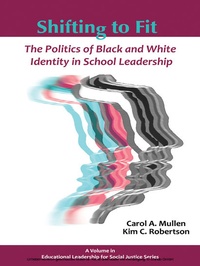
Shifting to Fit
The Politics of Black and White Identity in School Leadership
1st Edition
Published on 1. March 2014
187 pages
978-1-62396-663-8 (ISBN)
Description

While social identity challenges probably confront all school administrators, the authors focus on a doubly marginalized leadership population-Black female principals-whose experiences are rarely tapped. Based on lessons from this study and the literature reviewed, the authors think that leadership preparation programs should give prospective administrators opportunities to gain knowledge and develop skills relevant to navigating their leadership identities.
In the age of accountability, and with the pressures placed on the education system to ensure the success of all students, school leaders are under constant scrutiny. The appearance, speech, body language, and interactions of principals with students, parents, teachers, and community members are dissected. Stretching to satisfy expectations, many principals find themselves trying to conform to a predefined image. Work pressures like these prove immeasurably intense for many Black women. Society has subscribed to certain beliefs about different groups, and these beliefs affect the roles, responsibilities, and identities of the individuals. They can have a positive or negative influence.
Many principals have created professional identities that they have fine-tuned and learned to steer. Trial and error has helped them learn identity-fitting techniques, while other principals may still be learning how to effectively manage people, address supporters and nonsupporters, and be politically savvy. Regardless of how they develop their identity, principals work toward inventing and branding themselves, fulfilling public identities (e.g., caregiver) and trying out new identities, such as commander-and-chief. Black female principals must navigate their identities as bicultural beings with different stakeholder groups and within work spaces that are traditionally geared to monocultural White males.
All prices
More details
Other editions
Additional editions

Carol A. Mullen | Kim Robertson
Shifting to Fit
The Politics of Black and White Identity in School Leadership
Book
03/2014
Information Age Publishing
€111.20
Shipment within 3-4 weeks
Content
- Front Cover
- Shifting to Fit
- The Politics of Black and White Identity in School Leadership
- A Volume in Educational Leadership for Social Justice Series
- Series Editors:
- Jeffrey S. Brooks, University of Idaho Denise E. Armstrong, Brock University Ira Bogotch, Florida Atlantic University Sandra Harris, Lamar University Whitney H. Sherman, Virginia Commonwealth University George Theoharis, Syracuse University
- CONTENTS
- 1. Snapshot 1
- 2. Under the Watchful Eyes of the Public 9
- 3. Theorizing About Identity Politics in School Leadership 25
- 4. Race-Sensitive Methods of Inquiry 49
- 5. Interviews With Black Female Principals 57
- 6. Identity Issues in a Black Female Principal's Diary 87
- 7. Behavioral Shifts of Black Female Principals on the Job 105
- 8. Educating For Critical Consciousness in Leadership Preparation 113
- 9. Parting Reflections, In Solidarity 123
- 10. Appendixes 131
- Educational Leadership for Social Justice Series
- Shifting to Fit
- The Politics of Black and White Identity in School Leadership
- by
- Carol A. Mullen Virginia Tech
- and
- Kim Robertson Vandalia Elementary School
- Information Age Publishing, Inc.
- Charlotte, North Carolina www.infoagepub.com
- Foreword
- Noelle Witherspoon Arnold University of Missouri-Columbia
- Writing Black Females Into Educational Leadership History
- References
- Preface
- Readers and Audience
- We All Shift
- Shifting Is Pronounced For Black Females
- Acknowledgments
- Abbreviations
- CHAPTER 1
- Snapshot
- 1. How do African American female principals construct and navigate their leadership identities?
- 2. How do Black female administrators describe their experiences with identity navigation and shifting in terms of personality, behavior, and physical appearance?
- 3. How do Black female leaders use identity navigation and shifting to "fit" their workplaces?
- Gender and Race Identity Theories
- Social Identity Theory
- Black Feminist Theory
- Critical Race Theory
- Methods and Data Sources
- Results
- An Elevator View
- CHAPTER 2
- Under the Watchful Eyes of the Public
- What Is Shifting?
- 1. Black women feel inferior to other people
- 2. Black women are unshakable and physically and emotionally invulnerable to challenging circumstances
- 3. Black women are unfeminine
- 4. Black women are especially prone to criminal behavior
- 5. Black women are sexually promiscuous and irresponsible (Jones & Shorter-Gooden, 2004, pp. 66-67)
- Why Shift?
- 1. Battle the myths in an effort to disprove and transcend society's misconceptions about them
- 2. Scan, survey, and scrutinize the environment to monitor how they are being perceived at every turn
- 3. Wall off the impact of discrimination by downplaying or ignoring sexism and racism in an effort to avoid the suffering they would otherwise experience
- 4. Seek spiritual and emotional support through religious communities, friends, and family members to find a higher purpose and build emotional connections
- 5. Retreat to the Black community and abide by home codes, seeking refuge but possibly being faced with pressure to abide by a different set of cultural conventions and codes
- 6. Fight back by directly challenging and working to overturn dynamics of racism and sexism in their lives, workplaces, or society (see Jones & Shorter-Gooden, 2004)
- Battling the Myths
- Scanning, Surveying, and Scrutinizing
- 1. Facilitating cultural change through transformative leadership. Creating the conditions for Black students to succeed in their public education by garnering the support of multiple stakeholder groups (e.g., community, other schools)
- attracting Bl...
- 2. Encouraging racial uplift through leadership activism. Reforming the power and influence in their buildings through such expectations as high standards and civic responsibility for students
- encouraging others to assume leadership roles
- generatin...
- Walling Off the Impact of Discrimination
- Seeking Spiritual and Emotional Support
- Retreating to the Black Community
- Fighting Back
- Shifting Her Outward Appearance
- Shifting Her Voice
- So, What's The Problem?
- Watch As She Shifts To Fit
- Bucking the System
- An Elevator View
- CHAPTER 3
- Theorizing About Identity Politics in School Leadership
- 1. Identity theory and development in school leaders
- 2. Navigating the role of school leader
- 3. Black Feminist Theory and Critical Race Theory
- 4. Advocacy through stories about identity shifting
- Identity Theory and Development in School Leaders
- 1. A common culture that connects participants
- 2. Parts of a self that are composed of meanings attached to the roles people play in society (see also hooks, 1991)
- Navigating the Role of School Leader
- Shifting to Fit
- Gender Effects on Leadership Identity
- Double Jeopardy-Black Female Leader
- Class as a Barrier
- Black Feminist Theory and Critical Race Theory
- Black Feminist Theory
- Critical Race Theory
- 1. Race is a significant factor explaining certain inequities in the United States.
- 2. American society is based on property rights, and the intersection of race and property generates a tool through which we can examine social (and, consequently, school) inequity.
- 3. CRT supports the premise that racism is a systemic condition that is pervasive, permanent, and indefensible. (Vaught & Castagno, 2008, paraphrased)
- 1. Racism is endemic to American life.
- 2. Dominant claims of neutrality, objectivity, colorblindness, and meritocracy are to be looked upon with skepticism.
- 3. Ahistoricism is to be challenged
- historical analyses are needed for understanding the disadvantages (and advantages) of all groups.
- 4. Experiential knowledge and communities of origin should be recognized.
- 5. Interdisciplinary is essential for embracing different ways of knowing.
- 6. Eliminating racial oppression as part of the broader goal of ending all forms of oppression should be a global vision.
- 1. Reality is socially constructed, meaning that people and groups can generate empowering or limiting representations of each other. As people and groups create mental representations of each other, these become habituated and played out. What peopl...
- 2. Stories provide people who are in the out-group with a vehicle for self-preservation, health, and healing, although they may feel forced to tell these in private.
- 3. Storytelling exchanges between tellers and listeners can help with viewing the world in as many ways as possible and in changing limited conceptions of race and gender.
- 1. Challenges the experiences of Whites as the normative standard
- 2. Posits that the master narrative supports racism found at all levels of society and reflects White norms and experiences
- 3. Espouses that sharing stories of racism gives people of color a "unique voice"
- 4. Advocates the use of storytelling as an act of opposition, activism, and education to counter master narratives
- 5. Acknowledges that White privilege and norms are often difficult and invisible to Whites
- 6. Purports that understanding objective truth and merit means challenging concepts that are socially constructed to reflect and benefit Whites
- 7. Communicates that our socially constructed racial, gender, sexual, and other identities have intersectionality
- 8. Explains that differences in communication styles, perceptions of success, and performance mask roots of racism, sexism, power, and White privilege that plague our society, and
- 9. Says that providing any deconstruction or intervention should take into account how it will and can affect people of color. (Stanley, 2007, p. 17, cited verbatim)
- Advocacy Through Stories About Identity Shifting
- An Elevator View
- Table 4.1. Black Female Principals' Profiles
- CHAPTER 4
- Race-Sensitive Methods of Inquiry
- Phenomenology as Lens
- Critical Race Methodology
- 1. Concrete explanations of the informant's experience of marginalization are valued.
- 2. Dialogue is used as data and serves as a basis for asserting knowledge claims.
- 3. Care promotes connection and builds trust through emotions and empathy.
- 4. Personal accountability ensures that the participant's words or interpretations are understood to the extent possible. (Smith, 2008, pp. 64-65, paraphrased
- also Collins, 2000a, 2000b)
- Who and Where? Setting the Scene
- Getting Close to Hear
- Interview Protocol, Prompts, and Probes
- Data Coding and Themes
- Chapter Sequencing
- An Elevator View
- CHAPTER 5
- Interviews with Black Female Principals
- Amber: Proving Her Blackness
- Shifting Identities
- Shifting Communication
- Shifting Appearance
- Benefits and Drawbacks of Gender And Race
- Recognizing Shifting in Others
- Shifting to Serve a Different Clientele
- Deejay: Trying to Appear Older
- Shifting Identities
- Shifting Communication
- Shifting Appearance
- Benefits and Drawbacks of Gender and Race
- Recognizing Shifting in Others
- Shifting to Serve a Different Clientele
- Joelle: Being Seasoned and Steady
- Shifting Communication
- Shifting Appearance
- Benefits and Drawbacks of Gender and Race
- Recognizing Shifting in Others
- Shifting to Serve a Different Clientele
- Breeanne: Striving to Build Relationships
- Shifting Identities
- Shifting Communication
- Shifting Appearance
- Benefits and Drawbacks of Gender and Race
- Recognizing the Shift in Others
- Shifting to Serve a Different Clientele
- Gaetane: Altering Herself to Fit
- Shifting Identities
- Shifting Communication
- Shifting Appearance
- Benefits and Drawbacks of Gender and Race
- Recognizing Shifting In Others
- Shifting to Serve a Different Clientele
- Tawanda: Code Switching Early and Often
- Shifting Identities
- Shifting Communication
- Shifting Appearance
- Benefits and Drawbacks of Gender and Race
- Recognizing Shifting in Others
- Shifting to Serve a Different Clientele
- A Nongeneralizable Metasynthesis
- Gender-Based Barriers
- Race-Based Barriers
- An Elevator View
- Figure 6. 1. Principal in Storybook costume.
- CHAPTER 6
- Identity Issues in a Black Female Principal's Diary
- Day One
- Taking Charge
- Letting Go of Control
- Being Comfortable in Her Own Skin
- Comparison With a Young White Female Principal
- Day Two
- Comparison With a Young White Female Principal
- Day Three
- Day Four
- Comparison With a Young White Female Principal
- Day Five
- Comparison With a Young White Female Principal
- Looking Back
- An Elevator View
- CHAPTER 7
- Behavioral Shifts of Black Female Principals on the Job
- Image and Dress
- Personality, Choice, and Politics
- Young Professionals and Dress
- Power Dressing and Values
- Behavioral Shifting to Fit
- An Elevator View
- CHAPTER 8
- Educating For Critical Consciousness in Leadership Preparation
- Developing Activist Identities
- Heeding Civic Callings
- Identifying Pathways for Scholars
- 1. The perspectives and experiences of Black females in leadership need to be sought and incorporated in the mainstream literature in order to increase the knowledge base of such leaders (Smith, 2008).
- 2. Research needs to explore the intersectionality of race, gender, and class focused on the experiences of Black female principals.
- 3. A much more comprehensive sample of Black female principals would help increase generalizability and, more importantly, generate insight for the common good. Currently, the only comprehensive study in existence features Black women of color across...
- 4. The experiences of Black female principals should be explored using a regional sample to determine whether racial and gender barriers, as examples, are more prevalent in southern or northern states.
- 5. Comparative studies of Black female principals' experiences and those of White female and non-Black principals would help educate society about a whole host of race and gender issues.
- 6. Research is needed to compare the experiences of female principals of different cultures from within the United States and different countries.
- 7. Research is also needed to compare the experiences of male and female leaders to determine barriers based on gender (and any other demographic variables), with a focus on understanding the shifting process of male leaders from their own perspectiv...
- Naming Social Identity Platforms
- An Elevator View
- Table 9.1. Social Justice Terminology of Black Female Principals
- CHAPTER 9
- Parting Reflections, In Solidarity
- Coauthor Kim-Principal Robertson-Speaks
- Professor Mullen's Parting Reflection
- An Elevator View
- Appendixes
- Appendix A: Glossary
- Agency
- Biculturality
- Black Feminist Thought (BFT)
- Ceiling
- Class
- Code Switching
- Counternarrative
- Critical Race Theory (CRT)
- Deep-Seated Insecurities
- Dual Consciousness
- Dysconscious Racism
- Fit
- Hegemony
- Home Codes
- Identity
- Identity Shifting
- Identity Theory
- Institutionalized Racism
- Institutionalized Sexism
- Internal Racism
- Intersectionality
- Leadership Identity Navigation
- Margin of Tolerance
- Master Narrative
- Power Dressing
- Professional Identity
- Shifting
- Stereotype
- White Privilege
- Workplace
- Appendix B: Interview Protocol
- 1. How do you understand your leadership identity?
- 2. When you first began the principalship, did you feel you had to change any aspects of your identity? If so, how?
- 3. What do you do to shift your personal appearance for this position?
- 4. Describe your identity when you are among colleagues.
- 5. Describe your identity when you are around district personnel.
- 6. Describe your identity when you are around students and their parents.
- 7. In what ways has your gender benefited and/or hindered your identity as a principal?
- 8. How have you used identity shifting to navigate gender-related challenges as a principal?
- 9. In what ways has your race/ethnicity benefited and/or hindered your identity as a principal?
- 10. How have you used identity shifting to navigate race-related challenges as a principal?
- 11. Have you seen identity shifting among colleagues, and if so, how was it displayed?
- 12. If you were to become an administrator at a school that is racially different from your own background, would you shift your identity? If so, how?
- 13. As a principal, do you believe you are adept at navigating your workspaces?
- Appendix C: Demographic Prompts
- 1. Name
- 2. Age
- 3. Gender
- 4. Race/ethnicity
- 5. Years as a principal
- 6. School settings served
- 7. Description of settings (demographics)
- NOTES
- References
- About The Authors
- Back Cover

