

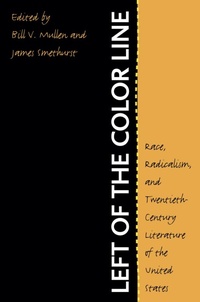
Left of the Color Line
Race, Radicalism, and Twentieth-Century Literature of the United States
Published on 1. January 2012
344 pages
978-0-8078-8239-9 (ISBN)
Description

This collection of fifteen new essays explores the impact of the organized Left and Leftist theory on American literature and culture from the 1920s to the present. In particular, the contributors explore the participation of writers and intellectuals on the Left in the development of African American, Chicano/Chicana, and Asian American literature and culture. By placing the Left at the center of their examination, the authors reposition the interpretive framework of American cultural studies.
Tracing the development of the Left over the course of the last century, the essays connect the Old Left of the pre–World War II era to the New Left and Third World nationalist Left of the 1960s and 1970s, as well as to the multicultural Left that has emerged since the 1970s. Individual essays explore the Left in relation to the work of such key figures as Ralph Ellison, T. S. Eliot, Chester Himes, Harry Belafonte, Américo Paredes, and Alice Childress. The collection also reconsiders the role of the Left in such critical cultural and historical moments as the Harlem Renaissance, the Cold War, and the Black Arts Movement of the 1960s and 1970s.
The contributors are Anthony Dawahare, Barbara Foley, Marcial González, Fred Ho, William J. Maxwell, Bill V. Mullen, Cary Nelson, B. V. Olguín, Rachel Rubin, Eric Schocket, James Smethurst, Michelle Stephens, Alan Wald, and Mary Helen Washington.
Tracing the development of the Left over the course of the last century, the essays connect the Old Left of the pre–World War II era to the New Left and Third World nationalist Left of the 1960s and 1970s, as well as to the multicultural Left that has emerged since the 1970s. Individual essays explore the Left in relation to the work of such key figures as Ralph Ellison, T. S. Eliot, Chester Himes, Harry Belafonte, Américo Paredes, and Alice Childress. The collection also reconsiders the role of the Left in such critical cultural and historical moments as the Harlem Renaissance, the Cold War, and the Black Arts Movement of the 1960s and 1970s.
The contributors are Anthony Dawahare, Barbara Foley, Marcial González, Fred Ho, William J. Maxwell, Bill V. Mullen, Cary Nelson, B. V. Olguín, Rachel Rubin, Eric Schocket, James Smethurst, Michelle Stephens, Alan Wald, and Mary Helen Washington.
More details
Other editions
Additional editions
James Smethurst
Left of the Color Line
Race, Radicalism, and Twentieth-Century Literature of the United States
Book
10/2003
The University of North Carolina Press
€49.90
Shipment within 15-20 days
Persons
Bill V. Mullen is professor of English and co-coordinator of American studies at the University of Texas at San Antonio. He is author of Popular Fronts: Chicago and African American Cultural Politics, 1935–1946. James Smethurst is assistant professor in the W. E. B. Du Bois Department of Afro-American Studies at the University of Massachusetts–Amherst. He is author of The New Red Negro: The Literary Left and African-American Poetry, 1930–1946.
