

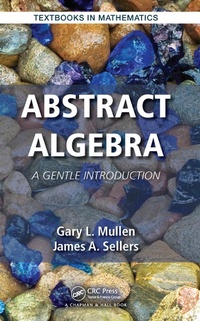
Abstract Algebra
A Gentle Introduction
1st Edition
Published on 19. December 2016
214 pages
978-1-4822-5007-7 (ISBN)
Description

Abstract Algebra: A Gentle Introduction advantages a trend in mathematics textbook publishing towards smaller, less expensive and brief introductions to primary courses. The authors move away from the 'everything for everyone' approach so common in textbooks. Instead, they provide the reader with coverage of numerous algebraic topics to cover the most important areas of abstract algebra.
Through a careful selection of topics, supported by interesting applications, the authors Intend the book to be used for a one-semester course in abstract algebra. It is suitable for an introductory course in for mathematics majors. The text is also very suitable for education majors
who need to have an introduction to the topic.
As textbooks go through various editions and authors employ the suggestions of numerous well-intentioned reviewers, these book become larger and larger and subsequently more expensive. This book is meant to counter that process. Here students are given a "gentle introduction," meant to provide enough for a course, yet also enough to encourage them toward future study of the topic.
Features
Groups before rings approach
Interesting modern applications
Appendix includes mathematical induction, the well-ordering principle, sets, functions, permutations, matrices, and complex nubers.
Numerous exercises at the end of each section
Chapter "Hint and Partial Solutions" offers built in solutions manual
Through a careful selection of topics, supported by interesting applications, the authors Intend the book to be used for a one-semester course in abstract algebra. It is suitable for an introductory course in for mathematics majors. The text is also very suitable for education majors
who need to have an introduction to the topic.
As textbooks go through various editions and authors employ the suggestions of numerous well-intentioned reviewers, these book become larger and larger and subsequently more expensive. This book is meant to counter that process. Here students are given a "gentle introduction," meant to provide enough for a course, yet also enough to encourage them toward future study of the topic.
Features
Groups before rings approach
Interesting modern applications
Appendix includes mathematical induction, the well-ordering principle, sets, functions, permutations, matrices, and complex nubers.
Numerous exercises at the end of each section
Chapter "Hint and Partial Solutions" offers built in solutions manual
Reviews / Votes
As the subtitle implies, those seeking a standard undergraduate text in abstract algebra should look elsewhere. The authors provide readers with a very brief introduction to some of the central structures of algebra: groups, rings, fields, and vector spaces. As an example of the textaEUR (TM)s brevity, its treatment of groups consists of definitions, examples, and a discussion of subgroups and cosets that culminates in LaGrangeaEUR (TM)s theorem. There is no mention of group homomorphisms, normal subgroups, or quotient groups. Nonetheless, various applications of the subject not often addressed in traditional texts are treated within this work. It appears that the intent is to provide enough content for readers to comprehend these applications. Just enough elementary number theory is presented to allow a discussion of the RSA cryptosystem. Sufficient material on finite fields is given for a discussion of Latin squares and the Diffie-Hellman public key exchange. Adequate linear algebra topics foster a discussion of Hamming codes. This text will be suitable for an algebra-based course introducing students to abstract mathematical thought or an algebra course with an emphasis on applications.--D. S. Larson, Gonzaga University, Choice magazine 2016 As the subtitle implies, those seeking a standard undergraduate text in abstract algebra should look elsewhere. The authors provide readers with a very brief introduction to some of the central structures of algebra: groups, rings, fields, and vector spaces. As an example of the textaEUR (TM)s brevity, its treatment of groups consists of definitions, examples, and a discussion of subgroups and cosets that culminates in LaGrangeaEUR (TM)s theorem. There is no mention of group homomorphisms, normal subgroups, or quotient groups. Nonetheless, various applications of the subject not often addressed in traditional texts are treated within this work. It appears that the intent is to provide enough content for readers to comprehend these applications. Just enough elementary number theory is presented to allow a discussion of the RSA cryptosystem. Sufficient material on finite fields is given for a discussion of Latin squares and the Diffie-Hellman public key exchange. Adequate linear algebra topics foster a discussion of Hamming codes. This text will be suitable for an algebra-based course introducing students to abstract mathematical thought or an algebra course with an emphasis on applications.
--D. S. Larson, Gonzaga University, Choice magazine, 2016
More details
Series
Language
English
Place of publication
Philadelphia, PA
United States
Publishing group
Taylor & Francis Inc
Target group
College/higher education
Illustrations
24 Tables, black and white
File size
3,57 MB
ISBN-13
978-1-4822-5007-7 (9781482250077)
Copyright in bibliographic data and cover images is held by Nielsen Book Services Limited or by the publishers or by their respective licensors: all rights reserved.
Schweitzer Classification
Other editions
New editions
E-Book
12/2023
2nd Edition
Taylor & Francis
€138.99
Available for download
E-Book
07/2022
2nd Edition
Chapman & Hall/CRC
€78.99
Available for download
Additional editions
Book
01/2023
1st Edition
Chapman & Hall/CRC
€78.17
Shipment within 10-20 days
Book
12/2016
1st Edition
Chapman & Hall/CRC
€128.50
Article not available for order
Persons
Gary Mullen is Professor of Mathematics, The Pennsylvania State University, where he earned his Ph.D. His main interest is finite fields, and is founder of the journal "Finite Fields and Their Introduction." He is also the Editor of The Handbook of Finite Fields published by CRC Press.
James Sellers is Professor and Associate Head for Undergraduate Mathematics, The Pennsylvania State University, where he also earned his Ph.D. He has published many research articles and won awards related to his efforts to advance mathematics education.
James Sellers is Professor and Associate Head for Undergraduate Mathematics, The Pennsylvania State University, where he also earned his Ph.D. He has published many research articles and won awards related to his efforts to advance mathematics education.
Content
Elementary Number Theory
Divisibility
Primes and factorization
Congruences
Solving congruences
Theorems of Fermat and Euler
RSA cryptosystem
Groups
De nition of a group
Examples of groups
Subgroups
Cosets and Lagrange's Theorem
Rings
Defiition of a ring
Subrings and ideals
Ring homomorphisms
Integral domains
Fields
Definition and basic properties of a field
Finite Fields
Number of elements in a finite field
How to construct finite fields
Properties of finite fields
Polynomials over finite fields
Permutation polynomials
Applications
Orthogonal latin squares
Di?e/Hellman key exchange
Vector Spaces
Definition and examples
Basic properties of vector spaces
Subspaces
Polynomials
Basics
Unique factorization
Polynomials over the real and complex numbers
Root formulas
Linear Codes
Basics
Hamming codes
Encoding
Decoding
Further study
Exercises
Appendix
Mathematical induction
Well-ordering Principle
Sets
Functions
Permutations
Matrices
Complex numbers
Hints and Partial Solutions to Selected Exercises
Divisibility
Primes and factorization
Congruences
Solving congruences
Theorems of Fermat and Euler
RSA cryptosystem
Groups
De nition of a group
Examples of groups
Subgroups
Cosets and Lagrange's Theorem
Rings
Defiition of a ring
Subrings and ideals
Ring homomorphisms
Integral domains
Fields
Definition and basic properties of a field
Finite Fields
Number of elements in a finite field
How to construct finite fields
Properties of finite fields
Polynomials over finite fields
Permutation polynomials
Applications
Orthogonal latin squares
Di?e/Hellman key exchange
Vector Spaces
Definition and examples
Basic properties of vector spaces
Subspaces
Polynomials
Basics
Unique factorization
Polynomials over the real and complex numbers
Root formulas
Linear Codes
Basics
Hamming codes
Encoding
Decoding
Further study
Exercises
Appendix
Mathematical induction
Well-ordering Principle
Sets
Functions
Permutations
Matrices
Complex numbers
Hints and Partial Solutions to Selected Exercises
