

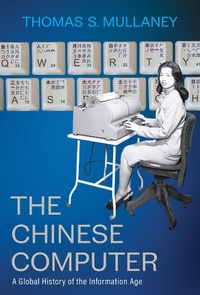
The Chinese Computer
A Global History of the Information Age
Published on 28. May 2024
376 pages
978-0-262-37243-5 (ISBN)
Description

The fascinating, untold story of how the Chinese language overcame unparalleled challenges and revolutionized the world of computing.
A standard QWERTY keyboard has a few dozen keys. How can Chinese-a language with tens of thousands of characters and no alphabet-be input on such a device? In The Chinese Computer, Thomas S. Mullaney sets out to resolve this paradox, and in doing so, discovers that the key to this seemingly impossible riddle has given rise to a new epoch in the history of writing-a form of writing he calls "hypography." Based on fifteen years of research, this pathbreaking history of the Chinese language charts the beginnings of electronic Chinese technology in the wake of World War II up through to its many iterations in the present day.
Mullaney takes the reader back through the history and evolution of Chinese language computing technology, showing the development of electronic Chinese input methods-software programs that enable Chinese characters to be produced using alphanumeric symbols-and the profound impact they have had on the way Chinese is written. Along the way, Mullaney introduces a cast of brilliant and eccentric personalities drawn from the ranks of IBM, MIT, the CIA, the Pentagon, the Taiwanese military, and the highest rungs of mainland Chinese establishment, to name a few, and the unexpected roles they played in developing Chinese language computing. Finally, he shows how China and the non-Western world-because of the hypographic technologies they had to invent in order to join the personal computing revolution-"saved" the Western computer from its deep biases, enabling it to achieve a meaningful presence in markets outside of the Americas and Europe.
An eminently engaging and artfully told history, The Chinese Computer is a must-read for anyone interested in how culture informs computing and how computing, in turn, shapes culture.
A standard QWERTY keyboard has a few dozen keys. How can Chinese-a language with tens of thousands of characters and no alphabet-be input on such a device? In The Chinese Computer, Thomas S. Mullaney sets out to resolve this paradox, and in doing so, discovers that the key to this seemingly impossible riddle has given rise to a new epoch in the history of writing-a form of writing he calls "hypography." Based on fifteen years of research, this pathbreaking history of the Chinese language charts the beginnings of electronic Chinese technology in the wake of World War II up through to its many iterations in the present day.
Mullaney takes the reader back through the history and evolution of Chinese language computing technology, showing the development of electronic Chinese input methods-software programs that enable Chinese characters to be produced using alphanumeric symbols-and the profound impact they have had on the way Chinese is written. Along the way, Mullaney introduces a cast of brilliant and eccentric personalities drawn from the ranks of IBM, MIT, the CIA, the Pentagon, the Taiwanese military, and the highest rungs of mainland Chinese establishment, to name a few, and the unexpected roles they played in developing Chinese language computing. Finally, he shows how China and the non-Western world-because of the hypographic technologies they had to invent in order to join the personal computing revolution-"saved" the Western computer from its deep biases, enabling it to achieve a meaningful presence in markets outside of the Americas and Europe.
An eminently engaging and artfully told history, The Chinese Computer is a must-read for anyone interested in how culture informs computing and how computing, in turn, shapes culture.
More details
Other editions
Additional editions
Book
05/2024
MIT Press
€32.50
Available immediately
Person
Thomas S. Mullaney is Professor of Chinese History at Stanford University and a Guggenheim Fellow. He is the author of The Chinese Typewriter: A History, Where Research Begins, and Coming to Terms with the Nation: Ethnic Classification in Modern China.
Content
- Intro
- Contents
- Acknowledgments
- Introduction: Chinese in the Digital Age
- The Six Axioms of Chinese Computing
- The Hypographic Age
- 1: When IMEs Were Women: IBM, Lois Lew, and the Dawn of Electronic Chinese
- Code Consciousness: From Chinese Telegraphy to the Electric Chinese Typewriter
- Grace Under Pressure: The First Chinese Inputter
- Living in Code: Lois Lew in China
- 0275: You / 0178: He / 0314: Me
- 2: Breaking the Spell: Sinotype and the Invention of Autocompletion
- How Do You Spell in Chinese?
- Waging Peace: The Weaponization of Sinotype
- Splitting the Screen: Feedback Loops, Disambiguation, and the Origins of the "Pop-Up Menu"
- Chinese Is Redundant: "Minimum Spelling" and the Invention of Autocompletion
- The Death of Sinotype
- 3: Farewell, QWERTY: The Quest for a Chinese Keyboard
- Chan-hui Yeh, IPX, and the 120-Dimensional Hypershift Keyboard
- One Key, Many Uses: The "Medium-Sized" Keyboard in Mainland China and Beyond
- Ideo-Matic 66
- The Return of Input
- 4: The Input Wars: Zhi Bingyi and the Return of Hypography
- The Return of QWERTY: Zhi Bingyi's Journey from Character Retrieval to Character Input
- Hypographic Semiotics: What Is an Alphabet That Doesn't Spell?
- The Hypography Market
- One Computer, Many Systems
- Hallucinations Made Real
- 5: The Search for Modding China: Printers, Screens, and the Politics of Peripherals
- Feats of Memory
- Dot-Matrix Printing and the Metallurgical Depths of Alphabetic Order
- Pop-Up Modernity: Chinese Character Monitors
- Interrupting Modernity
- No ESC
- 6: Connected Thoughts: Chinese in the Age of Predictive Text
- The Problem with Pinyin
- From Hanyu Pinyin to Pinyin Input: Exploiting the Hypographic Potential of Phonetic IMEs
- Pinyin and the New Input Technocracy
- Pinyin Input Is Not Hanyu Pinyin
- What Does Pinyin Input Change?
- Conclusion: Welcome to Hypography
- What Are the Limits of Hypography?
- What about English?
- Archival Abbreviations
- Interviews and Correspondences
- Character Glossary
- Notes
- Introduction
- Chapter 1
- Chapter 2
- Chapter 3
- Chapter 4
- Chapter 5
- Chapter 6
- Conclusion
- Bibliography
- Previous Publications
- Figures
- Index
