

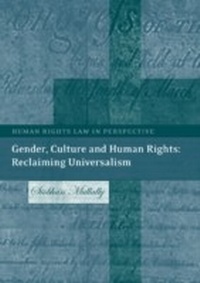
Gender, Culture and Human Rights
Reclaiming Universalism
1st Edition
Published on 26. May 2006
287 pages
978-1-84731-155-9 (ISBN)
Description

In recent years, feminist theory has increasingly defined itself in opposition to universalism and to discourses of human rights. Rejecting the troubled legacies of Enlightenment thinking, feminists have questioned the very premises upon which the international human rights movement is based. Rather than abandoning human rights discourse, however, this book argues that feminism should reclaim the universal and reconstruct the theory and practice of human rights. Discourse ethics and its post-metaphysical defence of universalism is offered as a key to this process of reconstruction.
The implications of discourse ethics and the possibility of reclaiming universalism are explored in the context of the reservations debate in international human rights law and further examined in debates on women's human rights arising in Ireland, India and Pakistan. Each of these states shares a common constitutional heritage and, in each, religious-cultural claims, intertwined with processes of nation-building, have constrained the pursuit of gender equality. Ultimately, this book argues in favour of a dual-track approach to cultural conflicts, combining legal regulation with an ongoing moral-political dialogue on the scope and content of human rights.
The implications of discourse ethics and the possibility of reclaiming universalism are explored in the context of the reservations debate in international human rights law and further examined in debates on women's human rights arising in Ireland, India and Pakistan. Each of these states shares a common constitutional heritage and, in each, religious-cultural claims, intertwined with processes of nation-building, have constrained the pursuit of gender equality. Ultimately, this book argues in favour of a dual-track approach to cultural conflicts, combining legal regulation with an ongoing moral-political dialogue on the scope and content of human rights.
More details
Series
Edition
1. Auflage
Language
English
Place of publication
London
United Kingdom
Publishing group
Bloomsbury Publishing PLC
Target group
Professional and scholarly
ISBN-13
978-1-84731-155-9 (9781847311559)
Copyright in bibliographic data and cover images is held by Nielsen Book Services Limited or by the publishers or by their respective licensors: all rights reserved.
Schweitzer Classification
Other editions
Additional editions
Book
05/2006
Hart Publishing
€133.92
Shipment within 15-20 days
Person
Siobhán Mullally is a Senior Lecturer at the Faculty of Law, University College Cork, where she teaches international human rights law, immigration and refugee law and public international law.
Content
1 The Discourse of Human Rights: 'An Active Enemy of Women's Progress'?
2 Alan Gewirth's Community of Rights: Feminism, Liberalism and the Value of Community
3 Political Liberalism, Feminism and the Limits of an 'Overlapping Consensus'
4 Nussbaum and the Human Capabilities Approach: Reconciling Feminism and Universalism?
5 Discourse Ethics, Feminism and the Return to the Universal
6 Opting out of Women's Human Rights: Reservations to Human Rights Treaties and the Defence of Culture
7 Debating Gender in Ireland (1): Family Values
8 Debating Gender in Ireland (2): Reproductive Rights
9 Women, Human Rights and Cultural Claims in Pakistan
10 Debating Gender Equality in India: Feminism and Multicultural Dilemmas
CONCLUSION
2 Alan Gewirth's Community of Rights: Feminism, Liberalism and the Value of Community
3 Political Liberalism, Feminism and the Limits of an 'Overlapping Consensus'
4 Nussbaum and the Human Capabilities Approach: Reconciling Feminism and Universalism?
5 Discourse Ethics, Feminism and the Return to the Universal
6 Opting out of Women's Human Rights: Reservations to Human Rights Treaties and the Defence of Culture
7 Debating Gender in Ireland (1): Family Values
8 Debating Gender in Ireland (2): Reproductive Rights
9 Women, Human Rights and Cultural Claims in Pakistan
10 Debating Gender Equality in India: Feminism and Multicultural Dilemmas
CONCLUSION
