

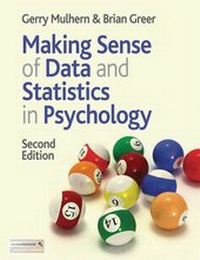
Making Sense of Data and Statistics in Psychology
2nd Edition
Published on 9. September 2017
320 pages
978-0-230-35799-0 (ISBN)
Description

An innovative and easy-to-read introduction to understanding statistical concepts and data in Psychology, written with even the most maths-averse Psychology student in mind. Authored by the current president of the BPS (British Psychological Society), this second edition includes guidance for SPSS and extended statistical coverage to bridge the gap between conceptual understanding of data and how to run statistical tests.
More details
Other editions
Additional editions
Gerry Mulhern | Brian Greer
Making Sense of Data and Statistics in Psychology
Book
05/2011
2nd Edition
Red Globe Press
€66.30
Shipment within 15-20 days
Gerry Mulhern | Brian Greer
Making Sense of Data and Statistics in Psychology
Book
05/2011
2nd Edition
Palgrave Macmillan
€155.97
Shipment within 15-20 days
Persons
GERRY MULHERN is Senior Lecturer in Psychology at Queens University Belfast, UK, and current president of the British Psychological Society. He has previously taught at the Universities of Edinburgh and Ulster, and has published widely in the areas of applied cognition and mathematics education.
BRIAN GREER is Adjunct Professor in the Graduate School of Education at Portland State University. He has taught statistics to psychology students for many years, and has published widely on mathematics education.
Both authors conduct research on how people learn mathematical concepts and they bring this knowledge to bear in the explanations contained within Making Sense of Data and Statistics in Psychology.
BRIAN GREER is Adjunct Professor in the Graduate School of Education at Portland State University. He has taught statistics to psychology students for many years, and has published widely on mathematics education.
Both authors conduct research on how people learn mathematical concepts and they bring this knowledge to bear in the explanations contained within Making Sense of Data and Statistics in Psychology.
Content
Statistics in Psychology.- PART 1: MAKING SENSE OF BASIC DESIGNS.- Variables.- Describing and Summarising Data.- Seeing Patterns in Data: Comparing.- Seeing Patterns in Data: Correlating.- The Relevance of Probability.- Statistical Tests: Comparing.- Statistical Tests: Correlating.- Experimentation in Psychology.- Other ways of assessing the importance of results.- PART 2: MAKING SENSE OF 'BIGGER' DESIGNS.- Seeing Patterns in Data: Comparing More Than Two Groups.- Statistical Tests: Comparing More Than Two Groups.- Seeing Patterns in Data: Comparisons Involving More than One Independent Variable.- Statistical Tests: Comparing More than One Independent Variable.- Relating: Multiple Variables.- Overview.- Index.
