

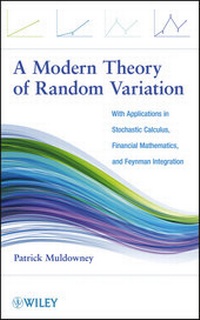
A Modern Theory of Random Variation
Description

More details
Other editions
Additional editions
Person
PATRICK MULDOWNEY, PhD, served as lecturer in the Magee Business School at the University of Ulster for over twenty years. Dr. Muldowney has published extensively in his areas of research, including integration theory, financial mathematics, and random variation.
Content
Symbols xiii
1 Prologue 1
2 Introduction 37
3 Infinite-Dimensional Integration 83
4 Theory of the Integral 111
5 Random Variability 183
6 Gaussian Integrals 257
7 Brownian Motion 305
8 Stochastic Integration 383
9 Numerical Calculation 447
A Epilogue 491
Bibliography 505
Index 521
Chapter 1
Prologue
1.1 About This Book
This is a self-contained study of a Riemann sum approach to the theory of random variation, assuming only some familiarity with probability or statistical analysis, basic Riemann integration, and mathematical proof. The primary idea of the book, and the reason why it is different from other treatments of random variation, is its use of non-absolute convergence. The series diverges to infinity. On the other hand, the oscillating series converges—but only on condition that the terms are added up in the order in which they are written, without rearranging them. This convergence is called conditional or non-absolute.
What has this got to do with the theory of random variation? Any conception or understanding of the random variation phenomenon hinges on the notions of probability and its mathematical representation in the form of probability distribution functions. The central, recurring theme of this book is that, provided a non-absolute method of summation is used, every finitely additive function of disjoint intervals is integrable. In other words, every distribution function is integrable.
In contrast, more traditional methods in probability theory exclude significant classes of such functions whose integrability cannot be established whenever only absolute convergence is considered. Examples of this include:
The Feynman “probability measure” (which is not a measure and not a probability)—the probability amplitudes used in the Feynman path integrals of quantum mechanics. This book presents a framework in which the Feynman path integrals are actual integrals. In effect, the missing pieces of Feynman’s original paper [64] are provided here; and then used to express Feynman diagrams as convergent series of integrals—as they were originally conceived. The increments in the sample paths of Brownian motion—these have infinite variation in every interval, and their integrals (in the usual absolute sense) are therefore divergent. But these increments are integrable in the non-absolute sense, so the stochastic calculus of Brownian motion can be put on a simpler footing.Incorporating these innovations in the theory of random variation entails a radical reformulation of the subject. It turns out that the standard theory of probability or random variation can be simplified and extended provided non-absolute summation procedures are used.
Reformulation and extension of the theory involves some changes and reinterpretations in the standard concepts and notations. Unnecessary changes have been avoided, and as far as possible the text is consistent with more traditional versions. Therefore, with due caution and attention to definitions of terminology and notation, the text can be read in that spirit. An outline and overview are presented in Chapters 1 and 2.
Chapter 7 is the main part of this book, with Chapter 6 providing introductory material, and Chapter 8 some consequences. The book presents a new sphere of application of probability theory by means of the conception of random variation which is elaborated in Chapter 5.
Ralph Henstock’s general theory of integration, as extended in [162] (Muldowney, 1987), is the basis for this reformulation of the traditional theory of probability and random variation, and is presented in Chapter 4.
Even though Henstock’s theory is different from standard integration theory, many of the results are similar. Therefore Chapter 4 can be regarded as a kind of appendix to subsequent chapters, providing technical background in the manner of many books on probability theory in which measure and integration are appended to the main part of the text. Included in this chapter are results for non-absolutely integrable functions which are not available in traditional integration theory.
A fundamental modification and extension of the Riemann integral was introduced by R. Henstock and, independently, by J. Kurzweil in the 1950s. In Henstock [93] this was designated as the Riemann-complete1 integral.
The work of Kurzweil has transformed the theory of differential equations—see, for instance, Schwabik [129, 207]. Henstock went on to develop a general theory of integration [85, 93, 94, 103, 105], which includes as special cases the integrals of Riemann, Stieltjes, Lebesgue, Perron, Denjoy, Ward, Burkill, Henstock-Kurzweil, and McShane (see [82]). This is the Henstock integral on which this book is based.
The Henstock integral is not so well known as the Lebesgue integral. Also, the Riemann sum approach to probability theory is new. Therefore the main ideas of this book are introduced in a relatively informal way in Chapters 1 and 2, while Chapter 3 brings forward some notation and definitions from Chapter 4, in advance of the fuller exposition of the main theorems and proofs in the theory of the integral—the Burkill-complete integral—provided in Chapter 4.
Chapter 4 can be read as a stand-alone account of the Stieltjes-complete and Burkill-complete versions of the Henstock integral, with emphasis on those parts of integration theory which are important in the study of random variation.
It is possible to get the gist of this book by reading Chapters 1, 2, and 3 in conjunction with Chapter 9’s numerical exploration of observable processes, stochastic processes, Brownian motion, and Itô calculus.
The book contains a new approach to several topics. There have to be good reasons for going to the trouble of engaging with a new approach to subjects for some of which there already exist tried and tested methods. As the occasion arises such reasons are pointed out in the text.
Much detail is provided in exposition, explanation, commentary, and proof; with a view to transparency and, not least, facilitation of error detection, error correction, and the like. A degree of repetition is present, for the same purposes.
The text contains examples which illustrate the material of the text with solutions to less difficult issues. They can be regarded as exercises or solved problems and can be used as models for devising further exercises and problems. The numerical calculations in Chapter 9 are intended to illustrate notation and to clarify concepts. Also, as a rich source of insight, motivation, and grounding, there is endless scope for further practical numerical exercises of this kind.
The book builds on the work of numerous authors, many of whom are listed in the text and in the bibliography. The generous help of many colleagues in bringing the material to publication is gratefully acknowledged.
1.2 About the Concepts
An integrand generally involves a point function f(x) multiplied by an integrator2 function F(I). Many treatises on integration focus strongly on the properties of f(x), such as continuity and differentiability, or their absence. In mathematical analysis the integrator is often taken to be F(I) = |I|, the length of the interval I, with less attention given to alternative integrator functions.
But random variation is not so much concerned with the more difficult manifestations of point function integrands f (x). In this book much more emphasis is placed on properties of probability distribution functions F(I). This is one of the reasons why the book gives much attention to the properties of variation3 of interval functions F(I), a concept which it possible to extend distribution functions F defined on intervals to outer measure defined on arbitrary sets.
In addition, the classical form of an integrand function is a product f(x)F(I) of a point function multiplied by an interval function. But it turns out that Henstock integration is most naturally formulated with integrands of the form h(x, I) which are not necessarily the product of a point function times an interval function.
The wording and symbols used in the theory of random variation, as presented in this book, are consistent with or similar to those already in general use and, for the most part, can be understood in the usual way. A note of caution, however. The symbol X is traditionally used to denote a random variable, in the sense of a measurable function. But in this book X denotes a mathematical representation of an “experiment” for which a range of potential data values x is known in advance. And a random variable is a calculation f(X) based on the potential data values x. The symbol X will usually denote a process of joint observation of several unpredictable occurrences. The occurrences or outcomes are actual joint data x, where x is a ’tuple of real numbers such as the observed values of an experiment consisting of repeated throws of a die.
A determination f(X) derived from this experiment or joint observation X could consist of the value of a payout made on the first occasion when ten successive sixes are thrown. X can be thought of as an experiment, an “observable”, or a “random variation”.
Both X and f(X) involve potential data, x and f(x), respectively, generated by an act of measurement—often joint measurement. Thus X (or f(X)) refers to unpredictable potential data, in advance of actual observation. The corresponding x (or f(x)) is the actual datum selected by the process of measurement...
