

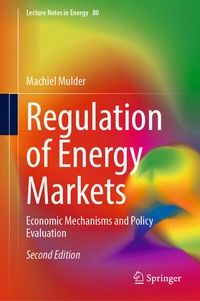
Regulation of Energy Markets
Description

This textbook explains the main economic mechanisms behind energy markets and assesses how governments can implement policies to improve these markets' performance. Adopting a microeconomic perspective, it systematically analyses the various types of market failures on the electricity and gas markets as well as coal, oil, hydrogen and heat markets in order to identify government policies that can improve welfare. Critical factors in this regard include the natural monopoly and the public-goods character of energy infrastructures; market power structures resulting from inflexibility of supply and demand; international trade restrictions; negative externalities concerning the use of fossil energy; positive externalities concerning innovative new energy technologies; information asymmetries with regard to the product characteristics of energy commodities; and other public concerns, such as energy poverty. In turn, readers will learn about various measures that governments can useto address these market failures, including incentive regulations for electricity grids; international integration of wholesale energy markets; environmental regulatory measures like emissions trading schemes; subsidy schemes for new technologies; green-energy certificate schemes; and energy taxes.
This second, updated and expanded edition addresses recent developments in international energy markets that have resulted in extremely high prices and concerns about the markets' ability to provide a secure energy supply. Further, it examines several countries' intensified measures to implement the transition to a low-carbon energy system. Given its scope, the book will appeal to upper-undergraduate and graduate students from various disciplines who want to learn more about the economics and regulation of energy systems and markets.
"Given Mulder's experience in government and academia, he provides a novel contribution to the literature by systematically analyzing different types of market failures and potential remedies offered by economic theory. Overall, Mulder's textbook should be a valuable reference for students and energy policy analysts."(J. Wesley Burnett, The Energy Journal , Vol. 43, Number 3)
More details
Other editions
Additional editions
Previous edition
Person
Machiel Mulder is a Professor of Energy Economics and Director of the Centre for Energy Economics Research at the University of Groningen, the Netherlands. Previously he was Chief Economic Advisor at the Dutch energy regulator and Head of the Energy Department at the Netherlands Bureau for Economic Policy Analysis.
