

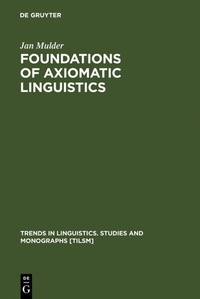
Foundations of Axiomatic Linguistics
1st Edition
Published on 1. June 2011
XII, 475 pages
978-3-11-087201-9 (ISBN)
Description

No detailed description available for "Foundations of Axiomatic Linguistics".
More details
Other editions
Additional editions
Jan Mulder
Foundations of Axiomatic Linguistics
Book
04/1989
1st Edition
De Gruyter Mouton
€149.95
Shipment within 7-9 days
Content
- Intro
- Acknowledgements
- Chapter I: Introduction
- 1. Foreword to the introduction
- 2. Descriptive linguistics - objects and method. The functional principle
- 3. Scientific linguistics. Epistemological considerations
- 4. The hypothetico-deductive method
- Chapter II: Theory and strategy - C'est le point de vue qui crée l'objet (Saussure)
- 1. Preparing the raw material
- 2. The relation of theory to description, and of both to the speech-phenomena
- 3. The axiomatic approach
- 4. The three legs of the theory
- Chapter III: Function, system, and systemology
- 1. The first axiom
- 2. The notion 'self-containedness'
- 3. Earlier stages and development of the theory
- 4. Further on the theory of semiotic systems, and the sub-systems of language
- Chapter IV: Semiotic foundations of axiomatic functionalism - Ontological considerations and the 'linguistic sign'
- 1. The theory of indices
- 2. The ontology or 'signum-theory'
- Chapter V: Linguistic description I: General principles, and phonology
- 1. Introduction
- 2. Practical hints for successful descriptivism
- 3. Methodology and hypothetico-deductive logic
- 4. 'Pseudo-composites and pseudo-words' revisited
- 5. Productivity and pseudo-productivity. Analogy as motivation for the formation of new words
- 6. Productivity and non-productivity in so-called 'derivations'
- 7. Further notes on 'productivity' and potential pitfalls
- 8. Some further remarks
- 9. The notion 'simultaneity'
- 10. The phoneme as a simultaneous bundle of distinctive features
- 11. Phoneme tables as practical descriptive devices
- 12. Consonants, vowels, semi-vowels, and semi-consonants
- 13. The notion 'position', 'nuclearity', and 'peripheralness' in phonology
- 14. The notions 'neutralization' and 'archiphoneme'
- 15. The description of vowel systems
- 16. Some further practical hints for establishing vowel-systems
- 17. The English vowel system
- 18. Some further examples of descriptive problems in phonology
- 19. Effective phonological description
- 20. Tone-languages of East and Southeast Asia
- Chapter VI: Linguistic description II: Syntax and the sentential level
- 1. Introduction
- 2. Direct and indirect tactic and non-tactic relations
- 3. Functional dependency versus occurrence dependency
- 4. Correlations between functional dependency and occurrence dependency
- 5. Parallel determination versus diverse determination
- 6. The notion 'semi-cluster'
- 7. The notion 'plereme'
- 8. Syntactic description
- 9. Concord and congruity
- 10. Syntactic patterns in English
- 11. Some remarks on 'sentence' and 'sentential entities'
- Chapter VII: Further examples of syntactic analysis and additional remarks
- Chapter VIII: Postulates for axiomatic linguistics. Revised version
- Bibliography
- Index to the definitions
- General Index
