

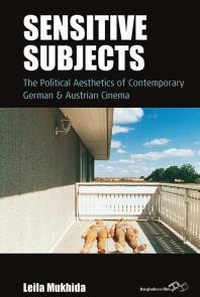
Sensitive Subjects
The Political Aesthetics of Contemporary German and Austrian Cinema
1st Edition
Published on 1. November 2020
218 pages
978-1-78920-631-9 (ISBN)
Description

Both politically and aesthetically, the contemporary German and Austrian film landscape is a far cry from the early days of the medium, when critics like Siegfried Kracauer produced foundational works of film theory amid the tumult of the early twentieth century. Yet, as Leila Mukhida demonstrates in this innovative study, the writings of figures like Kracauer and Walter Benjamin in fact remain an undervalued tool for understanding political cinema today. Through illuminating explorations of Michael Haneke, Valeska Grisebach, Andreas Dresen, and other filmmakers of the post-reunification era, Mukhida develops an analysis centered on film aesthetics and experience, showing how medium-specific devices like lighting, sound, and mise-en-scene can help to cultivate political sensitivity in spectators.
Reviews / Votes
"Mukhida provides an innovative analysis of political aesthetics in contemporary German and Austrian film...This volume is a noteworthy contribution to the scholarship of German-language film, as many of these films have not yet been analyzed with the theories of Benjamin, Kracauer, or Kluge. Readers will definitely benefit from Mukhida's excellent introduction, in which she gives background on film theory and explains her methodology thoroughly....Highly Recommended." * Choice"Overall, Sensitive Subjects is well-written and interrogates how the films move the audience and thus have an impact on viewers, and 'by extension to the societies in which they are located'... The book offers a unique methodological approach and astute filmic analyses...[and] speaks to scholars from a variety of disciplines such as cultural studies, film and media studies, and German (film) studies, along with a general reader interested in actively engaging with contemporary German and Austrian cinema, and can serve as secondary course readings." * German Studies Review
"This very well-constructed book has a lot to offer, including a uniquely systematic methodological approach to contemporary German-language cinema, an engaging discussion of a range of German-language films that have not been discussed together before, and a very accessible and elegant prose style that is a real pleasure to read." * Marco Abel, University of Nebraska
More details
Series
Edition
1. Auflage
Language
English
Place of publication
Oxford
United Kingdom
Target group
Professional and scholarly
Product notice
Reflowable
Illustrations
Bibliography; Index; 20 Illustrations
ISBN-13
978-1-78920-631-9 (9781789206319)
DOI
10.3167/9781789206302
Copyright in bibliographic data and cover images is held by Nielsen Book Services Limited or by the publishers or by their respective licensors: all rights reserved.
Schweitzer Classification
Other editions
Additional editions
Book
11/2020
1st Edition
Berghahn Books
€146.00
Shipment within 3-4 weeks
Person
Leila Mukhida is Lecturer in Modern German Studies at the University of Cambridge.
Content
List of Illustrations
Acknowledgements
List of Abbreviations
Introduction
Chapter 1. The Twenty-First-Century Worker Film: Workingman's Death (2004) by Michael Glawogger and Karger (2007) by Elke Hauck
Chapter 2. Radical Realisms: Angela Schanelec's Marseille (2004), Andreas Dresen's Halt Auf Freier Strecke (2011), and Gerhard Friedl's Hat Wolff Von Amerongen Konkursdelikte Begangen? (2004)
Chapter 3. Fragmented Stories for Fragmented Viewers: 71 Fragmente einer Chronologie des Zufalls (1994) and Code Inconnu: Recit incomplet de divers voyages (2000) by Michael Haneke
Chapter 4. Sensitive Subjects: Shock and Distraction in Hundstage (2001) by Ulrich Seidl, and in Sehnsucht (2006) by Valeska Grisebach
Conclusion
Filmography
Bibliography
Index
Acknowledgements
List of Abbreviations
Introduction
Chapter 1. The Twenty-First-Century Worker Film: Workingman's Death (2004) by Michael Glawogger and Karger (2007) by Elke Hauck
Chapter 2. Radical Realisms: Angela Schanelec's Marseille (2004), Andreas Dresen's Halt Auf Freier Strecke (2011), and Gerhard Friedl's Hat Wolff Von Amerongen Konkursdelikte Begangen? (2004)
Chapter 3. Fragmented Stories for Fragmented Viewers: 71 Fragmente einer Chronologie des Zufalls (1994) and Code Inconnu: Recit incomplet de divers voyages (2000) by Michael Haneke
Chapter 4. Sensitive Subjects: Shock and Distraction in Hundstage (2001) by Ulrich Seidl, and in Sehnsucht (2006) by Valeska Grisebach
Conclusion
Filmography
Bibliography
Index
