

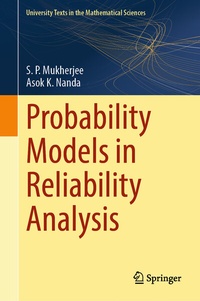
Probability Models in Reliability Analysis
Description

This book delves into the fundamental theoretical aspects of reliability analysis, focusing on various probabilistic models. These models are essential for representing random variations in underlying variables such as time-to-failure, the number of failures between consecutive repairs and similar metrics. The calculation, estimation and prediction of reliability all hinge on using appropriate probability models. The book introduces various models beneficial for researchers in the field of reliability. It also provides a comprehensive overview of the available models, highlighting their distinctive features and practical applications in a narrative format. The content of the book is designed to appeal to a broad readership. Students and researchers in the field of reliability analysis will find a comprehensive yet easily understandable summary of models applicable to their data sets of interest. It should be noted, however, As stated clearly in the preface, this book does not illustrate applications of the models discussed in terms of real-life data.
More details
Other editions
Additional editions
Persons
Asok K. Nanda is Professor and former Head of the Department of Mathematics and Statistics and former Dean of Academic Affairs, at the Indian Institute of Science Education and Research (IISER) Kolkata, West Bengal, India. He is a former member of the Board of Governors, IISER Kolkata. He had visited the University of Brunswick, Canada, for his post-doctoral research. With more than 30 years of teaching and research experience, he has been associated with Panjab University, Indian Institute of Technology Kharagpur, and the University of Arizona, USA.
He is Associate Editor of several prestigious journals: Communications in Statistics: Theory and Methods, Communications in Statistics: Simulation and Computation, Communications in Statistics: Case Studies, Data Analysis and Applications, Statistics and Probability Letters and Journal of Indian Statistical Association.
Shyama Prasad Mukherjee is formerly Centenary Professor at the Department of Statistics, University of Calcutta. He delivered short courses and lectures at several universities and research institutions in India and abroad. He guided more than 25 scholars in their doctoral work on topics like parametric estimation including queueing parameters, prediction intervals, stochastic optimization, reliability analysis and inventory management. Editor of several contributed volumes, he has authored four books: A Guide to Research Methodology, Decision-making, Quality: Domains and Dimensions (Springer) and Statistical Methods for Social Science Research (Springer).
Content
1. Introduction.- 2. Properties of Life Distributions.- 3. Univariate Continuous Distributions.- 4. Some Discrete Distributions.- 5. Distributions Derived from the Parent Distribution.- 6. Finite Range Life Distributions.- 7. Ordering among Life Distributions .- 8. Classes of Life Distributions .- 9. Characterizations of Life Distributions .- 10. Distributions of Special Interest .- 11. Using an Appropriate Probability Model.
