

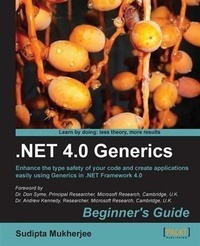
.NET 4.0 Generics Beginner's Guide
Enhance the type safety of your code and create applications easily using Generics in the .NET 4.0 Framework with this book and ebook
Published on 13. January 2025
396 pages
978-1-84969-079-9 (ISBN)
Description

Enhance the type safety of your code and easily create applications using .Net Generics 4.0
Key Features
Learn how to use Generics' methods and generic collections to solve complicated problems.
Develop real-world applications using Generics
Know the importance of each generic collection and Generic class and use them as per your requirements
Benchmark the performance of all Generic collections
Book DescriptionGenerics were added as part of .NET Framework 2.0 in November 2005. Although similar to generics in Java, .NET generics do not apply type erasure but every object has unique representation at run-time. There is no performance hit from runtime casts and boxing conversions, which are normally expensive..NET offers type-safe versions of every classical data structure and some hybrid ones. This book will show you everything you need to start writing type-safe applications using generic data structures available in Generics API. You will also see how you can use several collections for each task you perform. This book is full of practical examples, interesting applications, and comparisons between Generics and more traditional approaches. Finally, each container is bench marked on the basis of performance for a given task, so you know which one to use and when. This book first covers the fundamental concepts such as type safety, Generic Methods, and Generic Containers. As the book progresses, you will learn how to join several generic containers to achieve your goals and query them efficiently using Linq. There are short exercises in every chapter to boost your knowledge. The book also teaches you some best practices, and several patterns that are commonly available in generic code. Some important generic algorithm definitions are present in Power Collection (an API created by Wintellect Inc.) that are missing from .NET framework. This book shows you how to use such algorithms seamlessly with other generic containers. The book also discusses C5 collections. Java Programmers will find themselves at home with this API. This is the closest to JCF. Some very interesting problems are solved using generic containers from .NET framework, C5, and PowerCollection Algorithms n a clone of Google Set and Gender Genie for example! The author has also created a website (http://www.consulttoday.com/genguide) for the book where you can find many useful tools, code snippets, and, applications, which are not the part of code-download sectionWhat you will learn
How different kinds of generic listsare related
How to implement your own generic list
Query every kind of generic container alike with Linq Standard Query Operators
Augment .NET collections with general purpose algorithms available in C5 and PowerCollection
Build concurrent apps in breathing easy steps.
Find those algorithms you have been missing in .NET framework in PowerCollection and C5 API.
Learn how different generic collections/containers perform under benchmarking, and when to use one over another
Port your STL code blocks to .NET Generics which can be very handy if you are a veteran C++ developer and looking for an alternative in .NET world.
Who this book is forThis book is aimed at beginners in Generics. It assumes some working knowledge of C# , but it isn't mandatory. The following would get the most use out of the book: Newbie C# developers struggling with Generics. Experienced C++ and Java Programmers who are migrating to C# and looking for an alternative to other generic frameworks like STL and JCF would find this book handy. Managers who want to know what Generics is and how to put it to good use. Architects will find the benchmarking extremely useful, because it's the first of its kind across a framework of several collections.
Key Features
Learn how to use Generics' methods and generic collections to solve complicated problems.
Develop real-world applications using Generics
Know the importance of each generic collection and Generic class and use them as per your requirements
Benchmark the performance of all Generic collections
Book DescriptionGenerics were added as part of .NET Framework 2.0 in November 2005. Although similar to generics in Java, .NET generics do not apply type erasure but every object has unique representation at run-time. There is no performance hit from runtime casts and boxing conversions, which are normally expensive..NET offers type-safe versions of every classical data structure and some hybrid ones. This book will show you everything you need to start writing type-safe applications using generic data structures available in Generics API. You will also see how you can use several collections for each task you perform. This book is full of practical examples, interesting applications, and comparisons between Generics and more traditional approaches. Finally, each container is bench marked on the basis of performance for a given task, so you know which one to use and when. This book first covers the fundamental concepts such as type safety, Generic Methods, and Generic Containers. As the book progresses, you will learn how to join several generic containers to achieve your goals and query them efficiently using Linq. There are short exercises in every chapter to boost your knowledge. The book also teaches you some best practices, and several patterns that are commonly available in generic code. Some important generic algorithm definitions are present in Power Collection (an API created by Wintellect Inc.) that are missing from .NET framework. This book shows you how to use such algorithms seamlessly with other generic containers. The book also discusses C5 collections. Java Programmers will find themselves at home with this API. This is the closest to JCF. Some very interesting problems are solved using generic containers from .NET framework, C5, and PowerCollection Algorithms n a clone of Google Set and Gender Genie for example! The author has also created a website (http://www.consulttoday.com/genguide) for the book where you can find many useful tools, code snippets, and, applications, which are not the part of code-download sectionWhat you will learn
How different kinds of generic listsare related
How to implement your own generic list
Query every kind of generic container alike with Linq Standard Query Operators
Augment .NET collections with general purpose algorithms available in C5 and PowerCollection
Build concurrent apps in breathing easy steps.
Find those algorithms you have been missing in .NET framework in PowerCollection and C5 API.
Learn how different generic collections/containers perform under benchmarking, and when to use one over another
Port your STL code blocks to .NET Generics which can be very handy if you are a veteran C++ developer and looking for an alternative in .NET world.
Who this book is forThis book is aimed at beginners in Generics. It assumes some working knowledge of C# , but it isn't mandatory. The following would get the most use out of the book: Newbie C# developers struggling with Generics. Experienced C++ and Java Programmers who are migrating to C# and looking for an alternative to other generic frameworks like STL and JCF would find this book handy. Managers who want to know what Generics is and how to put it to good use. Architects will find the benchmarking extremely useful, because it's the first of its kind across a framework of several collections.
More details
Edition
Digital original
Language
English
Place of publication
Birmingham
United Kingdom
Target group
Professional and scholarly
US School Grade: College Graduate Student
Edition type
Digital original
File size
7,62 MB
ISBN-13
978-1-84969-079-9 (9781849690799)
Copyright in bibliographic data and cover images is held by Nielsen Book Services Limited or by the publishers or by their respective licensors: all rights reserved.
Schweitzer Classification
Other editions
Additional editions
Sudipta Mukherjee
.Net Generics 4.0 Beginner's Guide
Book
01/2011
Packt Publishing
€63.80
Shipment within 3-4 weeks
Person
Mukherjee Sudipta :
Sudipta Mukherjee was born in Kolkata and migrated to Bangalore. He is an electronics engineer by education and a computer engineer/scientist by profession and passion. He graduated in 2004 with a degree in electronics and communication engineering. He has a keen interest in data structure, algorithms, text processing, natural language processing tools development, programming languages, and machine learning at large. His first book on Data Structure using C has been received quite well. Parts of the book can be read on Google Books. The book was also translated into simplified Chinese, available from Amazon.cn. This is Sudipta's second book with Packt Publishing. His first book, .NET 4.0 Generics , was also received very well. During the last few years, he has been hooked to the functional programming style. His book on functional programming, Thinking in LINQ, was released in 2014. He lives in Bangalore with his wife and son. Sudipta can be reached via e-mail at sudipto80@yahoo.com and via Twitter at @samthecoder.
Sudipta Mukherjee was born in Kolkata and migrated to Bangalore. He is an electronics engineer by education and a computer engineer/scientist by profession and passion. He graduated in 2004 with a degree in electronics and communication engineering. He has a keen interest in data structure, algorithms, text processing, natural language processing tools development, programming languages, and machine learning at large. His first book on Data Structure using C has been received quite well. Parts of the book can be read on Google Books. The book was also translated into simplified Chinese, available from Amazon.cn. This is Sudipta's second book with Packt Publishing. His first book, .NET 4.0 Generics , was also received very well. During the last few years, he has been hooked to the functional programming style. His book on functional programming, Thinking in LINQ, was released in 2014. He lives in Bangalore with his wife and son. Sudipta can be reached via e-mail at sudipto80@yahoo.com and via Twitter at @samthecoder.
Content
Table of Contents
