

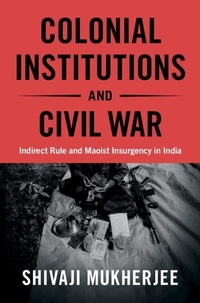
Colonial Institutions and Civil War
Indirect Rule and Maoist Insurgency in India
Published on 19. May 2021
416 pages
978-1-108-95762-5 (ISBN)
Description

What explains the peculiar spatial variation of Maoist insurgency in India? Mukherjee develops a novel typology of colonial indirect rule and land tenure in India, showing how they can lead to land inequality, weak state and Maoist insurgency. Using a multi-method research design that combines qualitative analysis of archival data on Chhattisgarh and Andhra Pradesh states, Mukherjee demonstrates path dependence of land/ethnic inequality leading to Maoist insurgency. This is nested within a quantitative analysis of a district level dataset which uses an instrumental variable analysis to address potential selection bias in colonial choice of princely states. The author also analyses various Maoist documents, and interviews with key human rights activists, police officers, and bureaucrats, providing rich contextual understanding of the motivations of agents. Furthermore, he demonstrates the generalizability of his theory to cases of colonial frontier indirect rule causing ?ethnic secessionist insurgency in Burma, and the Taliban insurgency in Pakistan.
Reviews / Votes
'Colonial Institutions and Civil war makes a crucial contribution to the fast-growing literature that analyzes how historical legacies influence contemporary political violence. Focusing on the consequences of colonial governance for the Naxalite rebellion in India, Mukherjee abandons simplistic dichotomies of direct and indirect rule in favour of a sophisticated, detailed scrutiny of historically rooted causal mechanisms. Based on painstaking analysis of rich data with state-of-the-art research designs and methods, this book has important lessons for students of political violence and comparative politics in India and beyond.' Lars-Erik Cederman, Professor of International Conflict Research, ETH Zuerich 'Colonial Institutions and Civil War breaks new ground in the study of intrastate wars by pointing to the historical roots of insurgency, which may account for more proximate factors often cited in the literature. Adding to the rich body of knowledge about the long-term effects of colonialism, Mukherjee shows how areas where the British ruled indirectly offer more fertile ground for more recent insurgencies to thrive. At the same time, he does not take history as destiny: Both wittingly and unwittingly, policy-makers can undo or dampen the effects colonial legacies. Mukherjee's close analysis of the Maoist insurgency in India capitalizes on his deep knowledge of his cases and his compelling, multi-methods research approach.' Melani Cammett, Clarence Dillon Professor of International Affairs, Government Department, Harvard University 'The fundamental problem of development is how to attain order in post-colonial states. This book provides a new theory and rich empirical analysis of the Indian case which reorients (pun intended) our understanding. If only Hobbes had lived to see it.' James Robinson, The Reverend Dr. Richard L. Pearson Professor of Global Conflict Studies, University of Chicago 'In this masterful work of comparative-historical analysis, Shivaji Mukherjee shows that variations in the way in which the British built the colonial state are crucial for explaining Maoist rebellions in India. Social scientists who adopt presentist explanations of civil wars will need to pay attention, for Mukherjee finds that their explanations are endogenous to colonialism. Likewise, experts of conflict in India must read this book in order see how a systematic social science perspective provides a new way of understanding the past and its lessons for the future.' James Mahoney, Professor of Political Science, Northwestern University 'Mukherjee's analysis promises to enrich the understanding of how historical legacies shape civil conflicts.' Andrew J. Nathan, Foreign Affairs 'Mukherjee is not simply rehashing well-known arguments about how European colonialism contributed to ethnic conflicts. India's Maoists don't have any single ethnic profile. Their goal is state takeover, not secession. Mukherjee's focus on the colonial origins of class conflict sets this book apart. A second innovation is that Mukherjee goes beyond the binary between 'direct' and 'indirect' colonialism - or, worse still, the ultra-reductive exercise of comparing, for example, all French colonies to all British colonies. Instead, Mukherjee grapples with the astonishingly Byzantine institutions that prevailed in British India. He guides the reader through a dozen colonial revenue systems and multiple forms of indigenous monarchy. He reduces these complexities by categorizing colonial institutions according to their tendency to produce land inequality and limited physical infrastructure. This aspect of the book provides a framework that could be fruitfully adapted for the study of colonial legacies across many economic and political outcomes.' Bethany Lacina, Journal of Peace Studies 'Mukherjee's analysis promises to enrich the understanding of how historical legacies shape civil conflicts.' Andrew J. Nathan, Foreign Affairs 'a commendable analysis of colonialism and its links to violence in the Indian context ...' Jingwei Li, International AffairsMore details
Series
Language
English
Place of publication
Cambridge
United Kingdom
Target group
Professional and scholarly
Illustrations
Worked examples or Exercises
File size
12,79 MB
ISBN-13
978-1-108-95762-5 (9781108957625)
Copyright in bibliographic data and cover images is held by Nielsen Book Services Limited or by the publishers or by their respective licensors: all rights reserved.
Schweitzer Classification
Other editions
Additional editions
Book
06/2021
Cambridge University Press
€109.30
Shipment within 15-20 days
Person
Content
Part I. Theory: 1. Colonial Institutions and Civil War; 2. Legacies of Colonial Indirect Rule: Weak State, Ethnic Inequality and Insurgency; 3. Varieties of Indirect Rule and Causal Pathways to Maoist Insurgency in India; Part II. Qualitative and Quantitative Testing: 4. Qualitative Analysis of Maoist Strategy and Rebel Agency; 5. Quantitative Testing of Effects of British Indirect Rule on Maoist Insurgency; 6. Colonial Choice or Random Contingency? Addressing Selection Bias in British Indirect Rule; 7. Maoist Insurgency in Chhattisgarh: The Raja of Bastar and Tribal Rebellion; 8. Maoist Insurgency in Andhra Pradesh: The Nizam's Shadow on Telangana; Part III. Generalizability: 9. Explaining Partial Success of Maoists in Kerala and Karnataka; 10. Frontiers of Empire: Indirect Rule and Insurgency in Burma and Pakistan; 11. Conclusion: Policy Implications and Future of the Maoist Conflict.
