

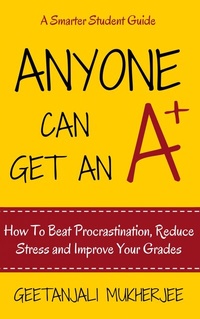
Anyone Can Get An A+
Description

Are you spending hours studying in the library, and still getting poor grades? Are you convinced that you are just not a 'math person' or 'science person'? Do you wish you could improve your grades to qualify for a particular course or scholarship? Do you need to ace your SAT, GRE or GMAT?
This book is written for students like you, who are struggling to get through a tough course, need to do well on a standardized test or just want to do well in school without spending all day in the library. Based on research from the fields of neuroscience and psychology, this conversational, down-to-earth guide is packed full of tips that can transform your study habits and help you significantly improve your grades, whether you are in high school or college or an adult returning to get your degree after a gap.
I highly recommend Anyone Can Get an A+ to every college student and any secondary student thinking about higher education. McNeil's Reviews
Practical and sound advice presented in a caring supportive manner. Sarah Jackson, Author and Reviewer
Anyone Can Get An A+ contains 39 tips on various aspects of studying and preparing for exams. In this book, you will learn:
• The best and worst techniques to revise for an exam
• What is the top mistake most students make when doing exam preparation and how to avoid it
• How to overcome procrastination and use your study time wisely
• How to break down larger assignments into smaller chunks
• How to write a paper painlessly
• How to use small segments of time effectively
• How to get help to understand difficult material
• How to do well in a subject even if you hate it
• How to improve your grades in quantitative subjects like mathematics
• How to organize your time and study schedule
• How to keep track of all your deadlines and school-related paperwork
Who this book is for:
• College students who want to learn how to juggle classes, extra-curricular activities, other activities and also have room for a social life
• High school students struggling with the pressure to get good grades to get into college, pass standardized tests and be eligible for scholarships
• Parents who are worried about how to help their children get better grades without overburdening them
• Teachers who want to understand how to help their students learn more deeply while enjoying their lessons
• Counselors and tutors who work directly with students, to better help motivate and inspire students to do their best
Anyone Can Get An A+ includes the following chapters:
Chapter 1: Adopting The Right Attitude
Chapter 2: Nourishing Your Mind and Body
Chapter 3: Organizing Your Study Life
Chapter 4: Getting The Most From Your Study Time
Chapter 5: Beating Procrastination
Chapter 6: Studying Effectively
Chapter 7: Tackling Difficult Subjects
Chapter 8: Revising For Exams
More details
Content
Tip #2
Don't Compare Yourself To Your Peers
A recent article in the New York Times describes how smart, talented and outwardly successful students are falling prey to depression and mental health issues, some even taking their own lives because they feel overwhelmed by the pressure to be perfect. According to an organization that spreads awareness about mental health issues among students, more than half of all college students have had suicidal thoughts, and 1 in 10 have seriously considered ending their life. Every year in the United States, approximately 1,100 college students commit suicide. These statistics are chilling, but what is worse is that they stem from feelings of isolation, of being alone, and of not being good enough compared to their peers. In an age when we are just a click away from knowing everything everyone is doing, we can't help but constantly compare ourselves to others and fall short in our own estimation.
All around us people are accomplishing incredible feats - starting companies, landing record deals, becoming internet celebrities. It's become pretty common to be intimidated by all the seemingly amazing things others can do, and to doubt ourselves. Sometimes it feels like anyone who isn't doing something out of the ordinary must be lacking in some way. In the New York Times article, the writer describes how a student contemplating suicide compared herself to her classmates and found herself lacking. "Friends' lives, as told through selfies, showed them having more fun, making more friends and going to better parties. Even the meals they posted to Instagram looked more delicious." Social media compounds our natural insecurities, showing us in glossy images and excited punctuation that exactly as we feared, those around us are living far more exciting and meaningful lives. And we start to think that this reflects poorly on us.
We compare ourselves to others, our friends and classmates. Someone loves to read books and aces every English test. Someone else is a math whiz, and never needs to study, just gets perfect grades. Maybe because some things seem so effortless for others, or maybe because we feel intimidated by seeing someone far more obviously talented than ourselves, we start to have this list of "Can't Dos", things that we think we simply cannot master, or things that someone else does so much better, so we think why should we even bother in the first place. We think we can't play the piano, or learn math, or act in a play. We decide that reading Shakespeare is beyond us, or that French grammar is just way too complicated to get the hang of. And we give up, before we even tried.
The thing is, though, we don't really know everything everyone is doing. We only see the perfect, happy, filtered images. We don't see the struggles and mistakes and sacrifices; we see the end product, the moment of happiness, the rare triumph. And from that we assume the rest - this person is happier, prettier, more successful, and by extension, we aren't good enough.
And make no mistake, most of us go to incredible lengths to preserve this image of perfection. When I was in high school, my peers would habitually exaggerate how hard they were working - telling me how they had already completed going over the syllabus several times, and how many hours they were studying. I believed them, and got nervous, and stepped up my own studying, thinking that the amount I was doing wasn't enough to pass the exams with good grades. I tried to imitate my classmates' habits, even though it was only much later that I realized that they hadn't exactly been telling me (or each other) the truth.
This peer pressure continued to affect me in college. Most of my classmates in my first year of college seemed to be focusing on partying and having a good time, bragging about how late they stayed out and how much they had to drink. Many turned up to classes perfectly attired and made-up, and I felt incredibly awkward and gauche in comparison. I was perpetually anxious that I was a social loser, because those around me seemed to have it all, and effortlessly. I may not have had their social ease, but I had come to college to expand my own horizons, and I did. I tried new things - acting in a play, singing in a rock gospel choir, briefly joining a Portuguese band for one memorable performance, and getting elected to office in the Student Union. The high school me would have been proud of all I achieved. But my college self, comparing myself to my peers, kept focusing on how I simply wasn't 'cool enough' or 'social enough'.
It's only much later that I realized how unproductive it was to compare myself with my peers - I came from a very different background, and I had different goals for my time there. I had already gone out of my comfort zone and accomplished a lot, and comparing to others only diminished that. As someone said, success isn't measured by what you achieve, it is measured by how far you have come from where you started.
When we look around us, or read about successful people, the primary message that comes across is how talented someone is, and how inevitable it was that they would succeed. Success is shown to us as a straight line, heading in one direction, up. There are no detours, no turn-arounds, no missteps allowed. Faced with intense competition for spots in top colleges, scholarships and jobs, in an increasingly less certain world, young people today face even greater pressure to have perfect resumes and transcripts. When you aren't allowed to fail, either due to the expectations of others or yourself, although it may seem like you are being pragmatic and focusing on how to succeed, you are actually making it that much harder for yourself.
In her influential book Mindset, renowned psychologist Carol Dweck describes research that shows that the way we approach learning makes a difference to how much we learn. Allow yourself to make mistakes, to stumble a little while you learn something new, and eventually, you can surpass someone who is incredibly bright but is too afraid to try something in which they might do badly and risk looking dumb. There are also some students who work hard, but put themselves under such intense pressure to succeed at all costs, they can end up burning out, or doing poorly simply because they succumbed to stress. In The Pursuit of Perfect, Harvard psychologist Professor Tal Ben-Shahar says that those with an overly perfectionist outlook have unrealistic ideas of success - believing that they can't afford to make any mistakes or show any weaknesses. They focus on the destination more than the journey. Someone who has a more realistic outlook on the other hand, sees failure as "an opportunity for receiving feedback. Because she isn't intensely afraid of failure, she can learn from it - when she fails at something, she.learns what set her back. She then tries again." Doing something badly then is how we learn to do something well.
Culturally, the message most of us receive is that those who don't seem to falter and have it all together, those who seem to effortlessly float from one success to another, those people are the ones to be admired and emulated. Not only do you admire, you expect the same from yourself and feel crushed or defeated when you can't make that happen. The problem with this sort of thinking is that ironically, your own success can cause you to feel even more like a failure. If you succeed in school in a particular sport, you feel great about yourself. You are one of the top sportspersons in your school, and you are fêted. Then you go to an inter-school tournament - where suddenly there are many others like you. Where you are just ordinary. If you believe that you have to be the best in every environment, if you look around at the others and feel inferior (the "fixed mindset"), then the tournament will be a very stressful environment. You might not ever want to attend another tournament, preferring to stay at school where you are still the best.
If on the other hand you approach sports with the "growth mindset" (see tip #1), you will go to the tournament excited about playing against others who are also quite good, and looking forward to all that you could learn. You would realize that while you aren't the best, you can probably improve with effort, and maybe try to get some pointers from watching or talking to the others. Maybe you work hard and do much better in the next tournament. You could apply this attitude to any aspect of your life.
And what about those who accomplish everything effortlessly? Well, maybe they aren't challenging themselves, and they only stick to those things they are good at. Maybe they too would like to try something new, but they are afraid of not being good enough right away, so they don't even allow themselves to try, preferring to stick only to things they can do smoothly.
Looking at peers and how they do things may not necessarily be optimal. A little friendly rivalry doesn't hurt; in fact it can actually spur you on. However, if comparing to others is pulling you down, it does more harm than good. The smartest strategy sometimes means simply ignoring the others completely and doing what works for you. Instead of comparing yourself to what others around you are doing, focus on what you can do, what you're good at, or what is possible for you. It's important to stretch yourself and try hard, but not to look at others and beat yourself up because you think you don't compare well. The years of being a student are short; they go by in a flash. Would you rather spend your time pursuing things that matter to you, things that you have always been curious to explore, things that you may not...
