

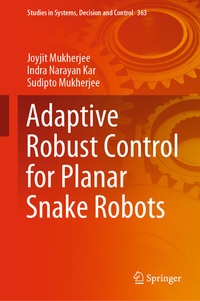
Adaptive Robust Control for Planar Snake Robots
Description

This book shows how a conventional multi-layered approach can be used to control a snake robot on a desired path while moving on a flat surface. To achieve robustness to unknown variations in surface conditions, it explores various adaptive robust control methods.
The authors propose a sliding-mode control approach designed to achieve robust maneuvering for bounded uncertainty with a known upper bound. The control is modified by addition of an adaptation law to alleviate the overestimation problem of the switching gain as well as to circumvent the requirement for knowledge regarding the bounds of uncertainty. The book works toward non-conservativeness, achieving efficient tracking in the presence of slowly varying uncertainties with a specially designed framework for time-delayed control. It shows readers how to extract superior performance from their snake robots with an approach that allows robustness toward bounded time-delayed estimation errors. The book also demonstrateshow the multi-layered control framework can be simplified by employing differential flatness for such a system. Finally, the mathematical model of a snake robot moving inside a uniform channel using only side-wall contact is discussed. The model has further been employed to demonstrate adaptive robust control design for such a motion.
Using numerous illustrations and tables, Adaptive Robust Control for Planar Snake Robots will interest researchers, practicing engineers and postgraduate students working in the field of robotics and control systems.
Reviews / Votes
"The book reports the recent progress in methods used to control planar snake robots, achieved by the authors. The book is well-written. It can be recommended to researchers, engineers and graduate students who are interested in robotics, automatic control, optimal control problems and their effective solutions." (Wieslaw Kotarski, zbMATH 1508.93005, 2023)More details
Other editions
Additional editions
Persons
Dr. Joyjit Mukherjee received his bachelor's degree in Electrical Engineering from National Institute of Technology (NIT) Durgapur in 2010, M.Tech. in Mechatronics & Robotics from Bengal Engineering & Science University (BESU, Now IIEST) in 2013, and his Ph.D. in Robotics & Control at the Department of Electrical Engineering, Indian Institute of Technology (IIT) in 2019. He worked as Research Associate in a JATC-DRDO project on Soft Exosuit at IIT Delhi from January to September 2019. Currently, he is working as Postdoc at the University of South Denmark on Digital Twins for Robotic Applications. His research interests include robotics, aerospace systems, time-delayed control, adaptive robust control, optimal control, differential flatness, human-robot interaction and digital twins.
Professor Indra Narayan Kar received his B.E. degree from Bengal Engineering College (Now IIEST, Shibpur) in 1988, and his M.Tech. and Ph.D. degrees from the Indian Institute of Technology Kanpur (IITK), India, in 1991 and 1997, respectively, all in Electrical Engineering. He was Research Student at Nihon University under the Japanese Government Monbusho Scholarship Program from 1996 to 1998. He joined the Department of Electrical Engineering, Indian Institute of Technology Delhi (IITD), in 1998, where, at present, he is working as Professor. He is presently working as Institute Chair Professor in the same department. His research interests include nonlinear control, time-delayed control, incremental stability analysis, cyber-physical system, application of control theory in power network and robotics. He has published more than 150 papers in international journals and conferences.
Professor Sudipto Mukherjee received his B.Tech degree from Indian Institute of Technology Kanpur (IITK), India, in 1985, and his M.S. and Ph.D. degrees from the Ohio State University (OSU), USA, in 1987 and 1992, respectively. He worked as Assistant Professor in the Department of MechanicalEngineering, Indian Institute of Technology Kanpur (IITK), from 1992 to 1996. He joined the Department of Mechanical Engineering, Indian Institute of Technology Delhi (IITD), in 1997. He is presently Ford Chair Professor in the same department. His research interests include mechanisms, robotics, mechanical system design and impact biomechanics.
