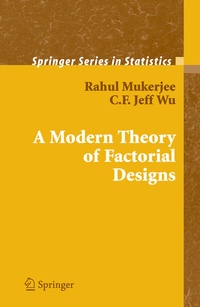
A Modern Theory of Factorial Design
Description

Factorial design plays a fundamental role in efficient and economic experimentation with multiple input variables and is extremely popular in various fields of application, including engineering, agriculture, medicine and life sciences. Factorial experiments are often used in case studies in quality management and Design for Six Sigma (DFSS). The last twenty years have witnessed a significant growth of interest in optimal factorial designs, under possible model uncertainty, via the minimum aberration and related criteria. The present book gives, for the first time in book form, a comprehensive and up-to-date account of this modern theory. Many major classes of designs are covered in the book. While maintaining a high level of mathematical rigor, it also provides extensive design tables for research and practical purposes. In order to equip the readers with the necessary background, some foundational concepts and results are developed in Chapter 2. Apart from being useful to researchers and practitioners, the book can form the core of a graduate level course in experimental design. It can also be used for courses in combinatorial designs or combinatorial mathematics.
Reviews / Votes
From the reviews:
"Minimum aberration (shortened to MA in this text) is a central feature in this excellent monograph, and the authors' stated intentions of 'providing a comprehensive account of the modern theory of factorial designs with the NMA appraoch at its core' (p. 4) are fully achieved." N.R. Draper for Short Book Reviews of the ISI, December 2006
"This book provides a unified summary of current research on the assessment through optimality criteria and construction methods for factorial and fractional factorial designs. ...[I]t contains excellent insights into this important class of desings." Christine Anderson-Cook, JASA, Vol. 102, No. 478, June 2007
"This book covers the theory of selecting minimum aberration factorial designs. . The book will serve as a great text for an advanced graduate level course in design theory for students . . The book will surely become an invaluable resource for researchers and graduate students doing research . . In addition, practitioners will also find the book useful . . Overall, this is a very well written book and a necessary addition to the existing literature on the design of factorial experiments." (Jason Loeppky, Technometrics, Vol. 49 (3), August, 2007)
"This book presents the modern theory of regular fractional factorial designs and is written by two leading experts in the field. It is intended for researchers, but practitioners will find useful the many tables of designs that are included. . This book is invaluable for someone who wants to understand this literature. Because the authors and their students are responsible for much of this literature, the book should be of great interest to anyone involved in research in this area." (William I. Notz, Mathematical Reviews, Issue 2007e)
More details
Other editions
Additional editions