
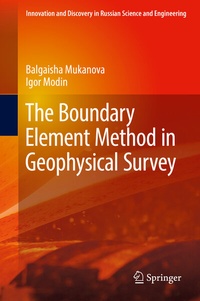
The Boundary Element Method in Geophysical Survey
Description
Alles über E-Books | Antworten auf Fragen rund um E-Books, Kopierschutz und Dateiformate finden Sie in unserem Info- & Hilfebereich.
This volume is devoted to the application of the integral equations method (IEM) and boundary elements method (BEM) to problems involving the sounding of geological media using direct current (DC). Adaptive mesh generation algorithms and numerical methods for solving a system of integral equations are discussed. Integral equations for the media, which contains piecewise linear contact boundaries, immersed local inclusions, and subsurface relief, are derived and solved numerically. Both 2.5D and 3D models with ground surface relief are considered. For 2D conductivity distributions, the influence of the relief on the interpretation of results is shown. Search solutions of the direct problem with ground surface relief are compared using the appropriate interpretation of results based on different inversion programs.
More details
Other editions
Additional editions
Persons
Dr. Balgaisha Mukanova is a Doctor of Mathematics and Physical Sciences, Professor at L.N. Gumilyov Eurasian National University, the Faculty of Mathematics and Mechanics, Astana, Kazakhstan.
Dr. Igor Modin is a Doctor of Technical Sciences, Professor at Lomonosov's Moscow State University, the Geological Faculty, Moscow, Russia.

Content
System requirements
File format: PDF
Copy protection: Watermark-DRM (Digital Rights Management)
System requirements:
- Computer (Windows; MacOS X; Linux): Use the free software Adobe Reader, Adobe Digital Editions, or any other PDF viewer of your choice (see eBook Help).
- Tablet/Smartphone (Android; iOS): Install the free app Adobe Digital Editions or another reading app for eBooks, e.g., PocketBook (see eBook Help).
- E-reader: Bookeen, Kobo, Pocketbook, Sony, Tolino and many more (only limited: Kindle).
The file format PDF always displays a book page identically on any hardware. This makes PDF suitable for complex layouts such as those used in textbooks and reference books (images, tables, columns, footnotes). Unfortunately, on the small screens of e-readers or smartphones, PDFs are rather annoying, requiring too much scrolling.
This eBook uses Watermark-DRM, a „soft” copy protection. This means that there are no technical restrictions to prevent illegal distribution. However, there is a personalised watermark embedded in the eBook that can be used to identify the purchaser of the eBook in the event of misuse and to provide evidence for legal purposes.
For more information, see our eBook Help page.