

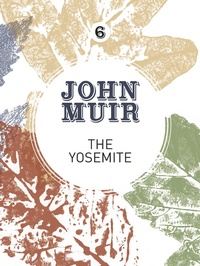
The Yosemite
Description

'All these colours, from the blue sky to the yellow valley smoothly blending as they do in a rainbow, making a wall of light ineffably fine.'
Having spent significant time obsessively exploring and learning about the Sierra, John Muir's passion for and belief in preserving the wilderness steadily grew. He believed that excessive grazing and logging would result in its eventual destruction, and so campaigned to designate the area as a protected national park.
In 1890, the US Congress passed the National Park Bill, and the Yosemite and Sequoia national parks were established. At the time of writing, Muir's views on conservation of the wilderness were totally radical; today, environmental activists are too often brushed aside in favour of something faster, easier, and cheaper.
Muir not only educates us in the particulars of the botanicals of this spectacular landscape, but also inadvertently traps us in his web of enthusiasm for the beauty and significance of Mother Nature. The Yosemite gives us the tools to construct a detailed mental map of the Sierra, and leaves us with the resolution to be more compassionate and environmentally mindful.
First published in 1912, and with a new introduction from Muir authority Terry Gifford, the message in The Yosemite is perhaps more pertinent now than it ever was. There is a lot to thank Muir for, not least opening our eyes to the earth beneath our feet.
More details
Other editions
Additional editions
Person
Born in 1838, John Muir was a Scottish-American naturalist, author, environmental philosopher and ahead-of-his-time advocate of preservation of wilderness in the United States.
Muir's works tell of his adventures in nature, especially in the Sierra Nevada of California. His activism helped to preserve the Yosemite Valley, Sequoia National Park and other exquisite wilderness areas.
He founded The Sierra Club, and petitioned the US Congress for the National Park bill that was passed in 1890, establishing Yosemite National Park. The 211-mile John Muir Trail - a hiking trail in the Sierra Nevada - was named in his honour, as was the John Muir Way in Scotland, and many other places including a beach, college and glacier.
Muir married Louisa Strentzel and they had two daughters together, living on a fruit orchard in California. Today he is referred to as the 'Father of the National Parks' and has a legacy as one of the most influential naturalists in America.
Content
- Intro
- Contents
- Series Introduction
- Foreword by Terry Gifford
- Chapter 1: The Approach to the Valley
- Chapter 2: Winter Storms and Spring Floods
- Chapter 3: Snowstorms
- Chapter 4: Snow Banners
- Chapter 5: The Trees of the Valley
- Chapter 6: The Forest Trees in General
- Chapter 7: The Big Trees
- Chapter 8: The Flowers
- Chapter 9: The Birds
- Chapter 10: The South Dome
- Chapter 11: The Ancient Yosemite Glaciers: How the Valley was Formed
- Chapter 12: How Best to Spend One's Yosemite Time
- Chapter 13: Lamon
- Chapter 14: Galen Clark
- Chapter 15: Hetch Hetchy Valley
- Photographs
