

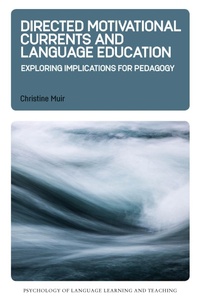
Directed Motivational Currents and Language Education
Exploring Implications for Pedagogy
Published on 17. September 2020
200 pages
978-1-78892-887-8 (ISBN)
Description

Directed motivational currents (DMCs) are goal-directed motivational surges in pursuit of a much-desired personal outcome. This book introduces the reader to cutting-edge theory and research in second language learner motivation and presents empirical research which investigates DMCs in the context of language learning. The studies explore the wider relevance of DMC theory from participants recruited worldwide, answering questions such as how many (and which) participants reported having experienced DMCs and what emerged as common triggers initiating such experiences. The studies also discuss the pedagogical implications of DMC theory, investigating whether it is possible to design and implement a project (specifically, a project 'with DMC potential') in such a way that it may be able to purposefully facilitate a group-DMC with learners in a second language classroom. The book's accessible writing style makes it suitable for researchers and students who are interested in second language learning as well as for teachers and trainee teachers who are looking for classroom inspiration.
Reviews / Votes
Motivational currents are intriguing phenomena - once you've experienced one you'll never forget it. This book shows how these surges of motivational energy can be harnessed in the language classroom to boost learning. The author's findings leave no doubt about the potential value of DMCs in the language learning process. This is SLA research at its most scholarly and most applied! * Zoltan Doernyei, University of Nottingham, UK * Amidst an emergent trend towards complex understandings of L2 learner psychology, this anticipated work not only suggests that DMCs are a widespread phenomenon, but that inclusion of student and teacher voices furnishes animated insight into their dynamic experience. In particular, Muir's focus on such intense motivation in the context of group projects will be highly valued by researchers and educational practitioners alike. * Richard J. Sampson, Rikkyo University, Japan * The DMC is one of those genuinely original concepts which makes intuitive good sense and one wonders 'why didn't I think of that?' As Muir argues in this compelling book, it now deserves the focused attention of language educators, so it can be further validated through research, engendered in teaching and perhaps even personally experienced. * Martin Lamb, University of Leeds, UK * Muir's research is prodigious, and there are many things to admire about the book; however, the three major reasons that this book is worth reading are the following. Firstly, this book exemplifies the utilization of the quantitative research method on DMC, which breaks the domination of qualitative methods in this field in the past [...] Secondly, the book contributes to the exploration of conducting intervention studies to trigger and maintain students' group DMC in classroom contexts-the underexplored and key topic of DMC [...] Thirdly, this book inspires us to explore some possible topics for future DMC research. -- Lixiang Gao, Xu Yang and Honggang Liu, Northeast Normal University, China * Frontiers in Psychology, Vol 11, November 2020 * The volume is an excellent, thought-provoking read and I recommend it to anyone interested in making L2 instruction more effective, whether they are researchers, teacher trainers, materials writes, or pre-service and in-service teachers. -- Miroslaw Pawlak Adam Mickiewicz University, Poland * SSLLT 10 (4) 2020 * Muir has successfully presented not only an organised and efficient foundational basis for key concepts of DMCs for novice readers, but has also provided concise descriptions for readers more familiar with the topic. The book is suitable for L2 learners and researchers who are interested in L2 language-learning motivation, and for teachers who are seeking activities to boost motivation within the classroom. -- Alfaf Albakistani, Birkbeck, University of London, UK * LINGUIST List 32.2218 *More details
Series
Language
English
Place of publication
Bristol
United Kingdom
Target group
College/higher education
Product notice
Reflowable
Dimensions
Height: 234 mm
Width: 156 mm
ISBN-13
978-1-78892-887-8 (9781788928878)
Copyright in bibliographic data and cover images is held by Nielsen Book Services Limited or by the publishers or by their respective licensors: all rights reserved.
Schweitzer Classification
Other editions
Additional editions
Christine Muir
Directed Motivational Currents and Language Education
Exploring Implications for Pedagogy
Book
09/2020
Multilingual Matters
€56.10
Shipment within 3-4 weeks
Person
Christine Muir is an Assistant Professor in Second Language Acquisition at the University of Nottingham, UK. Her research interests include language learner motivation, the self in language learning, language learner psychology, language learner narratives and narrative identity.
Content
Foreword
Section One. Introducing DMCs and Intensive Group Projects
Chapter One. Key Threads in the Field L2 Motivation Research and the Emergence of Directed Motivational Currents
Chapter Two. What Exactly is a DMC? Key Definitions and Core Characteristics
Chapter Three. DMCs in the L2 Classroom: Group-DMCs and Intensive Group Projects ('with DMC Potential')
Section Two. DMCs Worldwide: A Truly Global Phenomenon?
Chapter Four. Section Two Methodology
Chapter Five. First Look Results: Investigating the Wider Relevance and Recognisability of DMCs
Chapter Six. Exploring Commonly Reported Triggers & the Experience of DMCs
Section Three. From Theory to Application: Group-DMCs in the L2 Classroom
Chapter Seven. Section Three Methodology
Chapter Eight. Group-DMC Emergence: Assessing the Evidence
Chapter Nine. Intensive Group Projects 'with DMC Potential': Refining the Key Criteria for Success
Section Four. The Future of DMC Research
Chapter Ten. Revisiting the Seven Frameworks for Focused Interventions & the Future of DMC Research
Afterword
Section One. Introducing DMCs and Intensive Group Projects
Chapter One. Key Threads in the Field L2 Motivation Research and the Emergence of Directed Motivational Currents
Chapter Two. What Exactly is a DMC? Key Definitions and Core Characteristics
Chapter Three. DMCs in the L2 Classroom: Group-DMCs and Intensive Group Projects ('with DMC Potential')
Section Two. DMCs Worldwide: A Truly Global Phenomenon?
Chapter Four. Section Two Methodology
Chapter Five. First Look Results: Investigating the Wider Relevance and Recognisability of DMCs
Chapter Six. Exploring Commonly Reported Triggers & the Experience of DMCs
Section Three. From Theory to Application: Group-DMCs in the L2 Classroom
Chapter Seven. Section Three Methodology
Chapter Eight. Group-DMC Emergence: Assessing the Evidence
Chapter Nine. Intensive Group Projects 'with DMC Potential': Refining the Key Criteria for Success
Section Four. The Future of DMC Research
Chapter Ten. Revisiting the Seven Frameworks for Focused Interventions & the Future of DMC Research
Afterword
