

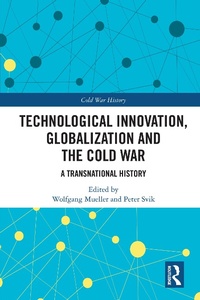
Technological Innovation, Globalization and the Cold War
A Transnational History
1st Edition
Published on 24. November 2022
268 pages
978-1-000-78501-2 (ISBN)
Description

This volume focuses on the interconnections between the Cold War, technological innovation and globalization.
Although the consequences of globalization have received ample attention in both academia and the public discourse, only limited attention has so far been given to the factors that instigated various waves of this process. This holds particularly true for the period following World War II, during which a struggle between the two global blocs fanned not only technological innovations but also their transfer. This volume is dedicated to examining the links between the Cold War and this phase in the history of globalization, a phase that gradually made the world-despite high levels of international tension-more and more inter-related. More specifically, it anchors a very contemporary phenomenon to its historical context and pinpoints how the varied and multi-layered East-West interactions helped to induce and foster the globalization processes. Emphasizing technology and its cross-bloc flows, as well as several levels of actors, including states, private companies, and individuals, this volume reflects an important shift towards "transnationalism" which has occurred in the historiography in the recent years.
This book will be of interest to students of Cold War Studies, science and technology studies, and International Relations.
Although the consequences of globalization have received ample attention in both academia and the public discourse, only limited attention has so far been given to the factors that instigated various waves of this process. This holds particularly true for the period following World War II, during which a struggle between the two global blocs fanned not only technological innovations but also their transfer. This volume is dedicated to examining the links between the Cold War and this phase in the history of globalization, a phase that gradually made the world-despite high levels of international tension-more and more inter-related. More specifically, it anchors a very contemporary phenomenon to its historical context and pinpoints how the varied and multi-layered East-West interactions helped to induce and foster the globalization processes. Emphasizing technology and its cross-bloc flows, as well as several levels of actors, including states, private companies, and individuals, this volume reflects an important shift towards "transnationalism" which has occurred in the historiography in the recent years.
This book will be of interest to students of Cold War Studies, science and technology studies, and International Relations.
Reviews / Votes
'An excellent introduction to cutting edge historical work. Development and deployment of technology were essential to the conduct of the Cold War, and this volume shows how innovation and technological globalization transformed politics and economics with effects lasting up to our own time.'Odd Arne Westad, author of The Cold War: A World History
'The process of globalization and the technological changes that spawned it were heavily influenced by the Cold War. The essays edited by Peter Svik and Wolfgang Mueller shed valuable light on this complex topic, showing how the competitive and cooperative elements of the Cold War shaped the globalized world we live in today. Globalization would have happened even if there had been no Cold War, but this book helps us understand how the Cold War sped up that process and gave it its particular form. '
Mark Kramer, Harvard University, USA
'This important Wolfgang Mueller and Peter Svik edited volume on "technopolitics" during the Cold War explores an unfortunately little known, but crucial dimension of the international history of relations between the communist world and the West. Using cutting-edge archival research, the international team of authors bring a series of fascinating case studies to the attention of Cold War historiography that illuminate the dynamics of technology transfer, East-West relations, and superpower competition.'
Norman M. Naimark, Stanford University, USA
More details
Series
Edition
1. Auflage
Language
English
Place of publication
London
United Kingdom
Publishing group
Taylor & Francis Ltd
Target group
College/higher education
Product notice
Reflowable
ISBN-13
978-1-000-78501-2 (9781000785012)
Copyright in bibliographic data and cover images is held by Nielsen Book Services Limited or by the publishers or by their respective licensors: all rights reserved.
Schweitzer Classification
Other editions
Additional editions
Wolfgang Mueller | Peter Svik
Technological Innovation, Globalization and the Cold War
A Transnational History
Book
05/2024
1st Edition
Routledge
€63.50
Shipment within 10-20 days
Wolfgang Mueller | Peter Svik
Technological Innovation, Globalization and the Cold War
A Transnational History
Book
11/2022
1st Edition
Routledge
€186.30
Shipment within 10-20 days
Persons
Wolfgang Mueller is professor of Russian history at the University of Vienna.
Peter Svik is Schroedinger fellow at the University of Vienna and Graduate Institute for International Studies in Geneva.
Peter Svik is Schroedinger fellow at the University of Vienna and Graduate Institute for International Studies in Geneva.
Content
Introduction Part I: Macrostructures and Superpowers 1. Cold War-Technological Innovation-Globalization: A Case Study of the Civil Aviation Sector 2. US and Chinese Discourses on Science in the People's Republic of China, 1971-1978 3. The Second World's "Technopolitics" in the Third World: Cold War and Global Challenges of Modernity in 1960s-1970s 4. Technology Transformation During the Cold War: The Case of Supersonic Gas Jet Targets at the National Accelerator Laboratory Part II: Agency of Smaller States 5. The Transnational Making of China's Industrial Economy in the Early Cold War, 1949-1957 6. Finnish Icebreaker Diplomacy in the Cold War: Ships of Security, Prestige, and Welfare 7. The West German Energy Dilemma and Soviet Natural Gas Part III: From Air Age to Space Age 8. The 1963 "Interflung Affair" and the Cold War: Civil Aviation between Austria and East Germany 9. Anglo-Romanian Cooperation in Civil Aircraft Production: The Case of the Rombac Airliner, 1976-1993 10. The Evolution of US Space Weapons during the Cold War Afterword
