

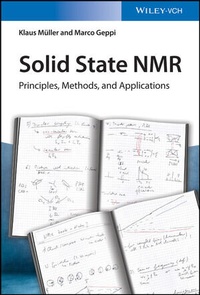
Solid State NMR
Principles, Methods, and Applications
1st Edition
Published on 18. June 2021
560 pages
978-3-527-69010-7 (ISBN)
Description

In one didactically uniform volume, this book covers experimental equipment and methodological concepts while providing numerous examples in biomaterials, polymers and inorganic substances. The topics covered range from theoretical background knowledge to practical applications and solutions. The whole is rounded off by a glossary, literature and a summary at the end of the chapters, making this a handy textbook for postgraduate courses.
More details
Other editions
Additional editions
Book
07/2021
1st Edition
Wiley-VCH
€115.00
Shipment within 5-7 days
Persons
Marco Geppi graduated in chemistry at the Scuola Normale Superiore of Pisa on the topic "Study of polymeric materials by means of solid state NMR". His further research activities brought him to Italian CNR (Dr. C. Forte), and the University of Durham, UK (Prof. R.K. Harris). Since 2001 he is researcher and lecturer in Physical Chemistry at the Department of Chemistry and Industrial Chemistry of the University of Pisa, where he leads the Solid-State NMR group.
Klaus Müller graduated in Chemistry at the University of Freiburg. After completion of the PhD thesis in physical chemistry at the University of Stuttgart, he went for a postdoctoral stay to the Weizmann Institute of Science, Rehovot/Israel (Dept. of Chemical Physics). He returned to the University of Stuttgart, and - upon completing his habilitation - became professor in Physical Chemistry. His main research activities were applications of solid-state NMR techniques for the characterization of different types of materials. Unexpectedly, he died in April 2011.
Klaus Müller graduated in Chemistry at the University of Freiburg. After completion of the PhD thesis in physical chemistry at the University of Stuttgart, he went for a postdoctoral stay to the Weizmann Institute of Science, Rehovot/Israel (Dept. of Chemical Physics). He returned to the University of Stuttgart, and - upon completing his habilitation - became professor in Physical Chemistry. His main research activities were applications of solid-state NMR techniques for the characterization of different types of materials. Unexpectedly, he died in April 2011.
Content
1. Introductory NMR concepts
1.1 Historical aspects
1.2 Basic Description of NMR Spectroscopy
1.3 Liquid-state NMR Spectroscopy: basic concepts
1.4 Liquid-state NMR Spectroscopy: some experiments
1.5 Solid Materials and NMR Spectroscopy
2. Mathematical and Quantum-Mechanical Tools
2.1 Definitions and basic concepts
2.2 Rotations and frame transformations
2.3 Time-independent features: energy levels and related aspects
2.4 Dealing with time-dependence
3. Nuclear Spin Interactions
3.1 Introduction
3.2 Interaction with external magnetic fields
3.3 Internal Interactions
4. Broadline NMR Spectroscopy
4.1 Introductory remarks
4.2 Finite pulse duration and adiabatic pulses
4.3 Inhomogeneous and homogeneous interactions/line broadening mechanisms
4.4 Dilute spin-½ nuclei
4.5 Abundant Spin-½ Nuclei
4.6 Quadrupolar nuclei
5. 1D high resolution solid-state NMR Spectroscopy
5.1 Dilute Spin-½ Nuclei
5.2 Abundant Spin-½ Nuclei
5.3 Quadrupolar Nuclei
6. 2D solid-state NMR Spectroscopy
6.1 Basic concepts
6.2 Experiments based on chemical shift anisotropy
6.3 Experiments based on heteronuclear dipolar coupling
6.4 Experiments based on homonuclear dipolar coupling
6.5 Experiments based on J-coupling
6.6 Experiments based on quadrupolar interaction
7. Molecular dynamics by solid state NMR
7.1 Experimental observables
7.2 Motional models
7.3 Broadline experiments
7.4 High resolution experiments
8. Application of SSNMR to selected classes of systems
8.1 Pharmaceuticals
8.2 Polymeric materials
8.3 Inorganic and organic-inorganic materials
8.4 Liquid crystals and model membranes
1.1 Historical aspects
1.2 Basic Description of NMR Spectroscopy
1.3 Liquid-state NMR Spectroscopy: basic concepts
1.4 Liquid-state NMR Spectroscopy: some experiments
1.5 Solid Materials and NMR Spectroscopy
2. Mathematical and Quantum-Mechanical Tools
2.1 Definitions and basic concepts
2.2 Rotations and frame transformations
2.3 Time-independent features: energy levels and related aspects
2.4 Dealing with time-dependence
3. Nuclear Spin Interactions
3.1 Introduction
3.2 Interaction with external magnetic fields
3.3 Internal Interactions
4. Broadline NMR Spectroscopy
4.1 Introductory remarks
4.2 Finite pulse duration and adiabatic pulses
4.3 Inhomogeneous and homogeneous interactions/line broadening mechanisms
4.4 Dilute spin-½ nuclei
4.5 Abundant Spin-½ Nuclei
4.6 Quadrupolar nuclei
5. 1D high resolution solid-state NMR Spectroscopy
5.1 Dilute Spin-½ Nuclei
5.2 Abundant Spin-½ Nuclei
5.3 Quadrupolar Nuclei
6. 2D solid-state NMR Spectroscopy
6.1 Basic concepts
6.2 Experiments based on chemical shift anisotropy
6.3 Experiments based on heteronuclear dipolar coupling
6.4 Experiments based on homonuclear dipolar coupling
6.5 Experiments based on J-coupling
6.6 Experiments based on quadrupolar interaction
7. Molecular dynamics by solid state NMR
7.1 Experimental observables
7.2 Motional models
7.3 Broadline experiments
7.4 High resolution experiments
8. Application of SSNMR to selected classes of systems
8.1 Pharmaceuticals
8.2 Polymeric materials
8.3 Inorganic and organic-inorganic materials
8.4 Liquid crystals and model membranes
