

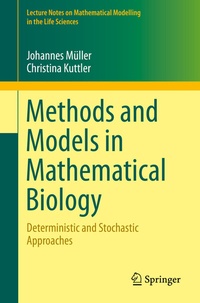
Methods and Models in Mathematical Biology
Description

This book developed from classes in mathematical biology taught by the authors over several years at the Technische Universität München. The main themes are modeling principles, mathematical principles for the analysis of these models and model-based analysis of data. The key topics of modern biomathematics are covered: ecology, epidemiology, biochemistry, regulatory networks, neuronal networks and population genetics. A variety of mathematical methods are introduced, ranging from ordinary and partial differential equations to stochastic graph theory and branching processes. A special emphasis is placed on the interplay between stochastic and deterministic models.
Reviews / Votes
"This extensive textbook provides an introduction to the most important mathematical tools and models used in mathematical biology. . Each section is supplemented with exercises and each chapter has an appendix with the solutions to the exercises . . The book concludes with an extensive bibliography and is well suited as an introduction to the subject for graduate students with a strong mathematics background and for researchers." (W. Huyer, Monatshefte für Mathematik, Vol. 186 (3), 2018)"The core of the book is based on a two-semester graduate course on the mathematical modeling of biological systems. In my opinion, the book is targeted at graduate students with a strong mathematics background. . The book has a very nice diversity of topics in biology and applied dynamical systems. . There is a nice bank of exercises, at the right level for first to second year graduate students." (Zachary P. Kilpatrick, SIAM Review, Vol. 59 (1), March, 2017)
More details
Other editions
Additional editions
Persons
Johannes Müller's research interest lies in the interface of mathematics and life sciences. In particular his research is concerned with the theory and biological applications of dynamical systems and branching processes. He studied in Karlsruhe and Tübingen, where he completed his habilitation in 2001. After stays in Utrecht and Cologne, he became head of a research group at the Institute for Biomathematics and Biometry at the Helmholtz Center, Munich. He has been appointed as a professor at the Technische Universität München (2004), where he is responsible for the masters program "Mathematics in Biosciences".
Christina Kuttler is a professor at the Technical University Munich, her work focusing on "Mathematics in Life Sciences". She previously worked at the University of Tübingen and at the Helmholtz Center Munich, Institute for Biomathematics and Biometry, as part of the interdisciplinary project on molecular interactions in the rhizosphere. Her main expertise is inthe field of biomathematics, particularly the mathematical modelling of biological processes using ordinary and partial differential equations. A main project deals with the modelling of bacterial communications, in which intracellular regulation mechanisms and diffusion processes are considered. Her primary goal is a better understanding of the underlying mechanisms and provide a quantitative description.
Content
1.Compartmental Modelling.- 2.Mathematical Ecology.- 3.Structured Models in Ecology.- 4.Epidemiology.- 5.Reaction Kinetics.- 6.Neuronal Activity.- 7.Evolution.- Index.
