

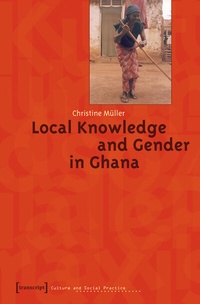
Local Knowledge and Gender in Ghana
1st Edition
Published on 15. July 2015
208 pages
978-3-8394-0378-5 (ISBN)
Description

The emergence of global knowledge societies is recently questioning the meaning and relevance of local knowledge in the context of Southern countries. Women have proved to be the central actors in the multiple channels of local-global networking, using these new social ties for the negotiation of old and new elements of knowledge, scientific knowledge and development discourses. The inherent politicisation of knowledge and the direct objective of transforming societal institutions are not only signs of resistance against global hegemony, but serve for a new definition and for a defence of local culture and of local knowledge.
More details
Other editions
Additional editions
Christine Müller
Local Knowledge and Gender in Ghana
Book
10/2005
1st Edition
transcript
€26.80
Article exhausted; check different version
Person
Christine Müller (Dr. rer. soc.) has recently become a scientific transmigrant being a Post-Doc at National Centre of Competence in Research North-South (NCCR North-South), University of Berne (Switzerland), and a lecturer at Sociology of Development Research Centre, University of Bielefeld (Germany). She has switched her research focus on virtual governance in Southern Africa and South East Asia.
Content
- Cover Local Knowledge and Gender in Ghana
- CONTENTS
- 1. Knowledge between Globalization and Localization
- 1.1 Introduction
- 1.2 The Emergence of the World-Wide Women's Web
- 1.2.1 The "Discovery" of Women for Development
- 1.2.2 UN Conferences as Vehicles of Movements
- 1.3 Global and Cross-National Networking
- 2. Doing Research and Writing Wor(l)ds
- 2.1 Setting of Research
- 2.2 The Interview Partners and Situations
- 2.3 From the Process of Fieldwork to the Process of Writing: Politics, Representation and Reflexivity
- 3. Conceptualising Local Knowledge
- 3.1 Agency-Orientation in Sociology of Knowledge
- 3.2 The Concept of Space/Time and Empirical Operationalisation
- 3.3 Research as an Explorative Process
- 3.4 Methods: Chances and Limitations
- 4. Knowledge Transfer over Generations:Continuity and Change
- 4.1 The Old Generation: "The young ones will not listen"
- 4.2 The Process of Knowledge Generation
- 4.3 The Mediation of Knowledge: Symbolic Spaces and Practices in the Everyday World
- 4.3.1 "At first there were gods in town"
- 4.3.2 "To drive the sickness out of town"
- 4.3.3 Worshipping at the River Susuan
- 4.3.4 Symbolic Spaces in Transition
- 4.4 The Young Generation: "Nowadays we are Christians"
- 4.4.1 Different Strategies in the Process of Knowledge Generation
- 4.4.1.1 The "traditional" type: Afia
- 4.4.1.2 The "mixed" type: Kofi
- 4.4.1.3 The "educated" type: Akosua
- 4.4.2 The Meaning of Formal Education
- 4.5 The Emergence of Ambivalences in Gendered Relations
- 5. "Traditional" Institutions as Arenas of Knowledge Struggle
- 5.1 Asymmetries within "Traditional" Institutions
- 5.1.1 The Queenmother's Dilemma
- 5.1.2 Loss within the Political Spaces: From "Complementarity" to Asymmetry
- 5.2 Challenging of Spaces: The Subqueenmothers
- 5.2.1 "We are not too shy": The Long Way to the Palace...
- 5.2.2 ...and how to get into the Palace
- 5.3 Discourse about Political Spaces: "Due to Beijing"
- 5.3.1 The Negotiation of Tradition "They want us to live like in ancient times"
- 5.3.2 Creation of New Spaces: The Queenmothers'association
- 5.3.3 Moving in Different Spaces: Nana Ama Serwaa
- 5.3.4 Self-Organization: Female Economy, Social Security and Public Sphere
- 5.4 The Knowledge Pillars
- 6. Social Networking between Women's Organizations
- 6.1 The Women's Forum at Sunyani: A Platform for Change
- 6.1.1 Organising Development: The National Council of Women and Development
- 6.1.2 The Women's Forum at Accra: Another Platform for Change
- 6.1.3 The Organizational Structure of the NCWD
- 6.2 The Pan-African Network Women in Law and Development Africa (WiLDAF)
- 6.2.1 Initiating WiLDAF: From Local Realities to Transnational Networking
- 6.2.2 The Organizational Structure: Struggling for Power on the Ground
- 6.2.3 WILDAF 1999: Backwards and Forwards
- 6.2.4 ...and from Transnational Networking back to Local Reality
- 6.3 Networking as a Knowledge Bridge
- 7. The Migrating Knowledge
- 7.1 Becoming a 31st December Woman
- 7.2 Every Human Being is a Political Person
- 7.3 Women doing Development
- 8. Decentralised Political Institutions: Knowledge between Bureaucratising and Lobbying
- 8.1 Processes of Decentralisation
- 8.2 The Unit Committee Council in Susuanso
- 8.3 The District Assembly Man: Linking Politics
- 8.4 The District Assembly
- 8.4.1 Planning Development-Development Planning
- 8.4.2 The Policy of the District Assembly
- 8.5 Planning at Regional Level
- 8.6 Reflecting on Women's Organizations: Changing Gender Ideologies ?
- 8.7 De-bureaucratising Development Knowledge
- 9. Glocalised Practices: Towards a Knowledge Society
- Bibliography
- Homepages: Web Addresses
- List of Abbreviations
