

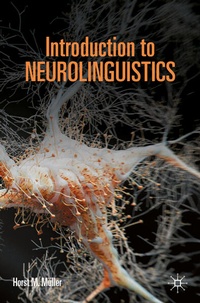
Introduction to Neurolinguistics
Description

This accessibly-written textbook introduces and explains the central research areas and core topics of neurolinguistics. It presents fundamental findings, relevant theories and models as well as current research methods for investigating the processing of language in the brain. The subjects covered range from psycholinguistics, brain imaging and clinical linguistics to experimental neurolinguistics. Structured into 14 clear and logical learning units, this textbook will be an invaluable resource for courses in linguistics, cognitive science and cognitive neuroscience.
More details
Other editions
Additional editions
Person
Horst M. Müller is Professor (ret.) and Head of the Experimental Neurolinguistics Group at Bielefeld University and at the Center of Cognitive Interaction Technology (CITEC), Germany. He holds degrees and PhDs in Neurobiology and Linguistics and is author/editor of numerous publications in both fields of research. Several research stays, e.g. at the University of California at San Diego, USA and the Center for Brain Research at the Medical University of Vienna, Austria.
Content
Chapter 1: Language as a research area in linguistics, psychology and neuroscience.- Chapter 2: Models of language processing.- Chapter 3: Word processing and the mental lexicon.- Chapter 4: Children's language acquisition.- Chapter 5: Multilingualism and neurocognitive disorders of language development.- Chapter 6: Specialization of the hemispheres - Language lateralization.- Chapter 7: Acquired language disorders due to brain damage.- Chapter 8: Language processing: Measuring behavioral performance and reaction time.- Chapter 9: Clinical studies on the functional neuroanatomy of language.- Chapter 10: Non-invasive electrophysiological methods.- Chapter 11: Language processing: Insights into the working brain.- Chapter 12: Brain metabolism and cognition: Cerebral blood flow measurement and metabolic methods.- Chapter 13: Language as a function of transient oscillatory interacting neuronal networks.- Chapter 14: Aspects of the history and the theory of science on the question of brain function.
