

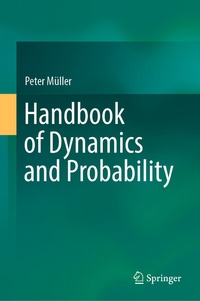
Handbook of Dynamics and Probability
Description

Our time is characterized by an explosive growth in the use of ever more complicated and sophisticated (computer) models. These models rely on dynamical systems theory for the interpretation of their results and on probability theory for the quantification of their uncertainties. A conscientious and intelligent use of these models requires that both these theories are properly understood.
This book is to provide such understanding. It gives a unifying treatment of dynamical systems theory and probability theory. It covers the basic concepts and statements of these theories, their interrelations, and their applications to scientific reasoning and physics. The book stresses the underlying concepts and mathematical structures but is written in a simple and illuminating manner without sacrificing too much mathematical rigor.
The book is aimed at students, post-docs, and researchers in the applied sciences who aspire to better understand the conceptual and mathematical underpinnings of the models that they use. Despite the peculiarities of any applied science, dynamics and probability are the common and indispensable tools in any modeling effort. The book is self-contained, with many technical aspects covered in appendices, but does require some basic knowledge in analysis, linear algebra, and physics.
Peter Müller, now a professor emeritus at the University of Hawaii, has worked extensively on ocean and climate models and the foundations of complex system theories.
Reviews / Votes
"A handbook of critically important mathematical concepts with broad utility in the applied and social sciences as well as pure sciences. Due to its applicability to a variety of disciplines this volume will likely see use in a wide array of academic institutions." (Ninah Moore, RUSA Update, rusaupdate.org, January 29, 2023)"This book emphasizes the conceptual and foundational aspects of dynamics and probability. It tries to present these aspects as simply as possible without losing too much mathematical rigor. Some required mathematics is summarized in appendices, which is to provide quick access to a perhaps forgotten definition or theorem . ." (N. N. Ganikhodjaev, Mathematical Reviews, November, 2022)
More details
Other editions
Additional editions
Person
Content
Introduction.- I Dynamics.- Deterministic dynamical systems.- Linear and integrable systems.- Stability and long-time behavior.- Ergodic theory.- Numerical Algorithms.- II Probability.- Probability Theory.- Discrete-time stochastic processes.- Continuous-time stochastic processes.- Information entropy.- III Probability in dynamical evolution .- Time evolution of broadened initial states.- Stochastic processes generated by observables.- Stochastic dynamical systems.- IV Probability in scientific reasoning.- Interpretations of probability.- Parameter estimation and hypothesis testing.- Bayesian inferences.- V Probability in physics.- Equilibrium statistical mechanics.- Non-equilibrium statistical mechanics.- Foundational issues of statistical mechanics.- Quantum Mechanics.- A Classical Mechanics.- B Thermostatics.- C Fluid dynamics.- D Some proofs and explicit computations.- E Mathematical tools, conventions and notation.- References.- Index.
