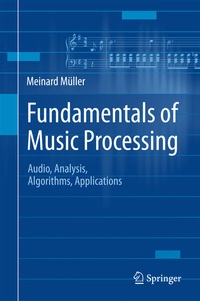
Fundamentals of Music Processing
Description

This textbook provides both profound technological knowledge and a comprehensive treatment of essential topics in music processing and music information retrieval. Including numerous examples, figures, and exercises, this book is suited for students, lecturers, and researchers working in audio engineering, computer science, multimedia, and musicology.
The book consists of eight chapters. The first two cover foundations of music representations and the Fourier transform-concepts that are then used throughout the book. In the subsequent chapters, concrete music processing tasks serve as a starting point. Each of these chapters is organized in a similar fashion and starts with a general description of the music processing scenario at hand before integrating it into a wider context. It then discusses-in a mathematically rigorous way-important techniques and algorithms that are generally applicable to a wide range of analysis, classification, and retrieval problems. At the same time, the techniques are directly applied to a specific music processing task. By mixing theory and practice, the book's goal is to offer detailed technological insights as well as a deep understanding of music processing applications. Each chapter ends with a section that includes links to the research literature, suggestions for further reading, a list of references, and exercises. The chapters are organized in a modular fashion, thus offering lecturers and readers many ways to choose, rearrange or supplement the material. Accordingly, selected chapters or individual sections can easily be integrated into courses on general multimedia, information science, signal processing, music informatics, or the digital humanities.
Reviews / Votes
"The book . covers a range of important and popular music processing topics, and strikes a balance between providing succinct and informative background theory and discussing applied examples in the context of real-world problem-solving. . Müller introduces the reader to analysis and processing techniques, algorithms and key underpinning theoretical concepts within the context of applied music analysis and processing tasks. . this is a very impressive book, and an excellent course in music processing." (Don Knox, Musicae Scientiae, Vol. 60 (2), June, 2016)
"If you are looking for a sound textbook in music analysis and music information retrieval, I would recommend this one. . The book may be used as a textbook at the postgraduate or advanced undergraduate levels in computational music science. It is also suitable for musicologists and researchers in music. Those with engineering backgrounds will find it easier to grasp. I enjoyed reading this book." (Soubhik Chakraborty, Computing Reviews, March, 2016)
More details
Other editions
New editions
Additional editions