

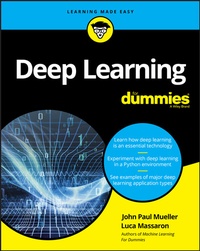
Deep Learning For Dummies
Description

Deep learning provides the means for discerning patterns in the data that drive online business and social media outlets. Deep Learning for Dummies gives you the information you need to take the mystery out of the topic--and all of the underlying technologies associated with it.
In no time, you'll make sense of those increasingly confusing algorithms, and find a simple and safe environment to experiment with deep learning. The book develops a sense of precisely what deep learning can do at a high level and then provides examples of the major deep learning application types.
* Includes sample code
* Provides real-world examples within the approachable text
* Offers hands-on activities to make learning easier
* Shows you how to use Deep Learning more effectively with the right tools
This book is perfect for those who want to better understand the basis of the underlying technologies that we use each and every day.
More details
Other editions
Additional editions
Content
Part 1: Discovering Deep Learning 7
Chapter 1: Introducing Deep Learning 9
Chapter 2: Introducing the Machine Learning Principles 25
Chapter 3: Getting and Using Python 45
Chapter 4: Leveraging a Deep Learning Framework 73
Part 2: Considering Deep Learning Basics 91
Chapter 5: Reviewing Matrix Math and Optimization 93
Chapter 6: Laying Linear Regression Foundations 111
Chapter 7: Introducing Neural Networks 131
Chapter 8: Building a Basic Neural Network 149
Chapter 9: Moving to Deep Learning 163
Chapter 10: Explaining Convolutional Neural Networks 179
Chapter 11: Introducing Recurrent Neural Networks 201
Part 3: Interacting with Deep Learning 215
Chapter 12: Performing Image Classification 217
Chapter 13: Learning Advanced CNNs 233
Chapter 14: Working on Language Processing 251
Chapter 15: Generating Music and Visual Art 269
Chapter 16: Building Generative Adversarial Networks 279
Chapter 17: Playing with Deep Reinforcement Learning 293
Part 4: The Part of Tens 307
Chapter 18: Ten Applications that Require Deep Learning 309
Chapter 19: Ten Must-Have Deep Learning Tools 317
Chapter 20: Ten Types of Occupations that Use Deep Learning 327
Index 335
Introduction
When you talk to some people about deep learning, they think of some deep dark mystery, but deep learning really isn't a mystery at all - you use it every time you talk to your smartphone, so you have it with you every day. In fact, you find deep learning used everywhere. For example, you see it when using many applications online and even when you shop. You are surrounded by deep learning and don't even realize it, which makes learning about deep learning essential because you can use it to do so much more than you might think possible.
Other people have another view of deep learning that has no basis in reality. They think that somehow deep learning will be responsible for some dire apocalypse, but that really isn't possible with today's technology. More likely is that someone will find a way to use deep learning to create fake people in order to commit crimes or to bilk the government out of thousands of dollars. However, killer robots are most definitely not part of the future.
Whether you're part of the mystified crowd or the killer robot crowd, we hope that you'll read Deep Learning For Dummies with the goal of understanding what deep learning can actually do. This technology can probably do a lot more in the way of mundane tasks than you think possible, but it also has limits, and you need to know about both.
About This Book
When you work through Deep Learning For Dummies, you gain access to a lot of example code that will run on a standard Mac, Linux, or Windows system. You can also run the code online using something like Google Colab. (We provide pointers on how to get the information you need to do this.) Special equipment, such as a GPU, will make the examples run faster. However, the point of this book is that you can create deep learning code no matter what sort of machine you have as long as you're willing to wait for some of it to complete. (We tell you which examples take a long time to run.)
The first part of this book gives you some starter information so that you don't get completely lost before you start. You discover how to install the various products you need and gain an understanding of some essential math. The beginning examples are more along the lines of standard regression and machine learning, but you need this basis to gain a full appreciation of just what deep learning can do for you.
After you get past these initial bits of information, you start to do some pretty amazing things. For example, you discover how to generate your own art and perform other tasks that you might have assumed to require many of coding and some special hardware to accomplish. By the end of the book, you'll be amazed by what you can do, even if you don't have an advanced machine learning or deep learning degree.
To make absorbing the concepts even easier, this book uses the following conventions:
- Text that you're meant to type just as it appears in the book is in bold. The exception is when you're working through a step list: Because each step is bold, the text to type is not bold.
- When you see words in italics as part of a typing sequence, you need to replace that value with something that works for you. For example, if you see "Type Your Name and press Enter," you need to replace Your Name with your actual name.
- Web addresses and programming code appear in
monofont. If you're reading a digital version of this book on a device connected to the Internet, you can click or tap the web address to visit that website, like this:http://www.dummies.com. - When you need to type command sequences, you see them separated by a special arrow, like this: File???New File. In this example, you go to the File menu first and then select the New File entry on that menu.
Foolish Assumptions
You might find it difficult to believe that we've assumed anything about you - after all, we haven't even met you yet! Although most assumptions are indeed foolish, we made these assumptions to provide a starting point for the book.
You need to be familiar with the platform you want to use because the book doesn't offer any guidance in this regard. (Chapter 3 does, however, provide Anaconda installation instructions, and Chapter 4 helps you install the TensorFlow and Keras frameworks used for this book.) To give you the maximum information about Python concerning how it applies to deep learning, this book doesn't discuss any platform-specific issues. You really do need to know how to install applications, use applications, and generally work with your chosen platform before you begin working with this book.
You must know how to work with Python. You can find a wealth of tutorials online (see https://www.w3schools.com/python/ and https://www.tutorialspoint.com/python/ as examples).
This book isn't a math primer. Yes, you see many examples of complex math, but the emphasis is on helping you use Python to perform deep learning tasks rather than teaching math theory. We include some examples that also discuss the use of machine learning as it applies to deep learning. Chapters 1 and 2 give you a better understanding of precisely what you need to know to use this book successfully.
This book also assumes that you can access items on the Internet. Sprinkled throughout are numerous references to online material that will enhance your learning experience. However, these added sources are useful only if you actually find and use them.
Icons Used in This Book
As you read this book, you see icons in the margins that indicate material of interest (or not, as the case may be).This section briefly describes each icon in this book.
Tips are nice because they help you save time or perform some task without a lot of extra work. The tips in this book are time-saving techniques or pointers to resources that you should try so that you can get the maximum benefit from Python or from performing deep learning-related tasks.
We don't want to sound like angry parents or some kind of maniacs, but you should avoid doing anything that's marked with a Warning icon. Otherwise, you might find that your application fails to work as expected, you get incorrect answers from seemingly bulletproof algorithms, or (in the worst-case scenario) you lose data.
Whenever you see this icon, think advanced tip or technique. You might find these tidbits of useful information just too boring for words, or they could contain the solution you need to get a program running. Skip these bits of information whenever you like.
If you don't get anything else out of a particular chapter or section, remember the material marked by this icon. This text usually contains an essential process or a bit of information that you must know to work with Python or to perform deep learning-related tasks successfully.
Beyond the Book
This book isn't the end of your Python or deep learning experience - it's really just the beginning. We provide online content to make this book more flexible and better able to meet your needs. That way, as we receive e-mail from you, we can address questions and tell you how updates to either Python or its associated add-ons affect book content. In fact, you gain access to all these cool additions:
- Cheat sheet: You remember using crib notes in school to make a better mark on a test, don't you? You do? Well, a cheat sheet is sort of like that. It provides you with some special notes about tasks that you can do with Python, machine learning, and data science that not every other person knows. You can find the cheat sheet by going to
www.dummies.com, searching this book's title, and scrolling down the page that appears. The cheat sheet contains really neat information such as the most common programming mistakes that cause people woe when using Python. -
Updates: Sometimes changes happen. For example, we might not have seen an upcoming change when we looked into our crystal ball during the writing of this book. In the past, this possibility simply meant that the book became outdated and less useful, but you can now find updates to the book by searching this book's title at
www.dummies.com.In addition to these updates, check out the blog posts with answers to reader questions and demonstrations of useful book-related techniques at
http://blog.johnmuellerbooks.com/. - Companion files: Hey! Who really wants to type all the code in the book and reconstruct all those neural networks manually? Most readers would prefer to spend their time actually working with Python, performing machine learning or deep learning tasks, and seeing the interesting things they can do, rather than typing. Fortunately for you, the examples used in the book are available for download, so all you need to do is read the book to learn Python for deep learning usage techniques. You can find these files at
www.dummies.com. Search this book's title, and on the page that appears, scroll down to the image of the book cover and click it. Then click the More about This Book button and on the page that opens, go to the...
