

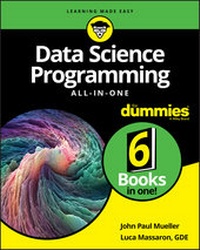
Data Science Programming All-in-One For Dummies
Description

Data science is exploding--in a good way--with a forecast of 1.7 megabytes of new information created every second for each human being on the planet by 2020 and 11.5 million job openings by 2026. It clearly pays dividends to be in the know. This friendly guide charts a path through the fundamentals of data science and then delves into the actual work: linear regression, logical regression, machine learning, neural networks, recommender engines, and cross-validation of models.
Data Science Programming All-In-One For Dummies is a compilation of the key data science, machine learning, and deep learning programming languages: Python and R. It helps you decide which programming languages are best for specific data science needs. It also gives you the guidelines to build your own projects to solve problems in real time.
* Get grounded: the ideal start for new data professionals
* What lies ahead: learn about specific areas that data is transforming
* Be meaningful: find out how to tell your data story
* See clearly: pick up the art of visualization
Whether you're a beginning student or already mid-career, get your copy now and add even more meaning to your life--and everyone else's!
More details
Other editions
Additional editions
Persons
Content
Introduction
Data science is a term that the media has chosen to minimize, obfuscate, and sometimes misuse. It involves a lot more than just data and the science of working with data. Today, the world uses data science in all sorts of ways that you might not know about, which is why you need Data Science Programming All-in-One For Dummies.
In the book, you start with both the data and the science of manipulating it, but then you go much further. In addition to seeing how to perform a wide range of analysis, you also delve into making recommendations, classifying real-world objects, analyzing audio, and even creating art.
However, you don't just learn about amazing new technologies and how to perform common tasks. This book also dispels myths created by people who wish data science were something different than it really is or who don't understand it at all. A great deal of misinformation swirls around the world today as the media seeks to sensationalize, anthropomorphize, and emotionalize technologies that are, in fact, quite mundane. It's hard to know what to believe. You find reports that robots are on the cusp of becoming sentient and that the giant tech companies can discover your innermost thoughts simply by reviewing your record of purchases. With this book, you can replace disinformation with solid facts, and you can use those facts to create a strategy for performing data science development tasks.
About This Book
You might find that this book starts off a little slowly because most people don't have a good grasp on getting a system prepared for data science use. Book 1 helps you configure your system. The book uses Jupyter Notebook as an Integrated Development Environment (IDE) for both Python and R. That way, if you choose to view the examples in both languages, you use the same IDE to do it. Jupyter Notebook also relies on the literate programming strategy first proposed by Donald Knuth (see http://www.literateprogramming.com/) to make your coding efforts significantly easier and more focused on the data. In addition, in contrast to other environments, you don't actually write entire applications before you see something; you write code and focus on the results of just that code block as part of a whole application.
After you have a development environment installed and ready to use, you can start working with data in all its myriad forms in Book 2. This book covers a great many of these forms - everything from in-memory datasets to those found on large websites. In addition, you see a number of data formats ranging from flat files to Relational Database Management Systems (RDBMSs) and Not Only SQL (NoSQL) databases.
Of course, manipulating data is worthwhile only if you can do something useful with it. Book 3 discusses common sorts of analysis, such as linear and logistic regression, Bayes' Theorem, and K-Nearest Neighbors (KNN).
Most data science books stop at this point. In this book, however, you discover AI, machine learning, and deep learning techniques to get more out of your data than you might have thought possible. This exciting part of the book, Book 4, represents the cutting edge of analysis. You use huge datasets to discover important information about large groups of people that will help you improve their health or sell them products.
Performing analysis may be interesting, but analysis is only a step along the path. Book 5 shows you how to put your analysis to use in recommender systems, to classify objects, work with nontextual data like music and video, and display the results of an analysis in a form that everyone can appreciate.
The final minibook, Book 6, offers something you won't find in many places, not even online. You discover how to detect and fix problems with your data, the logic used to interpret the data, and the code used to perform tasks such as analysis. By the time you complete Book 6, you'll know much more about how to ensure that the results you get are actually the results you need and want.
To make absorbing the concepts easy, this book uses the following conventions:
- Text that you're meant to type just as it appears in the book is in bold. The exception is when you're working through a step list: Because each step is bold, the text to type is not bold.
- When you see words in italics as part of a typing sequence, you need to replace that value with something that works for you. For example, if you see "Type Your Name and press Enter," you need to replace Your Name with your actual name.
- Web addresses and programming code appear in
monofont. If you're reading a digital version of this book on a device connected to the Internet, you can click or tap the web address to visit that website, like this:https://www.dummies.com. - When you need to type command sequences, you see them separated by a special arrow, like this: File ? New File. In this example, you go to the File menu first and then select the New File entry on that menu.
Foolish Assumptions
You might find it difficult to believe that we've assumed anything about you - after all; we haven't even met you yet! Although most assumptions are indeed foolish, we made these assumptions to provide a starting point for the book.
You need to be familiar with the platform you want to use because the book doesn't offer any guidance in this regard. (Book 1, Chapter 3 does, however, provide Anaconda installation instructions for both Python and R, and Book 1, Chapter 5 helps you install the TensorFlow and Keras frameworks used for this book.) To give you the maximum information about Python concerning how it applies to deep learning, this book doesn't discuss any platform-specific issues. You see the R version of the Python coding examples in the downloadable source, along with R-specific notes on usage and development. You really do need to know how to install applications, use applications, and generally work with your chosen platform before you begin working with this book.
You must know how to work with Python or R. You can find a wealth of Python tutorials online (see https://www.w3schools.com/python/ and https://www.tutorialspoint.com/python/ as examples). R, likewise, provides a wealth of online tutorials (see https://www.tutorialspoint.com/r/index.htm, https://docs.anaconda.com/anaconda/navigator/tutorials/r-lang/, and https://www.statmethods.net/r-tutorial/index.html as examples).
This book isn't a math primer. Yes, you see many examples of complex math, but the emphasis is on helping you use Python or R to perform data science development tasks rather than teaching math theory. We include some examples that also discuss the use of technologies such as data management (see Book 2), statistical analysis (see Book 3), AI, machine learning, deep learning (see Book 4), practical data science application (see Book 5), and troubleshooting both data and code (see Book 6). Book 1, Chapters 1 and 2 give you a better understanding of precisely what you need to know to use this book successfully. You also use a considerable number of libraries in writing code for this book. Book 1, Chapter 4 discusses library use and suggests other libraries that you might want to try.
This book also assumes that you can access items on the Internet. Sprinkled throughout are numerous references to online material that will enhance your learning experience. However, these added sources are useful only if you actually find and use them.
Icons Used in This Book
As you read this book, you see icons in the margins that indicate material of interest (or not, as the case may be). This section briefly describes each icon in this book.
Tips are nice because they help you save time or perform some task without a lot of extra work. The tips in this book are time-saving techniques or pointers to resources that you should try so that you can get the maximum benefit from Python or R, or from performing deep learning-related tasks. (Note that R developers will also find copious notes in the source code files for issues that differ significantly from Python.)
We don't want to sound like angry parents or some kind of maniacs, but you should avoid doing anything that's marked with a Warning icon. Otherwise, you might find that your application fails to work as expected, you get incorrect answers from seemingly bulletproof algorithms, or (in the worst-case scenario) you lose data.
Whenever you see this icon, think advanced tip or technique. You might find these tidbits of useful information just too boring for words, or they could contain the solution you need to get a program running. Skip these bits of information whenever you like.
If you don't get anything else out of a particular chapter or section, remember the material marked by this icon. This text usually contains an essential process or a bit of information that you must know to work with Python or R, or to perform deep learning-related tasks successfully. (Note that the R source code files contain a great deal of text that gives essential details for working with R when R...
