

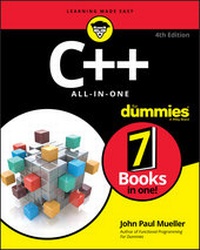
C++ All-in-One For Dummies
4th Edition
Published on 8. December 2020
912 pages
978-1-119-60175-3 (ISBN)
Description

Get ready for C++20 with all you need to know for complete mastery!
Your comprehensive and updated guide to one of the world's most popular programming languages is here! Whether you're a novice or expert, you'll find what you need to get going with the latest features of C++20. The workhorse of programming languages, C++ gives you the utmost control of data usage and interface and resource allocation. If your job involves data, proficiency in C++ means you're indispensable!
This edition gives you 7 books in 1 for total C++ mastery. Inside, internationally renowned expert John Paul Mueller takes you from the fundamentals of working with objects and classes to writing applications that use paradigms not normally associated with C++, such as those used for functional programming strategies. The book also includes online resources such as source code. You discover how to use a C++ GNU compiler to build applications and even how to use your mobile device for coding.
* Conquer advanced programming and troubleshooting
* Streamline your code with lambda expressions
* Use C++ where you need it: for gaming, enterprise applications, and Web services
* Uncover object secrets including the use of design patterns
* Discover how to use functional programming techniques to make code concise and easy to read
If you want to be your organization's C++ guru, C++ All-In-One for Dummies is where it's at!
Your comprehensive and updated guide to one of the world's most popular programming languages is here! Whether you're a novice or expert, you'll find what you need to get going with the latest features of C++20. The workhorse of programming languages, C++ gives you the utmost control of data usage and interface and resource allocation. If your job involves data, proficiency in C++ means you're indispensable!
This edition gives you 7 books in 1 for total C++ mastery. Inside, internationally renowned expert John Paul Mueller takes you from the fundamentals of working with objects and classes to writing applications that use paradigms not normally associated with C++, such as those used for functional programming strategies. The book also includes online resources such as source code. You discover how to use a C++ GNU compiler to build applications and even how to use your mobile device for coding.
* Conquer advanced programming and troubleshooting
* Streamline your code with lambda expressions
* Use C++ where you need it: for gaming, enterprise applications, and Web services
* Uncover object secrets including the use of design patterns
* Discover how to use functional programming techniques to make code concise and easy to read
If you want to be your organization's C++ guru, C++ All-In-One for Dummies is where it's at!
More details
Other editions
Additional editions
John Paul Mueller | Jeff Cogswell
C++ All in One for Dummies
Book
11/2019
4th Edition
Wiley
€41.00
Shipment within 15-20 days
Person
John Paul Mueller has produced 116 books and more than 600 articles on a range of topics that include functional programming techniques, application devel- opment using C++, and machine learning methodologies.
Content
- Intro
- Title Page
- Copyright Page
- Table of Contents
- Introduction
- About This Book
- Foolish Assumptions
- Icons Used in This Book
- Beyond the Book
- Where to Go from Here
- Book 1 Getting Started with C++
- Chapter 1 Configuring Your Desktop System
- Obtaining a Copy of C++ 20
- Obtaining Code::Blocks
- Installing Code::Blocks
- Working with Windows
- Working with Mac OS X
- Using the standard Linux installation
- Using the graphical Linux installation
- Touring the Essential Code::Blocks Features
- Starting Code::Blocks for the first time
- Opening the sample projects
- Viewing the essential windows
- Using Other IDEs
- Chapter 2 Configuring Your Mobile System
- Obtaining CppDroid
- Understanding why CppDroid is such a great choice
- Getting your copy of CppDroid
- Ensuring you get a good install
- Considering Other Alternatives
- Working with C4Droid
- Getting multiple language support with AIDE
- Using web-based IDEs
- Touring the Essential CppDroid Features
- Getting started with CppDroid
- Accessing an example
- Working with a simple online project
- Accessing your source code
- Considering differences with the desktop environment
- Obtaining CppDroid Help
- Working with the Help documentation
- Getting community support
- Using the free examples
- Accessing the tutorials
- Chapter 3 Creating Your First C++ Application
- Code::Blocks Creating a Project
- Understanding projects
- Defining your first project
- Building and executing your first application
- Typing the Code
- Starting with Main
- Showing Information
- Doing some math
- Tabbing your output
- Let Your Application Run Away
- Chapter 4 Storing Data in C++
- Putting Your Data Places: Variables
- Creating an integer variable
- Declaring multiple variables
- Changing values
- Setting one variable equal to another
- Initializing a variable
- Creating a great name for yourself
- Manipulating Integer Variables
- Adding integer variables
- Subtracting integer variables
- Multiplying integer variables
- Dividing integer variables
- Characters
- Null character
- Nonprintable and other cool characters
- Strings
- Getting a part of a string
- Changing part of a string
- Adding onto a string
- Adding two strings
- Making Decisions Using Conditional Operators
- Telling the Truth with Boolean Variables
- Reading from the Console
- Chapter 5 Directing the Application Flow
- Doing This or Doing That
- Evaluating Conditions in C++
- Finding the right C++ operators
- Combining multiple evaluations
- Including Evaluations in C++ Conditional Statements
- Deciding what if and also what else
- Going further with the else and if
- Repeating Actions with Statements That Loop
- Understanding how computers use loops
- Looping situations
- Looping for
- Performing a simple for loop
- Using multiple initialization variables
- Working with ranges
- Placing a condition within the declaration
- Letting C++ determine the type
- Looping while
- Doing while
- Breaking and continuing
- Breaking
- Continuing
- Nesting loops
- Chapter 6 Dividing Your Work with Functions
- Dividing Your Work
- Calling a Function
- Passing a variable
- Passing multiple variables
- Writing Your Own Functions
- Defining the AddOne() function
- Seeing how AddOne() is called
- Taking the AddOne() Function apart
- Considering the AddOne() parameter
- Understanding the AddOne() name and type
- Improving On the Basic Function
- Using multiple parameters or no parameters
- Returning nothing
- Keeping your variables local
- Forward references and function prototypes
- Writing two versions of the same function
- Calling All String Functions
- Inserting a string into a string
- Removing parts of a string
- Replacing parts of a string
- Using the string functions together
- Understanding main()
- Chapter 7 Splitting Up Source Code Files
- Creating Multiple Source Files
- Adding a new source code file
- Removing an existing source code file
- Creating a project with multiple existing files
- Getting multiple files to interact
- Sharing with Header Files
- Adding the header only once
- Using angle brackets or quotes
- Sharing Variables among Source Files
- Using the Mysterious Header Wrappers
- Chapter 8 Referring to Your Data Through Pointers
- Understanding the Changes in Pointers for C++ 20
- Avoiding broken code
- Considering the issues
- Writing cleaner and less bug-prone code
- Heaping and Stacking the Variables
- Getting a variable's address
- Changing a variable by using a pointer
- Pointing at a string
- Pointing to something else
- Tips on pointer variables
- Creating New Raw Pointers
- Using new
- Using an initializer
- Freeing Raw Pointers
- Working with Smart Pointers
- Creating smart pointers using std::unique_ptr and std::shared_ptr
- Defining nullable values using std::optional and std::nullopt
- Passing Pointer Variables to Functions
- Returning Pointer Variables from Functions
- Book 2 Understanding Objects and Classes
- Chapter 1 Working with Classes
- Understanding Objects and Classes
- Classifying classes and objects
- Describing methods and data
- Implementing a class
- Separating method code
- The parts of a class
- Working with a Class
- Accessing members
- Using classes and raw pointers
- Using classes and smart pointers
- Passing objects to functions
- Using const parameters in functions
- Using the this pointer
- Overloading methods
- Starting and Ending with Constructors and Destructors
- Starting with constructors
- Ending with destructors
- Sampling constructors and destructors
- Adding parameters to constructors
- Building Hierarchies of Classes
- Creating a hierarchy in C++
- Understanding types of inheritance
- Creating and Using Object Aliases
- Chapter 2 Using Advanced C++ Features
- Filling Your Code with Comments
- Converting Types
- Understanding how int and string conversions work
- Seeing int and string conversions in action
- Considering other conversion issues
- Reading from the Console
- Understanding Preprocessor Directives
- Understanding the basics of preprocessing
- Creating constants and macros with #define
- Performing conditional compilation
- Exercising the basic preprocessor directives
- Using Constants
- Using Switch Statements
- Supercharging enums with Classes
- Working with Random Numbers
- Storing Data in Arrays
- Declaring and accessing an array
- Arrays of pointers
- Passing arrays to functions
- Adding and subtracting pointers
- Chapter 3 Planning and Building Objects
- Recognizing Objects
- Observing the Mailboxes class
- Observing the Mailbox class
- Finding other objects
- Encapsulating Objects
- Considering the Application Programming Interface
- Understanding properties
- Choosing between private and protected
- Defining a process
- Implementing properties
- Building Hierarchies
- Establishing a hierarchy
- Protecting members when inheriting
- Overriding methods
- Specializing with polymorphism
- Getting abstract about things
- Chapter 4 Building with Design Patterns
- Delving Into Pattern History
- Introducing a Simple Pattern: the Singleton
- Using an existing pattern
- Creating a singleton pattern class
- Watching an Instance with an Observer
- Understanding the observer pattern
- Defining an observer pattern class
- Observers and the Standard C++ Library
- Automatically adding an observer
- Mediating with a Pattern
- Defining the mediator pattern scenario
- Outlining the car example
- Creating the car example
- Book 3 Understanding Functional Programming
- Chapter 1 Considering Functional Programming
- Understanding How Functional Programming Differs
- Defining an Impure Language
- Considering the requirements
- Understanding the C++ functional limitations
- Seeing Data as Immutable
- Working with immutable variables
- Working with immutability in classes and structures
- Creating constant expressions
- Considering the Effects of State
- Eliminating Side Effects
- Contrasting declarations and functions
- Associating functions with side effects
- Removing side effects
- Creating a declarative C++ example
- Understanding the Role of auto
- Passing Functions to Functions
- Seeing a simple example of function input
- Using transforms
- Using Lambda Expressions for Implementation
- Chapter 2 Working with Lambda Expressions
- Creating More Readable and Concise C++ Code
- Defining the Essential Lambda Expression
- Defining the parts of a lambda expression
- Relying on computer detection of return type
- Using the auto keyword with lambda expressions
- Using lambda expressions as macros
- Developing with Lambda Expressions
- Using lambda expressions with classes and structures
- Working with the capture clause
- Sorting data using a lambda expression
- Specifying that the lambda expression throws exceptions
- Chapter 3 Advanced Lambda Expressions
- Considering the C++ 20 Lambda Extensions
- Defining an immediate function
- Using = and this in captures
- Finding other changes
- Working in Unevaluated Contexts
- Using Assignable Stateless Lambda Expressions
- Dealing with Pack Expansions
- Considering the template
- Processing the variables using recursion
- Processing the variables using a lambda expression
- Book 4 Fixing Problems
- Chapter 1 Dealing with Bugs
- It's Not a Bug. It's a Feature!
- Make Your Application Features Look Like Features
- Anticipating (Almost) Everything
- Considering menus
- Dealing with textual input
- Performing string processing
- Avoiding Mistakes, Plain and Simple
- Chapter 2 Debugging an Application
- Programming with Debuggers
- Running the debugger
- Recognizing the parts of the Code::Blocks debugger
- Debugging with Different Tools
- Debugging a Code::Blocks Application with Command-Line Arguments
- Chapter 3 Stopping and Inspecting Your Code
- Setting and Disabling Breakpoints
- Setting a breakpoint in Code::Blocks
- Enabling and disabling breakpoints
- Watching, Inspecting, and Changing Variables
- Watching the variables
- Changing values
- Chapter 4 Traveling About the Stack
- Stacking Your Data
- Moving about the stack
- Storing local variables
- Debugging with Advanced Features
- Viewing threads
- Tracing through assembly code
- Book 5 Advanced Programming
- Chapter 1 Working with Arrays, Pointers, and References
- Building Up Arrays
- Declaring arrays
- Arrays and pointers
- Using multidimensional arrays
- Arrays and command-line parameters
- Allocating an array on the heap
- Deleting an array from the heap
- Storing arrays of pointers and arrays of arrays
- Building constant arrays
- Pointing with Pointers
- Becoming horribly complex
- Pointers to functions
- Pointing a variable to a method
- Pointing to static methods
- Referring to References
- Reference variables
- Returning a reference from a function
- Chapter 2 Creating Data Structures
- Working with Data
- The great variable roundup
- Expressing variables from either side
- Casting a spell on your data
- Comparing casting and converting
- Casting safely with C++
- Structuring Your Data
- Structures as component data types
- Equating structures
- Returning compound data types
- Naming Your Space
- Creating a namespace
- Employing using namespace
- Using variables
- Using part of a namespace
- Chapter 3 Constructors, Destructors, and Exceptions
- Constructing and Destructing Objects
- Overloading constructors
- Initializing members
- Adding a default constructor
- Functional constructors
- Calling one constructor from another
- Copying instances with copy constructors
- When constructors go bad
- Destroying your instances
- Virtually inheriting destructors
- Programming the Exceptions to the Rule
- Creating a basic try. . .catch block
- Using multiple catch blocks
- Throwing direct instances
- Catching any exception
- Rethrowing an exception
- Using a standard category
- Chapter 4 Advanced Class Usage
- Inherently Inheriting Correctly
- Morphing your inheritance
- Avoiding polymorphism
- Adjusting access
- Avoiding variable naming conflicts
- Using class-based access adjustment
- Returning something different, virtually speaking
- Multiple inheritance
- Virtual inheritance
- Friend classes and functions
- Using Classes and Types within Classes
- Nesting a class
- Types within classes
- Chapter 5 Creating Classes with Templates
- Templatizing a Class
- Considering types
- Defining the need for templates
- Creating and using a template
- Understanding the template keyword
- Going Beyond the Basics
- Separating a template from the function code
- Including static members in a template
- Parameterizing a Template
- Putting different types in the parameter
- Including multiple parameters
- Working with non-type parameters
- Typedefing a Template
- Deriving Templates
- Deriving classes from a class template
- Deriving a class template from a class
- Deriving a class template from a class template
- Templatizing a Function
- Overloading and function templates
- Templatizing a method
- Chapter 6 Programming with the Standard Library
- Architecting the Standard Library
- Containing Your Classes
- Storing in a vector
- Working with std::array
- Mapping your data
- Containing instances, pointers, or references
- Working with copies
- Comparing instances
- Iterating through a container
- A map of pairs in your hand
- The Great Container Showdown
- Associating and storing with a set
- Unionizing and intersecting sets
- Listing with list
- Stacking the deque
- Waiting in line with stacks and queues
- Copying Containers
- Creating and Using Dynamic Arrays
- Working with Unordered Data
- Using std::unordered_set to create an unordered set
- Manipulating unordered sets
- Working with Ranges
- Book 6 Reading and Writing Files
- Chapter 1 Filing Information with the Streams Library
- Seeing a Need for Streams
- Programming with the Streams Library
- Getting the right header file
- Opening a file
- Reading from a file
- Reading and writing a file
- Working with containers
- Handling Errors When Opening a File
- Flagging the ios Flags
- Chapter 2 Writing with Output Streams
- Inserting with the && Operator
- Formatting Your Output
- Formatting with flags
- Specifying a precision
- Setting the width and creating fields
- Chapter 3 Reading with Input Streams
- Extracting with Operators
- Encountering the End of File
- Using the record count approach
- Using the EOF check approach
- Reading Various Types
- Understanding data reading issues
- Writing and reading string-type data
- Writing and reading structured data
- Chapter 4 Building Directories and Contents
- Manipulating Directories
- Creating a directory
- Deleting a directory
- Getting the Contents of a Directory
- Copying Files
- Copying with windows
- Using the quick-and-dirty method
- Moving and Renaming Files and Directories
- Chapter 5 Streaming Your Own Classes
- Streaming a Class for Text Formatting
- Understanding the process
- Considering the insertion implementation
- Considering the extraction implementation
- Manipulating a Stream
- What's a manipulator?
- Writing your own manipulator
- Book 7 Advanced Standard Library Usage
- Chapter 1 Exploring the Standard Library Further
- Considering the Standard Library Categories
- Algorithms
- Atomic operations
- C Compatibility
- Concepts
- Containers
- Coroutines
- Filesystem
- Input/Output
- Iterators
- Localization
- Numerics
- Ranges
- Regular Expressions
- Strings
- Thread Support
- Utilities
- Parsing Strings Using a Hash
- Obtaining Information Using a Random Access Iterator
- Locating Values Using the Find Algorithm
- Using the Random Number Generator
- Working with Temporary Buffers
- Chapter 2 Working with User-Defined Literals (UDLs)
- Understanding the Need for UDLs
- Prefixes and suffixes
- Differentiating between raw and cooked
- Working with the UDLs in the Standard Library
- std::basic_string
- std::complex
- std::chrono::duration
- Creating Your Own UDLs
- Developing a conversion UDL
- Developing a custom type UDL
- Using a custom UDL for side effects
- Chapter 3 Building Original Templates
- Deciding When to Create a Template
- Defining the Elements of a Good Template
- Creating a Basic Math Template
- Building a Structure Template
- Developing a Class Template
- Considering Template Specialization
- Creating a Template Library
- Defining the library project
- Configuring the library project
- Coding the library
- Using Your Template Library
- Chapter 4 Investigating Boost
- Considering the Standard Library Alternative
- Understanding why the Standard Library contains Boost features
- Defining the trade-offs of using the Standard Library
- Understanding Boost
- Boost features
- Licensing
- Paid support
- Obtaining and Installing Boost for Code::Blocks
- Unpacking Boost
- Using the header-only libraries
- Building the libraries
- Testing the installation
- Creating the Boost Tools
- Using Boost.Build
- Getting a successful build
- Creating your own example
- Using Inspect
- Understanding BoostBook
- Using QuickBook
- Using bcp
- Using Wave
- Building Your First Boost Application Using Date Time
- Chapter 5 Boosting up a Step
- Parsing Strings Using RegEx
- Adding the RegEx library
- Creating the RegEx code
- Breaking Strings into Tokens Using Tokenizer
- Performing Numeric Conversion
- Creating Improved Loops Using Foreach
- Accessing the Operating System Using Filesystem
- Index
- EULA
