

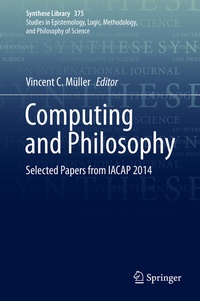
Computing and Philosophy
Description

This volume offers very selected papers from the 2014 conference of the "International Association for Computing and Philosophy" (IACAP) - a conference tradition of 28 years. The theme of the papers is the two-way relation between computing technologies and philosophical questions: Computing technologies both raise new philosophical questions, and shed light on traditional philosophical problems. The chapters cover: 1) philosophy of computing, 2) philosophy of computer science & discovery, 3) philosophy of cognition & intelligence, 4) computing & society, and 5) ethics of computation.
More details
Other editions
Additional editions
Person
Content
Editorial.- Part I philosophy of computing.- Chapter 1 Çem Bozsahin. What's a computational constraint?.- Chapter 2 Joe Dewhurst. Computing Mechanisms and Autopoietic Systems.- Chapter 3 Vincenzo Fano, Pierluigi Graziani, Roberto Macrelli and Gino Tarozzi. Are Gandy Machines really local?.- Chapter 4 Doukas Kapantais. A refutation of the Church-Turing thesis according to some interpretation of what the thesis says.- Chapter 5 Paul Schweizer. In What Sense Does the Brain Compute?.- Part II philosophy of computer science & discovery.- Chapter 6 Mark Addis, Peter Sozou, Peter C R Lane and Fernand Gobet. Computational Scientific Discovery and Cognitive Science Theories.- Chapter 7 Nicola Angius and Petros Stefaneas. Discovering Empirical Theories of Modular Software Systems. An Algebraic Approach.- Chapter 8 Selmer Bringsjord, John Licato, Daniel Arista, Naveen Sundar Govindarajulu and Paul Bello. Introducing the Doxastically Centered Approach to Formalizing Relevance Bonds in Conditionals.- Chapter 9 Orly Stettiner. From Silico to Vitro: Computational Models of Complex Biological Systems Reveal Real-world Emergent Phenomena.- Part III philosophy of cognition & intelligence.- Chapter 10 Douglas Campbell. Why We Shouldn't Reason Classically, and the Implications for Artificial Intelligence.- Chapter 11 Stefano Franchi. Cognition as Higher Order Regulation.- Chapter 12 Marcello Guarini. Eliminativisms, Languages of Thought, & the Philosophy of Computational Cognitive Modeling.- Chapter 13 Marcin Milkowski. A Mechanistic Account of Computational Explanation in Cognitive Science and Computational Neuroscience.- Chapter 14 Alex Tillas. Internal supervision & clustering: A new lesson from 'old' findings?.- Part IV computing & society.- Chapter 15 Vasileios Galanos. Floridi/Flusser: Parallel Lives in Hyper/Posthistory.- Chapter 16 Paul Bello. Machine Ethics and Modal Psychology.- Chapter 17 Marty J. Wolf and Nir Fresco. My Liver Is Broken, Can You PrintMe a New One?.- Chapter 18 Marty J. Wolf, Frances Grodzinsky and Keith W. Miller. Robots, Ethics and Software - FOSS vs. Proprietary Licenses.
