

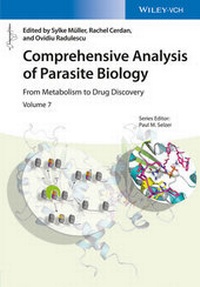
Comprehensive Analysis of Parasite Biology
From Metabolism to Drug Discovery
1st Edition
Published on 19. July 2016
XXIV, 548 pages
978-3-527-69409-9 (ISBN)
Description

Written and edited by experts in the field, this book brings together the current state of the art in phenotypic and rational, target-based approaches to drug discovery against pathogenic protozoa. The chapters focus particularly on virtual compounds and high throughput screening, natural products, computer-assisted drug design, structure-based drug design, mechanism of action identification, and pathway modelling. Furthermore, state-of the art "omics" technologies are described and currently studied enzymatic drug targets are discussed. Mathematical, systems biology-based approaches are introduced as new methodologies for dissecting complex aspects of pathogen survival mechanisms and for target identification. In addition, recently developed anti-parasitic agents targeting particular pathways, which serve as lead compounds for further drug development, are presented.
More details
Other editions
Additional editions
Sylke Müller | Rachel Cerdan | Ovidiu Radulescu
Comprehensive Analysis of Parasite Biology
From Metabolism to Drug Discovery
Book
08/2016
1st Edition
Wiley-Blackwell
€199.00
Article exhausted; check different version
Software
07/2016
Wiley-VCH
€256.09
No shipping information available
Persons
Volume Editors:
Prof. Sylke Müller received her PhD in 1991 from the University of Hamburg. In 1992 she worked at the London School of Hygiene and Tropical Medicine, before returning to the Bernhard Nocht Institute for Tropical Medicine in Hamburg in 1994. In 1999 she was awarded the Habilitation and the venia legendi. From 2001 to 2012 she was funded by a Wellcome Trust Senior Fellowship at Dundee University (until 2004) and the University of Glasgow (2004 to 2012). In 2006 she was awarded a Personal Chair in Molecular and Biochemical Parasitology at the University of Glasgow.
Prof. Rachel Cerdan received her PhD from the University of Paris XI in 1997. She spent three years at the Laboratory of Molecular Biology (Medical Research Council) in Cambridge, UK as a Marie Curie post-doctoral fellow. She then moved to the Centre of Structural Biochemistry in Montpellier, France. In 2003, she joined the laboratory of Dynamics of Membrane Interactions in Normal and Pathological Cells in Montpellier. Currently, she is professor in biochemistry and structural biology at the University of Montpellier, France. Her current projects focus on the biochemical and structural characterization of pharmacological targets to develop new classes of antimalarials.
Prof. Ovidiu Radulescu studied physics and mathematics in Bucharest and Paris and obtained his PhD in 1994 from the University of Paris XI, France. Immediately after his PhD, he worked in theoretical condensed matter physics, first in the Institute of Theoretical Physics in Nijmegen, the Netherlands, and then in the Physics Department of the University of Leeds, UK. In 1999 he joined as a lecturer the Department of Mathematics of the University of Rennes 1, France. At that time, he was also associate member of the French Institute for Research in Computer Science and Automation, INRIA.
Since 2009, he is Professor in Systems Biology and team leader at the University of Montpellier, France. His team is part of the laboratory DIMNP UMR5235, whose main focuses are in parasitology and immunology.
Series Editor:
Prof. Paul M. Selzer studied biology, parasitology, and biochemistry at the University of Tübingen,
Germany, where he also received his PhD in biochemistry. He spent three years at the Molecular Design Institute and the Parasitology and Tropical Disease Research Laboratory at the University of California, San Francisco. During his career he has worked as a researcher and scientific manager for several pharmaceutical companies, and is currently Head of Antiparasitics R&D at Boehringer Ingelheim Animal Health, Germany. He is also a visiting professor at the Interfaculty Institute of Biochemistry of the University of Tübingen, and an honorary professor of the Department of Infection, Immunity, and Inflammation at the University of Glasgow, UK.
Prof. Sylke Müller received her PhD in 1991 from the University of Hamburg. In 1992 she worked at the London School of Hygiene and Tropical Medicine, before returning to the Bernhard Nocht Institute for Tropical Medicine in Hamburg in 1994. In 1999 she was awarded the Habilitation and the venia legendi. From 2001 to 2012 she was funded by a Wellcome Trust Senior Fellowship at Dundee University (until 2004) and the University of Glasgow (2004 to 2012). In 2006 she was awarded a Personal Chair in Molecular and Biochemical Parasitology at the University of Glasgow.
Prof. Rachel Cerdan received her PhD from the University of Paris XI in 1997. She spent three years at the Laboratory of Molecular Biology (Medical Research Council) in Cambridge, UK as a Marie Curie post-doctoral fellow. She then moved to the Centre of Structural Biochemistry in Montpellier, France. In 2003, she joined the laboratory of Dynamics of Membrane Interactions in Normal and Pathological Cells in Montpellier. Currently, she is professor in biochemistry and structural biology at the University of Montpellier, France. Her current projects focus on the biochemical and structural characterization of pharmacological targets to develop new classes of antimalarials.
Prof. Ovidiu Radulescu studied physics and mathematics in Bucharest and Paris and obtained his PhD in 1994 from the University of Paris XI, France. Immediately after his PhD, he worked in theoretical condensed matter physics, first in the Institute of Theoretical Physics in Nijmegen, the Netherlands, and then in the Physics Department of the University of Leeds, UK. In 1999 he joined as a lecturer the Department of Mathematics of the University of Rennes 1, France. At that time, he was also associate member of the French Institute for Research in Computer Science and Automation, INRIA.
Since 2009, he is Professor in Systems Biology and team leader at the University of Montpellier, France. His team is part of the laboratory DIMNP UMR5235, whose main focuses are in parasitology and immunology.
Series Editor:
Prof. Paul M. Selzer studied biology, parasitology, and biochemistry at the University of Tübingen,
Germany, where he also received his PhD in biochemistry. He spent three years at the Molecular Design Institute and the Parasitology and Tropical Disease Research Laboratory at the University of California, San Francisco. During his career he has worked as a researcher and scientific manager for several pharmaceutical companies, and is currently Head of Antiparasitics R&D at Boehringer Ingelheim Animal Health, Germany. He is also a visiting professor at the Interfaculty Institute of Biochemistry of the University of Tübingen, and an honorary professor of the Department of Infection, Immunity, and Inflammation at the University of Glasgow, UK.
Content
Discovering the mechanism of action of novel compounds that target unicellular eucaryotic parasites
Contribution of Natural Products to drug discovery in tropical diseases
Isoxazolines as effective ectoparasiticides
Trypanosomal Cysteine Proteases: Target Validation and Drug Design Strategies
Potential of pyrimidine metabolism for antitrypanosomal drug discovery
The Kennedy pathways for phospholipid biosynthesis in Plasmodium
Immunophilins as possible drug targets
Autophagy in Plasmodium/invasion of Plasmodium
The glideosome: the locomotive complex behind gliding motility and invasion
Turnover of glycosomes in trypanosomes. Perspectives for drug discovery
N-myristoyltransferase as a target for Drug Discovery in Malaria
Intermediary carbon metabolism of Plasmodium revisited
The role of metabolomics in antiparasitic drug discovery
Methods to investigate system biology in Trypanosoma
The importance of targeting lipid metabolism in parasites for drug discovery
Epigenetic gene regulation: a key to development and survival of malaria parasites
Emerging importance of t-RNA synthetases as anti-malarial drug targets
Understanding protozoan parasite metabolism and identifying drug targets through flux balance analysis
Attacking blood-borne parasites with mathematics
Kinetic modeling of metabolism and drug target identification in Apicomplexa
Antiparasitics from algae
Mechanisms regulating transcription in Plasmodium falciparum as targets for novel antimalarial drugs
Contribution of Natural Products to drug discovery in tropical diseases
Isoxazolines as effective ectoparasiticides
Trypanosomal Cysteine Proteases: Target Validation and Drug Design Strategies
Potential of pyrimidine metabolism for antitrypanosomal drug discovery
The Kennedy pathways for phospholipid biosynthesis in Plasmodium
Immunophilins as possible drug targets
Autophagy in Plasmodium/invasion of Plasmodium
The glideosome: the locomotive complex behind gliding motility and invasion
Turnover of glycosomes in trypanosomes. Perspectives for drug discovery
N-myristoyltransferase as a target for Drug Discovery in Malaria
Intermediary carbon metabolism of Plasmodium revisited
The role of metabolomics in antiparasitic drug discovery
Methods to investigate system biology in Trypanosoma
The importance of targeting lipid metabolism in parasites for drug discovery
Epigenetic gene regulation: a key to development and survival of malaria parasites
Emerging importance of t-RNA synthetases as anti-malarial drug targets
Understanding protozoan parasite metabolism and identifying drug targets through flux balance analysis
Attacking blood-borne parasites with mathematics
Kinetic modeling of metabolism and drug target identification in Apicomplexa
Antiparasitics from algae
Mechanisms regulating transcription in Plasmodium falciparum as targets for novel antimalarial drugs
