

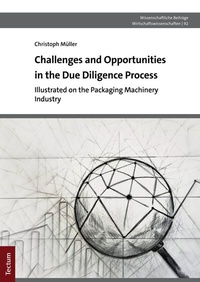
Challenges and Opportunities in the Due Diligence Process
Illustrated on Packaging Machinery Industry
1st Edition
Published on 14. December 2020
334 pages
978-3-8288-7654-5 (ISBN)
Description

Volumina von M&A-Transaktionen steigen. Die Gründe sind vielfältig, die Tendenz ist branchenübergreifend und unabhängig von der Unternehmensgröße. Doch viele Transaktionen liefern nicht das avisierte Resultat. Zeit für einen innovativen Ansatz im entscheidungsrelevanten M&A-Teilprozess Due Diligence. Dabei werden die Herausforderungen der für den Prozess nur limitiert zur Verfügung stehenden Ressourcen Zeit und Know-how abgearbeitet. Der Ansatz löst sich von den Retrospektiven und bildet zudem Nachhaltigkeit und Zukunftsorientierung mit ab. Heraus kommt ein Due-Diligence-Modell, das den Anspruch erhebt, die Qualität der Handlungsempfehlung zu erhöhen. Das Buch richtet sich an Kauf- und Verkaufsseite, sowie externe Berater gleichermaßen.
More details
Other editions
Additional editions
Christoph Müller
Challenges and Opportunities in the Due Diligence Process
Illustrated on the Packaging Machinery Industry
Book
12/2020
1st Edition
Tectum Wissenschaftsverlag
€68.00
Shipment within 5-7 days
Content
- Intro
- Preface by Prof. Dr. Rainer Moll
- Preface by Hans Bühler
- Acknowledgment
- Abstract
- Table of Contents
- List of Illustrations
- List of Tables
- List of Abbreviations and Symbols
- 1 Introduction
- 1.1 The packaging machinery industry in Germany and its drivers for M&A
- 1.1.1 Growth strategy
- 1.1.2 Demographic changes
- 1.1.3 Volatility, Uncertainty, Complexity and Ambiguity (VUCA)
- 1.2 Problem description and current state of the topic
- 1.2.1 Time and resource restrictions in M&A transactions
- 1.2.2 Development after DD
- 1.3 Hypothesis and research questions
- 1.4 Goal and structure of the dissertation
- 2 Desk research
- 2.1 Literature review
- 2.2 Stages of entrepreneurial cooperation
- 2.2.1 Strategic alliances
- 2.2.2 Mergers & Acquisitions
- 2.2.2.1 Process
- 2.2.2.2 Challenging phases
- 2.2.3 Advantages and disadvantages
- 2.3 Due Diligence
- 2.3.1 Definition
- 2.3.2 Organizational structure
- 2.3.2.1 Expert approach
- 2.3.2.2 Department approach
- 2.3.2.3 Interdisciplinary team approach
- 2.3.3 Procedure
- 2.3.4 Different areas of a Due Diligence
- 2.3.4.1 Financial Due Diligence
- 2.3.4.2 Legal Due Diligence
- 2.3.4.3 Tax Due Diligence
- 2.3.4.4 Commercial Due Diligence
- 2.3.4.5 Operational Due Diligence
- 2.3.4.6 HR Due Diligence
- 2.3.5 Due Diligence Report
- 2.4 Integrated controlling approach
- 2.4.1 Strategic controlling
- 2.4.2 Balanced Scorecard model
- 2.4.2.1 Employee perspective
- 2.4.2.2 Technology perspective
- 2.4.2.3 Process perspective
- 2.4.2.4 Commercial perspective
- 2.4.2.5 Financial perspective
- 2.4.2.6 Cause-and-effect relations
- 2.4.3 Key Performance Indicators
- 2.4.4 Benchmark
- 2.4.5 Risk analysis
- 2.4.6 Business Intelligence
- 2.4.7 Dashboard
- 2.5 Conclusion
- 3 Research Methods
- 3.1 Objectives
- 3.2 Introduction of quantitative and qualitative research methods
- 3.3 Definition of the research methods used in the dissertation
- 4 Expert interview - Analysis of the challenges within a DD
- 4.1 Expert interview
- 4.1.1 Definition
- 4.1.2 Methodology and number of population
- 4.1.2.1 Sampling of experts
- 4.1.2.2 Interview type
- 4.1.2.3 Transcript of the expert interview
- 4.1.2.4 Analysis of the expert interview
- 4.1.3 Usage within the dissertation thesis
- 4.2 Procedure for the qualitative empiric part of the studies
- 4.2.1 Design of the expert interview
- 4.2.2 Precise description of the study
- 4.2.3 Participants of the qualitative part of the studies
- 4.2.4 Guideline
- 4.2.5 Interview framework
- 4.3 Results of the expert interviews
- 4.3.1 Quantitative parameters
- 4.3.2 Qualitative parameters
- 4.4 Summary
- 5 Integrated Due Diligence concept
- 5.1 Selection of internal and external partners (organizational setup)
- 5.2 Time frame - procedure
- 5.3 Qualitative part - non-measurable aspects
- 5.3.1 Legal aspects
- 5.3.2 Tax-related challenges
- 5.4 Quantitative part - measurable aspects
- 5.4.1 Creation of a comparable data base with identical standards
- 5.4.2 Cause-and-effect relationships
- 5.4.3 KPI definition
- 5.4.3.1 HR Due Diligence
- 5.4.3.2 Operational Due Diligence
- 5.4.3.3 Commercial Due Diligence
- 5.4.3.4 Financial Due Diligence
- 5.4.4 Benchmark - a learning system
- 5.5 Visualization of the data
- 5.5.1 Due Diligence Dashboard
- 5.5.2 Due Diligence report
- 6 Case study - Realization and evaluation of the concept
- 6.1 Case study
- 6.1.1 Definition
- 6.1.2 Methodology and number of population
- 6.1.3 Usage within the dissertation thesis
- 6.2 Description of the case
- 6.2.1 Data base and background information
- 6.2.2 Result of the Due Diligence and its reasons
- 6.3 Simulation of the Due Diligence based on the new concept
- 6.3.1 Team approach
- 6.3.2 Preparation of the Due Diligence
- 6.3.3 Qualitative analyses
- 6.3.4 Quantitative analyses
- 6.3.5 Recommendation based on the new concept
- 6.4 Development of the target company after the Due Diligence
- 6.5 Indications of the result on the new concept
- 6.6 Discussion of the results out of the case study
- 7 Conclusion
- 7.1 Contribution of the research
- 7.2 Outlook and suggestions for further research
- Reference List
- Literature
- Appendices
