

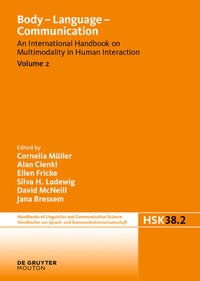
Body - Language - Communication. Volume 2
Description

Volume II of the handbook offers a unique collection of exemplary case studies. In five chapters and 99 articles it presents the state of the art on how body movements are used for communication around the world. Topics include the functions of body movements, their contexts of occurrence, their forms and meanings, their integration with speech, and how bodily motion can function as language. By including an interdisciplinary chapter on 'embodiment', volume II explores the body and its role in the grounding of language and communication from one of the most widely discussed current theoretical perspectives. Volume II of the handbook thus entails the following chapters:
VI. Gestures across cultures,
VII. Body movements: functions, contexts and interactions,
VIII. Gesture and language,
IX. Embodiment: the body and its role for cognition, emotion, and communication,
X. Sign Language: Visible body movements as language.
Authors include: Mats Andrèn, Richard Asheley, Benjamin Bergen, Ulrike Bohle, Dominique Boutet, Heather Brookes, Penelope Brown, Kensy Cooperrider, Onno Crasborn, Seana Coulson, James Essegby, Maria Graziano, Marianne Gullberg, Simon Harrison, Hermann Kappelhoff, Mardi Kidwell, Irene Kimbara, Stefan Kopp, Grigoriy Kreidlin, Dan Loehr, Irene Mittelberg, Aliyah Morgenstern, Rafael Nuñez, Isabella Poggi, David Quinto-Pozos, Monica Rector, Pio Enrico Ricci-Bitti, Göran Sonesson, Timo Sowa, Gale Stam, Eve Sweetser, Mark Tutton, Ipke Wachsmuth, Linda Waugh, Sherman Wilcox.
More details
Other editions
Additional editions
Persons
Content
- Intro
- VI. Gestures across cultures
- 73. Gestures in South Africa
- 74. Gestures in the Sub-Saharan region
- 75. Gestures in West Africa: Left hand taboo in Ghana
- 76. Gestures in West Africa: Wolof
- 77. Gestures in South America: Spanish and Portuguese
- 78. Gestures in South American indigenous cultures
- 79. Gestures in native South America: Ancash Quechua
- 80. Gestures in nativeMexico and Central America: TheMayan Cultures
- 81. Gestures in native Nothern America: Bimodal talk in Arapaho
- 82. Gestures in Southwest India: Dance theater
- 83. Gestures in China: Universal and culturally specific characteristics
- 84. Gestures and body language in Southern Europe: Italy
- 85. Gestures in Southern Europe: Children's pragmatic gestures in Italy
- 86. Gestures in Southwest Europe: Portugal
- 87. Gestures in Southwest Europe: Catalonia
- 88. Gestures in Western Europe: France
- 89. Gestures in Northern Europe: Children's gestures in Sweden
- 90. Gestures in Northeast Europe: Russia, Poland, Croatia, the Czech Republic, and Slovakia
- VII. Body movements - Functions, contexts, and interactions
- 91. Body posture and movement in interaction: Participation management
- 92. Proxemics and axial orientation
- 93. The role of gaze in conversational interaction
- 94. Categories and functions of posture, gaze, face, and body movements
- 95. Facial expression and social interaction
- 96. Gestures, postures, gaze, and movement in work and organization
- 97. Gesture and conversational units
- 98. The interactive design of gestures
- 99. Gestures and mimicry
- 100. Gestures and prosody
- 101. Structuring discourse: Observations on prosody and gesture in Russian TV-discourse
- 102. Body movements in political discourse
- 103. Gestures in industrial settings
- 104. Identification and interpretation of co-speech gestures in technical systems
- 105. Gestures, postures, gaze, and other body movements in the 2nd language classroom interaction
- 106. Bodily interaction (of interpreters) in music performance
- 107. Gestures in the theater
- 108. Contemporary classification systems
- 109. Co-speech gestures: Structures and functions
- 110. Emblems or quotable gestures: Structures, categories, and functions
- 111. Semantics and pragmatics of symbolic gestures
- 112. Head shakes: Variation in form, function, and cultural distribution of a head movement related to "no"
- 113. Gestures in dictionaries: Physical contact gestures
- 114. Ring-gestures across cultures and times: Dimensions of variation
- 115. Gesture and taboo: A cross-cultural perspective · Heather Brookes
- VIII. Gesture and language
- 116. Pragmatic gestures · Llui´s Payrato´ and Sedinha Teßendorf
- 117. Pragmatic and metaphoric - combining functional with cognitive approaches in the analysis of the "brushing aside gesture"
- 118. Recurrent gestures
- 119. A repertoire of German recurrent gestures with pragmatic functions
- 120. The family of Away gestures: Negation, refusal, and negative assessment
- 121. The cyclic gesture
- 122. Kinesthemes: Morphological complexity in co-speech gestures
- 123. Gesture families and gestural fields
- 124. Repetitions in gesture
- 125. Syntactic complexity in co-speech gestures: Constituency and recursion
- 126. Creating multimodal utterances: The linear integration of gestures into speech
- 127. Gestures and location in English
- 128. Gestural modes of representation as techniques of depiction
- 129. Levels of abstraction
- 130. Gestures and iconicity
- 131. Iconic and representational gestures
- 132. Gestures and metonymy
- 133. Ways of viewing metaphor in gesture
- 134. The conceptualization of time in gesture
- 135. Between reference and meaning: Object-related and interpretant-related gestures in face-to-face interaction · Ellen Fricke
- 136. Deixis, gesture, and embodiment from a linguistic point of view
- 137. Pointing by hand: Types of reference and their influence on gestural form
- IX. Embodiment - The body and its role for cognition, emotion, and communication
- 138. Gestures and cognitive development
- 139. Embodied cognition and word acquisition: The challenge of abstract words
- 140. The blossoming of children's multimodal skills from 1 to 4 years old
- 141. Gestures before language: The use of baby signs
- 142. Gestures and second language acquisition
- 143. Further changes in L2 Thinking for Speaking?
- 144. Gesture and the neuropsychology of language
- 145. Gestures in aphasia
- 146. Body movements and mental illness: Alterations of movement behavior associated with eating disorders, schizophrenia, and depression
- 147. Bodily communication and deception
- 148. Multi-modal discourse comprehension
- 149. Cognitive operations that take place in the Perception-Action Loop
- 150. Gesture and working memory
- 151. Body movements in robotics
- 152. Gestures, postures, gaze, and movements in computer science
- 153. The psychology of gestures and gesture-like movements in non-human primates
- 154. An evolutionary perspective on facial behavior
- 155. On the consequences of living without facial expression
- 156. Multimodal forms of expressing emotions: The case of interjections
- 157. Some issues in the semiotics of gesture: The perspective of comparative semiotics
- 158. Embodied meaning, inside and out: The coupling of gesture and mental simulation
- 159. Embodied and distributed contexts of collaborative remembering
- 160. Living bodies: Co-enacting experience
- 161. Aproprioception, gesture, and cognitive being
- 162. Embodying audio-visual media: Concepts and transdisciplinary perspectives
- 163. Cinematic communication and embodiment
- 164. The discovery of the acting body
- 165. Expressive movements in audio-visual media: Modulating affective experience
- 166. Expressive movement and metaphoric meaning making in audio-visual media
- 167. Gesture as interactive expressive movement: Inter-affectivity in face-toface communication
- X. Sign language - Visible body movements as language
- 168. Linguistic structures in a manual modality: Phonology and morphology in sign languages
- 169. The grammaticalization of gestures in sign languages
- 170. Nonmanual gestures in sign languages
- 171. Enactment as a (signed) language communicative strategy
- 172. Gestures in sign-language
