

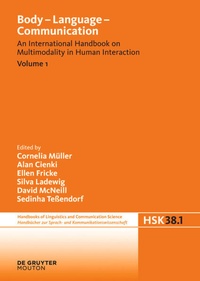
Body - Language - Communication. Volume 1
Description

Volume I of the handbook presents contemporary, multidisciplinary, historical, theoretical, and methodological aspects of how body movements relate to language. It documents how leading scholars from differenct disciplinary backgrounds conceptualize and analyze this complex relationship. Five chapters and a total of 72 articles, present current and past approaches, including multidisciplinary methods of analysis. The chapters cover:
I. How the body relates to language and communication: Outlining the subject matter,
II. Perspectives from different disciplines,
III. Historical dimensions,
IV. Contemporary approaches,
V. Methods.
Authors include: Michael Arbib, Janet Bavelas, Marino Bonaiuto, Paul Bouissac, Judee Burgoon, Martha Davis, Susan Duncan, Konrad Ehlich, Nick Enfield, Pierre Feyereisen, Raymond W. Gibbs, Susan Goldin-Meadow, Uri Hadar, Adam Kendon, Antja Kennedy, David McNeill, Lorenza Mondada, Fernando Poyatos, Klaus Scherer, Margret Selting, Jürgen Streeck, Sherman Wilcox, Jeffrey Wollock, Jordan Zlatev.
More details
Other editions
Additional editions
Persons
Content
2 - I. How the body relates to language and communication: Outlining the subject matter [Seite 15]
2.1 - 1. Exploring the utterance roles of visible bodily action: A personal account [Seite 15]
2.2 - 2. Gesture as a window onto mind and brain, and the relationship to linguistic relativity and ontogenesis [Seite 36]
2.3 - 3. Gestures and speech from a linguistic perspective: A new field and its history [Seite 63]
2.4 - 4. Emblems, quotable gestures, or conventionalized body movements [Seite 90]
2.5 - 5. Framing, grounding, and coordinating conversational interaction: Posture, gaze, facial expression, and movement in space [Seite 108]
2.6 - 6. Homesign: When gesture is called upon to be language [Seite 121]
2.7 - 7. Speech, sign, and gesture [Seite 133]
3 - II. Perspectives from different disciplines [Seite 143]
3.1 - 8. The growth point hypothesis of language and gesture as a dynamic and integrated system [Seite 143]
3.2 - 9. Psycholinguistics of speech and gesture: Production, comprehension, architecture [Seite 164]
3.3 - 10. Neuropsychology of gesture production [Seite 176]
3.4 - 11. Cognitive Linguistics: Spoken language and gesture as expressions of conceptualization [Seite 190]
3.5 - 12. Gestures as a medium of expression: The linguistic potential of gestures [Seite 210]
3.6 - 13. Conversation analysis: Talk and bodily resources for the organization of social interaction [Seite 226]
3.7 - 14. Ethnography: Body, communication, and cultural practices [Seite 235]
3.8 - 15. Cognitive Anthropology: Distributed cognition and gesture [Seite 248]
3.9 - 16. Social psychology: Body and language in social interaction [Seite 266]
3.10 - 17. Multimodal (inter)action analysis: An integrative methodology [Seite 283]
3.11 - 18. Body gestures, manners, and postures in literature [Seite 295]
4 - III. Historical dimensions [Seite 309]
4.1 - 19. Prehistoric gestures: Evidence from artifacts and rock art [Seite 309]
4.2 - 20. Indian traditions: A grammar of gestures in classical dance and dance theatre [Seite 314]
4.3 - 21. Jewish traditions: Active gestural practices in religious life [Seite 328]
4.4 - 22. The body in rhetorical delivery and in theater: An overview of classical works [Seite 337]
4.5 - 23. Medieval perspectives in Europe: Oral culture and bodily practices [Seite 351]
4.6 - 24. Renaissance philosophy: Gesture as universal language [Seite 372]
4.7 - 25. Enlightenment philosophy: Gestures, language, and the origin of human understanding [Seite 386]
4.8 - 26. 20th century: Empirical research of body, language, and communication [Seite 401]
4.9 - 27. Language - gesture - code: Patterns of movement in artistic dance from the Baroque until today [Seite 424]
4.10 - 28. Communicating with dance: A historiography of aesthetic and anthropological reflections on the relation between dance, language, and representation [Seite 435]
4.11 - 29. Mimesis: The history of a notion [Seite 446]
5 - IV. Contemporary approaches [Seite 459]
5.1 - 30. Mirror systems and the neurocognitive substrates of bodily communication and language [Seite 459]
5.2 - 31. Gesture as precursor to speech in evolution [Seite 474]
5.3 - 32. The co-evolution of gesture and speech, and downstream consequences [Seite 488]
5.4 - 33. Sensorimotor simulation in speaking, gesturing, and understanding [Seite 520]
5.5 - 34. Levels of embodiment and communication [Seite 541]
5.6 - 35. Body and speech as expression of inner states [Seite 559]
5.7 - 36. Fused Bodies: On the interrelatedness of cognition and interaction [Seite 572]
5.8 - 37. Multimodal interaction [Seite 585]
5.9 - 38. Verbal, vocal, and visual practices in conversational interaction [Seite 597]
5.10 - 39. The codes and functions of nonverbal communication [Seite 617]
5.11 - 40. Mind, hands, face, and body: A sketch of a goal and belief view of multimodal communication [Seite 635]
5.12 - 41. Nonverbal communication in a functional pragmatic perspective [Seite 656]
5.13 - 42. Elements of meaning in gesture: The analogical links [Seite 666]
5.14 - 43. Praxeology of gesture [Seite 682]
5.15 - 44. A "Composite Utterances" approach to meaning [Seite 697]
5.16 - 45. Towards a grammar of gestures: A form-based view [Seite 715]
5.17 - 46. Towards a unified grammar of gesture and speech: A multimodal approach [Seite 741]
5.18 - 47. The exbodied mind: Cognitive-semiotic principles as motivating forces in gesture [Seite 763]
5.19 - 48. Articulation as gesture: Gesture and the nature of language [Seite 793]
5.20 - 49. How our gestures help us learn [Seite 800]
5.21 - 50. Coverbal gestures: Between communication and speech production [Seite 812]
5.22 - 51. The social interactive nature of gestures: Theory, assumptions, methods, and findings [Seite 829]
6 - V. Methods [Seite 845]
6.1 - 52. Experimental methods in co-speech gesture research [Seite 845]
6.2 - 53. Documentation of gestures with motion capture [Seite 865]
6.3 - 54. Documentation of gestures with data gloves [Seite 876]
6.4 - 55. Reliability and validity of coding systems for bodily forms of communication [Seite 887]
6.5 - 56. Sequential notation and analysis for bodily forms of communication [Seite 900]
6.6 - 57. Decoding bodily forms of communication [Seite 912]
6.7 - 58. Analysing facial expression using the facial action coding system (FACS) [Seite 925]
6.8 - 59. Coding psychopathology in movement behavior: The movement psychodiagnostic inventory [Seite 940]
6.9 - 60. Laban based analysis and notation of body movement [Seite 949]
6.10 - 61. Kestenberg movement analysis [Seite 966]
6.11 - 62. Doing fieldwork on the body, language, and communication [Seite 982]
6.12 - 63. Video as a tool in the social sciences [Seite 990]
6.13 - 64. Approaching notation, coding, and analysis from a conversational analysis point of view [Seite 1000]
6.14 - 65. Transcribing gesture with speech [Seite 1015]
6.15 - 66. Multimodal annotation tools [Seite 1023]
6.16 - 67. NEUROGES - A coding system for the empirical analysis of hand movement behaviour as a reflection of cognitive, emotional, and interactive processes [Seite 1030]
6.17 - 68. Transcription systems for gestures, speech, prosody, postures, and gaze [Seite 1045]
6.18 - 69. A linguistic perspective on the notation of gesture phases [Seite 1068]
6.19 - 70. A linguistic perspective on the notation of form features in gestures [Seite 1087]
6.20 - 71. Linguistic Annotation System for Gestures (LASG) [Seite 1106]
6.21 - 72. Transcription systems for sign languages: A sketch of the different graphical representations of sign language and their characteristics [Seite 1133]
