

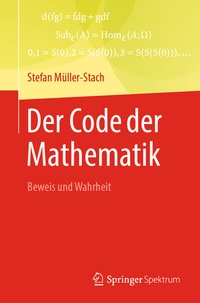
Der Code der Mathematik
Description

Motiviert durch aktuelle Entwicklungen in der abhängigen Typentheorie und bei Unendlichkategorien präsentiert dieses Buch die Ideengeschichte der Begriffe Wahrheit, Beweis, Gleichheit und Äquivalenz. Neben ausgewählten Ideen von Platon, Aristoteles, Leibniz, Kant, Frege und anderen werden Resultate von Gödel und Tarski über Unvollständigkeit, Unentscheidbarkeit und Wahrheit in deduktiven Systemen und ihren semantischen Modellen vorgestellt. Der Hauptgegenstand dieses Textes ist die abhängige Typentheorie und neuere Entwicklungen in der Homotopy Type Theory. Diese Theorien beinhalten Identitätstypen, die neue Möglichkeiten für Gleichheit, Symmetrie, Äquivalenz und Isomorphie auf konzeptuelle Weise eröffnen. Die Interaktion von Typentheorie und Unendlichkategorien ist ein neues Paradigma für eine strukturelle Sichtweise auf die Mathematik. Sie fördert auch den neuen Trend zur Formalisierung von Mathematik in Form von Beweisassistenten.
Reviews / Votes
"It is written by an established working mathematician, and it is addressed mainly to a general audience. It is useful though, to young students of mathematics and to mathematicians who would like to have a better view of the current situation on the foundations of mathematics." (Iosif Petrakis, zbMATH 1535.00001, 2024)
More details
Other editions
Additional editions
Person
Prof. Dr. Stefan Müller-Stach ist hauptamtlicher Vizepräsident für Forschung und wissenschaftlichen Nachwuchs an der Johannes Gutenberg-Universität Mainz. Seine Forschungsinteressen liegen in der Algebraischen und Arithmetischen Geometrie sowie in der mathematischen Physik.
Content
Grundlegende Fragen.- Die Suche nach einer Wissenschaftssprache. Die mathematische Denkweise.- Mathematik in unserer Kultur.- Berechenbarkeit und Entscheidbarkeit.- Deduktive Systeme und Unvollständigkeit.- Kategorientheorie.- Typentheorie.- Wahrheit und Semantik.
