

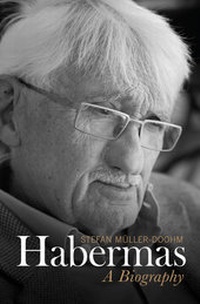
Habermas
Description

More details
Other editions
Additional editions
Person
Content
* Acknowledgements
* Preface
* Prologue: The Other among his Peers
* Part I: Catastrophe and Emancipation
* Chapter 1: Disaster Years as Normality. Childhood and Youth in Gummersbach
* Born in 1929
* Turning point: 1945
* Chapter 2: At University in Göttingen, Zurich and Bonn
* Doctorate on the philosophy of Schelling
* Speaking out as a freelance journalist
* The beginnings of a career as a public intellectual
* Part II: Politics and Critique
* Chapter 3: Education intellectuelle in Café Marx
* Mutual trust between Habermas and the Adornos
* Horkheimer's animosities towards the 'dialectical Mr H.'
* The 'most promising intellectual'
* Chapter 4: Under the Aegis of Conflicting Personalities: Abendroth and Gadamer
* A man of the democratic left
* Positions in the dispute over the right form of critique and good politics
* Chapter 5: Back in Frankfurt. Torn between Academic Work and Political Practice
* In search of an epistemological foundation for critique
* Thinking with the protest movement against the protest movement
* In the line of fire from his own side
* A new track in philosophical thought
* Chapter 6: In the Ivory Tower of Social Scientific Research
* Between Academic Management and Research
* A theory about the impossibility of not learning
* The minefield of political interpretations in the 'German Autumn'
* Resignation
* Part III: Science and Commitment
* Chapter 7: Genius Loci: In Frankfurt for the Third Time
* The major work
* The theory of action
* System and lifeworld
* Everyday life in Frankfurt
* Chapter 8: New Projects
* Under the spell of the philosophy of law
* Morality and law
* Chapter 9: Battles over the Politics of Ideas
* Opinion leader of the new left?
* The historians' debate
* Habermas as a sceptic towards reunification
* Chapter 10: Against Germanomania and Nationalism
* Habermas's ambiguous attitude towards military interventions
* The Asylum Debate
* A memorial to the murdered Jews
* Part IV: Cosmopolitan Society and Justice
* Chapter 11: Critique as a Vocation. The Transition into the Third Millennium
* A plea for freedom of the will and the inviolability of the person
* The philosopher as globetrotter
* Many honours and an affair
* Chapter 12: The Taming of Capitalism and the Democratization of Europe
* Democratic politics D a counterbalance to capitalism?
* European integration
* On the way to a democratically constituted world order
* Chapter 13: Philosophy in the Age of Postmetaphysical Modernity
* What can I know? - Linguistic pragmatics as a form of naturalism and realism
* What should I do? From the demand of virtue to the assumption of rationality
* What may I hope? Religion in a post-secular society
* What is Man? Language and Intersubjectivity
* Chapter 14: Books at an Exhibition
* Consciousness-Raising and Rescuing Critique
* Epilogue: The Inner Compass
* Notes
* Appendix
* * Genealogy
* Chronology
* List of Habermas's lectures and seminars
* Bibliography
* List of archives
* Illustration credits
* Index
Preface
No one has the right to behave towards me as if he knew me.
Robert Walser1
Many labels have been attached to Jürgen Habermas over the years: 'advocate of modernity' and 'master of communication', 'the public conscience of political culture' and the 'Hegel of the Federal Republic', the 'power at the Main',* the 'hothead of Frankfurt' [Frankfurter Feuerkopf] and 'Praeceptor Germaniae' [teacher of Germany], to name just a few.2 That this list of references to Habermas in the media - some of which are less than flattering - could easily be extended demonstrates just how newsworthy he is considered to be; his activities as an academic and as a commentator on contemporary developments certainly do not suffer from a lack of public attention. Why then, in light of all this, write a biography of this man, especially one that neither intends to place Jürgen Habermas, the (somewhat unknown) private person, at its centre nor aims to erect a monument to a 'master thinker' on the occasion of his eighty-fifth birthday? After all, we live in times which, according to Habermas himself, need neither heroes nor anti-heroes. What has driven me, as a sociologist, into the arms of biographical research, and has led me to try my hand at writing a biography once again, is the conviction that the visible traces of a life such as that of Jürgen Habermas are particularly suited for a study of what was, in a certain sense, the central concern of the sociological perspective from the very beginning: namely, the dialectic between individual and society. How is it that someone in interaction with others becomes an individual, and that individuals thus become capable of forging their own unique and specific biographies, but only through a process of engagement with and within their times?
It is admittedly a great temptation to present this particular biography as a story of exceptional success. However, not only would that amount to a misleading attenuation of some of the darker strands in this life's biography (some of which are well known), it would also contradict its, at least on the face of it, conventional bourgeois trajectory. In conversations, Habermas has repeatedly emphasized that the more or less linear course his life has taken fitted into the parameters of the historical circumstances of his generation and fell within the possibilities offered to this generation's members in terms of realizing their personal ambitions under conditions of a regained freedom. If we were to take this self-characterization at face value, we might conclude that Habermas's vita proceeded from phase to phase in the even steps of a standard biography. And it is true that it was characterized by a continuity based on a great degree of outward security: childhood, schooling, student days, marriage, children, profession, etc. As in every life, there were of course ruptures, setbacks and turning points. What, then, makes this existence unique? Where lies the unusual within the usual?
Of course, it is obvious what a remarkable career Habermas has had. With his monographs and collected essays, which have been translated into more than forty languages, he has established a tremendous national and international reputation as a scholar, and as an author he has found a responsive audience even beyond the academic world. With this in mind, one might conclude that Habermas's biography is simply the story of his published work. However, his life is so fascinating precisely because it amounts to more than just a stack of learned books: here is someone who continually left the protective space of academia in order to assume the role of a participant in controversial debates and, in this way, sought to influence the development of the national mentality in his home country. And, we may add, he was successful in this. In that sense, the retracing of the events that formed Habermas's life provides only the basso ostinato, so to speak, for what is actually the main interest of this biography: namely, to present a portrait of the entanglement of his main profession with his second occupation, of the interrelations between the development of a philosopher's thought and the interventions of a public intellectual, as seen against the backdrop of contemporary events.
No matter where a biographer may place the emphases, he is always guilty of a certain presumption; this is simply to be acknowledged. Biographical research and writing always involve a certain indiscretion - one may even speak of biographical investigations as hostile acts. A biographer cannot but make a private life the object of his curious gaze. Even worse: he roams around in the life of his protagonist and assumes the authority to decide which events will be looked at in detail and which will only be touched upon, or which will be considered so insignificant as to be left out altogether. Thus, he has to decide which moments of a life will be omitted, which connections will be left out, and if and when gaps will be filled by means of applying the method of 'exact fantasy' (Theodor W. Adorno).
At such moments, a biographer is not that far removed from the novelist. He is as much in the dark as to the significance of the insights gained while reviewing the course of a life as the protagonist in Max Frisch's Gantenbein - 'What really happened?' In order to capture the ruptures and contradictions in a life's history, a biographer adopts the stance of Frisch's protagonist, who feigns blindness: 'I imagine.'3 And then the search for the story of the story begins - a search in which, as compared to the novelist, the biographer may have the advantage that he can refer to a body of sources that guides his narration.
From all this follows that a biography may at best offer trustworthiness but never certainty. I believe that any attempt at representing the events that make up a life as they really happened, and be it on a miniature scale, is doomed to failure from the start. Thus, this biography does not claim to be true in that sense, and it must disappoint those readers who expect that the biographer will offer them a kind of intimate contact with the object of biographical curiosity, or that he may even include some sensational revelations about it.
This book shines the spotlight on Habermas's life and on significant movements in his thought and forgoes the chimera of an authentic representation of the person, as in a portrait. Instead, distinct types of texts are at the centre of this biographical study. To put it in simple terms: it is in the first instance about deeds and only in the second instance about the doer. I shall read first and foremost the traces left by Habermas as an author in the widest possible sense: as a philosopher and as an example of those intellectuals who, as doers, advance the political process.
The institutional spaces in which to find these traces are, of course, archives. Among them is my own Habermas Archive, which I compiled systematically over many years from sources I considered significant, such as available publications by Habermas, parts of his correspondence, interviews and autobiographical fragments, and the majority of the articles he published in daily and weekly newspapers and in cultural journals from 1953 onwards. In addition, there are photographs and other images, and also records of conversations with Habermas's acquaintances and contemporaries.4 The principles employed in the selection, systematic compilation and then analysis of the sources from this and other archives were informed by the specific question asked by this biography: how did Habermas become the philosopher of communicative reason, on the one hand, and the influential public intellectual, on the other?
As far as the discursive practice of the intellectual is concerned, the centre of attention will be not Habermas's personality but his concrete interventions in the public sphere. In this context, an important aspect will be the question of how the various battles for attention and intellectual dominance in the interpretation of events, which Habermas continually engaged in (and some of which he also initiated), led to the development of polarizations within the public life of the Federal Republic. I also consider the question of which discursive means - or strategies in the politics of ideas [ideenpolitische Strategien] - he used as a protagonist in intellectual controversies. And, finally, I ask how Habermas, who is often assigned the function of an opinion leader* of the left-liberal camp, if one wants to call it that, actually delineates his position through the process of his intellectual interventions.
This biography is structured by the interplay between philosophical reflections and intellectual interventions that characterizes Habermas's activities. For the most part it avoids focusing exclusively on the individual, and it eschews speculation about what Habermas might have 'thought' or 'felt' on this or that occasion. Rather, the aim is to present the interdependency of life and work within the historical context.
What role does the attitude of the biographer play in this? Without a doubt, the challenge of biographical writing is to succeed in walking the tightrope between intimacy and detachment, between the external...
