


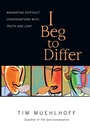
I Beg to Differ
Description

How do we communicate with people who disagree with us?In today's polarized world, friends and strangers clash with each other over issues large and small. Coworkers have conflicts in the office. Married couples fight over finances. And online commenters demonize one another's political and religious perspectives. Is there any hope for restoring civil discourse?Communications expert Tim Muehlhoff provides a strategy for having difficult conversations, helping us move from contentious debate to constructive dialogue. By acknowledging and entering into the other person's story, we are more likely to understand where they're coming from and to cultivate common ground. Insights from Scripture and communication theory provide practical ways to manage disagreements and resolve conflicts.We can disagree without being disagreeable. And we can even help another see different points of view and learn from one another. Find out how.
More details
Other editions
Additional editions
Person
Tim Muehlhoff (PhD, University of North Carolina, Chapel Hill) is professor of communication at Biola University in La Mirada, California, where he teaches classes in family communication, interpersonal communication, persuasion, and gender. Tim is senior director of the Winsome Conviction Project. His books include I Beg to Differ, Eyes to See, and Winsome Persuasion.
Gregg A. Ten Elshof (PhD, University of Southern California) is professor of philosophy at Biola University. His areas of interest include metaphysics, epistemology, modern philosophy, and Confucianism. His book, I Told Me So: Self-Deception and the Christian Life won the Christianity Today 2009 Book Award for Christian Living. He is also author of Confucius for Christians. Elshof has published articles in Midwest Studies in Philosophy, The Modern Schoolman, Grazer Philosophische Studien, The Journal of Philosophical Research, International Studies in Philosophy, Philosophia Christi, and Christian Scholar's Review.
Content
Table of Contents Foreword by Gregg Ten Elshof Acknowledgments Introduction Part I: Understanding Communication 1. Reclaiming the Power of Words 2. What Causes Verbal Dams to Rupture? 3. Managing and Expressing Emotions in the Midst of Disagreement 4. Spiritual Disciplines: Power to Resolve Conflict Part II: Organizing a Conversation 5. Question One: What Does this Person Believe? 6. QuestionTwo: Why Does This Person Hold This Belief? 7. Question Three: Where do We Agree? 8. The Rule of Reciprocation: Why Steps One Through Three Work 9. Question Four: Based on All I?ve Learned, How Should I Proceed? PartIII: Putting it into Practice 10. Case Study One: Disagreeing about Finances 11. Case Study Two: Disagreeing over Religion in the Workplace 12. Case Study Three: Teens and Excessive use of Video Games Epilogue Notes Name and Subject Index Scripture Index
