

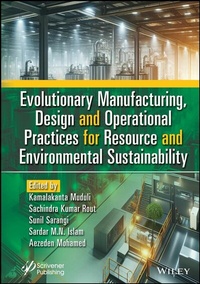
Evolutionary Manufacturing, Design and Operational Practices for Resource and Environmental Sustainability
Description

This book highlights the important use of digital technologies and the latest developments in mechanical and industrial engineering to enhance environmental and resource sustainability.
Sustainable Development Goals (SDGs) have as their overarching objective the reduction or eradication of a wide range of global problems, including, but not limited to poverty, climate change, environmental degradation, and inequality. Digital technologies (DTs) have the potential to be exploited to meet the goals associated with the circular economy (CE) and sustainable development. Additive manufacturing (AM), cyber-physical systems (CPS), and blockchain technology are examples of DT-enabled technologies that are helpful for businesses that seek to shift to a circular economic model.
With the remanufacturing of products, applications that make use of virtual reality and augmented reality, in addition to the Internet of Things, simplify the construction of strategic decision models that reduce time and expense while simultaneously increasing productivity. In addition, the utilization of big data analytics helps businesses discover previously undisclosed trends and unlock numerous opportunities for environmental and resource sustainability. Employing analytics makes it feasible to collect helpful information regarding the socio-environmental impact of a product, as well as consumption factors over the entirety of a product's life cycle.
This book contains 44 comprehensive chapters and is divided into five parts. Part 1 delves deeply into sustainable operational practices and supply chain management. The impact that digital technology-enabled operational techniques have on product life cycles is investigated, as well as the design of efficient remanufacturing processes, environmentally friendly logistics and warehousing practices, sustainable designs for distributed energy supply systems, and efficient recycling procedures.
Part 2 provides a perspective on advanced materials and developments for sustainable manufacturing. The chapters in this section address sustainable material development and its application in the circular economy concept. Included here is an in-depth exploration of cutting-edge technology for synthesis, processing, fabrication, process optimization, testing, and performance evaluation of advanced materials. Part 3 covers sustainable manufacturing practices and looks at the problems faced by the industry when using digital technologies in their operations, as well as the possible benefits.
Part 4 examines sustainable innovation in mechanical design. It addresses all aspects of mechanical design that contribute to sustainable innovation for nation-building. Part 5 delves into heat transfer and fluid flow concepts for sustainable product development and applications. The chapters explain how to construct sustainable energy systems by reducing the total amount of energy that is utilized, enhancing the efficiency of the process of energy conversion, and making use of sources of energy that are renewable.
Audience
This book has a wide audience in academic institutions and engineers in a variety of manufacturing industries. It will also appeal to economists and policymakers working on the circular economy, clean tech investors, industrial decision-makers, and environmental professionals.
More details
Other editions
Additional editions
Persons
Kamalakanta Muduli, Ph.D, is an associate professor in the Department of Mechanical Engineering, Papua New Guinea University of Technology, Papua New Guinea. His research interests focus on materials science, manufacturing, sustainable supply chain management, and industry 4.0 applications in operations and supply chains. He is the recipient of the ERASMUS award by the European Union and published more than 80 papers in peer-reviewed international journals.
Sachindra Kumar Rout, PhD, is an assistant professor at CV Raman Global University in Bhubaneswar, India. He obtained a PhD from the National Institute of Technology in Rourkela, India. His research is based on refrigeration & air conditioning along with the development of laboratory equipment. Rout has published 20+ papers in international journals.
Sunil Sarangi, PhD, is a professorial fellow at the Indian Institute of Technology in Bhubaneswar, India. He obtained his doctorate from the State University of New York. His research fields of interest include cryogenic refrigeration and liquefaction systems. He has published more than 100 papers in international journals and has been awarded the Lifetime Achievement Award of INAE in 2016.
Sardar M.N. Islam, PhD, is a professor at the Institute for Sustainable Industries and Liveable Cities, Victoria University in Australia. He was a professor of business, economics, and finance from 2007 to 2017, and has had many years of academic work experience in teaching, supervision, and multi-disciplinary research. He has published extensively across a broad range of disciplines and his research has attracted international acclaim, leading to several appointments as a distinguished visiting professor. His research ranges in fields of artificial intelligence, accounting, industrial engineering, and finance.
Aezeden Mohamed, PhD, is a senior lecturer in the Department of Mechanical Engineering, Papua New Guinea University of Technology in Lae, Papua New Guinea. He obtained his doctorate in mechanical engineering from the University of Manitoba, Winnipeg, Canada. His main research focuses on corrosion prevention, non-destructive technologies, and biomedical engineering. He has co-authored a book titled Theory of Metal Cutting, published more than 70 articles in journals and conference proceedings, and has 3 patents in material and manufacturing technology.
Content
Preface xxiii
Part 1: Sustainable Operational Practices and Supply Chain Management 1
1 Financial Impacts of COVID-19: A Special Emphasis on the Sustainability of Indian Banking Sectors and Stock Markets 3
Pradeep Reddy K., Venkateswarlu Chandu, Ch. Sahyaja, Shifaly, Elia Thagaram, Amala Gangula and Debesh Mishra
1.1 Introduction 4
1.2 Research Methodology 5
1.3 Literature 5
1.4 Conclusion 8
2 Dynamic Load Frequency Control of Microgrids with Diverse Distributed Energy Resources 11
Mathew Pua, Ashish Kr. Luhach and Joseph Fisher
2.1 Introduction 12
2.2 PV Modeling 12
2.3 Grid Modeling 17
2.4 Mathematical Model of PV-Grid System 27
2.5 Conclusion 28
3 Analysis of Microgrids with Diverse Distributed Energy Resources Using Genetic Algorithm 31
Mathew Pua, Ashish Kr. Luhach and Joseph Fisher
3.1 Introduction 32
3.2 Mathematical Model of PV-Grid System 33
3.3 Results and Discussion 35
3.4 Results Obtained at Dynamic State Using Proposed GA-Optimized PID Controller 41
3.5 Conclusion 47
4 Comparison of Solar Power Forecasting Using RNN-Dense and LSTM-Dense Neural Network 49
Sushree Samikshya Pattanaik, Ashwin Kumar Sahoo and Rajesh Panda
4.1 Introduction 50
4.2 Related Work 50
4.3 Machine Learning 51
4.4 Methodology 52
4.5 Results 56
4.6 Conclusion 59
5 Organizational Opportunities Through Digital-and Social-Media Marketing for Sustainable Businesses 61
Pradeep Reddy K., Venkateswarlu Chandu, Ch. Sahyaja, Shifaly, Elia Thagaram, Amala Gangula, Debesh Mishra and Sibabrata Mohanty
5.1 Introduction 62
5.2 Methodology 63
5.3 Literature 63
5.4 Challenges in DSMM 66
5.5 Conclusion 67
6 Design of Innovative and User-Friendly Household PET Plastic Bottle Shredder to Promote Green Economy 71
McKurai Minig, Christopher Bubuwau and Aezeden Mohamed
6.1 Introduction 71
6.2 Literature Review 72
6.3 Methodology 73
6.4 Results and Discussion 75
6.5 Conclusion and Recommendation 78
Part 2: Prospective of Advanced Materials and Development for Sustainable Manufacturing 81
7 Sacrificial Anodes and Environmental Effects 83
Noel Martin and Aezeden Mohamed
7.1 Introduction 84
7.2 Literature Review 91
7.3 Methodology 94
7.4 Recommendation 101
7.5 Conclusion 102
8 Experimental Investigation of Steel and Porous Al Foam LM Vehicle Leaf Spring By Using Mechanical and Computer Method 107
K. Manickaraj, R. Ramamoorthi, Karuppasamy R., S. Kannan and B. Vijayaprakash
8.1 Introduction 108
8.2 Manufacture of Al Foam 108
8.3 Tests for Deflection 108
8.4 Results and Discussion 111
8.5 Conclusion 111
9 Effect on Mechanical and Physical Properties of Microwave-Sintered Alumina Nanocomposite on Addition of ZrO2 and MgO 113
K.L. Meena, Shaik Mozammil and Eklavya Koshta
9.1 Introduction 114
9.2 Investigation Procedure 115
9.3 Results and Discussion 117
9.4 Conclusions 120
10 Pull Test Analysis of Friction Welding Samples on Boiler Grade Materials With the Assistance of Taguchi and ANOVA 125
A. Daniel Das and S. Manivannan
10.1 Introduction 126
10.2 Experimental Investigation 126
10.3 Discussion on Results 128
10.4 Conclusions 132
11 A Review of Natural Biofiber-Reinforced Polymer Matrix Composites 135
K. Manickaraj, R. Ramamoorthi, Karuppasamy R., K. R. Sakthivel and B. Vijayaprakash
11.1 Introduction 136
11.2 Biofibers in Manufacturing 136
11.3 Composites Made of Natural Biofibers 137
11.4 Natural Fibers Treatment 137
11.5 Selecting A Matrix 138
11.6 Mechanical Characteristics of Composites 138
11.7 Conclusion 139
12 Evaluation of Hot Corrosion and High Temperature Oxidation on GTA Weldments of Nb-Controlled INCONEL 718 143
A. Daniel Das and S. Manivannan
12.1 Introduction 144
12.2 Experimental Procedure 144
12.3 Results and Discussion 146
13 Review on "Fused Deposition Modeling" Process Parameters and Their Influence on Material Properties: A Sustainable Approach 153
Deepak J., Adarsha H., A. Pattanaik and Ramkumar N.P.
13.1 Introduction 154
13.2 Process Parameters 154
13.3 Properties Affected by Different Process Parameters 157
13.4 Conclusions 160
14 Numerical Investigation of Combustion Characteristics for Soybean Biodiesel Depending on Variable Compression Ratios by Using Diesel RK Software 163
Abdullah Lattouf Hussein Juma, M. K. Parida and H. Joardar
14.1 Introduction 164
14.2 Physical Properties of Biodiesel 165
14.3 Production of Biodiesel 167
14.4 Diesel-RK Software 168
14.5 Results and Discussion 169
14.6 Conclusion 173
15 Property Evaluation of Coconut Shell Ash-Reinforced Aluminum Composite Made by Squeeze Casting 177
P. Paranthaman, Debabrata Barik, R. Arul Murugan and N. Sathiesh Kumar
15.1 Introduction 177
15.2 Materials and Methods 179
15.3 Results and Discussion 180
15.4 Conclusion 182
16 Synthesis and Characterization of AZ91 Magnesium Alloy-Alumina/Ceria Composite Coating By Thermal Spray Technique 185
Adarsha H., Ashutosh Pattanaik, S. C. Sharma and Bikash Ranjan Moharana
16.1 Introduction 186
16.2 Selection of Materials and Methods 187
16.3 Results and Discussions 188
16.4 Conclusions 190
17 Sustainable Corrosion Prevention System of Steel Structures 193
Noel Martin and Aezeden Mohamed
17.1 Introduction 194
17.2 Sustainable Sacrificial Anodes 194
17.3 Impressed Current Cathodic Protection System 197
17.4 Test Results from Idubada SACP Terminal (PNG) 198
17.5 Wewak Sacrificial Anodes CP 200
17.6 Conclusion 202
18 Design of a Binary Distillation Column to Increase the Naphthalene Yield in Tar Distillation Plant of a Steel Plant 203
Rudra Narayan Mohapatro, Ranjita Swain, Sunita Routray and PrabhakarSethi
18.1 Introduction 204
18.2 Material Method 205
18.3 Results and Discussion 207
18.4 Results and Discussion by Using Software 211
18.5 Conclusion 216
18.6 References 216
19 Machining of Ni-Based Super Alloy with Coated and Uncoated Tools in a Sustainable Machining Environment 217
Pravatnalini Chhotaray and Bikash Chandra Behera
19.1 Introduction 217
19.2 Materials and Methods 218
19.3 Results and Discussion 219
19.4 Conclusion 221
Part 3: Sustainable Manufacturing Practices 223
20 The New Age of Manufacturing from Concept to Creation: Innovative World of 3D Printing 225
Sunil Kumar Panda, Kali Charan Rath and Sujit Mishra
20.1 Introduction 226
20.2 Additive Manufacturing Technology 226
20.3 3D Printing Method 234
20.4 Role of 3D Printing in Industry 4.0 240
20.5 Conclusion 242
21 Optimization of EDM Process Parameters with Fuzzy Logic Technique for SS-316 Steel and Investigation of Microstructural Characteristics of EDM Machining Surface 245
G. Sridevi, Kali Charan Rath, Sujit Mishra, Santosh Patro and P. Srinivasa Rao
21.1 Introduction 246
21.2 Investigational Setup 247
21.3 Fuzzy Modeling 249
21.4 Results and Discussion 251
21.5 Microstructural Characterization of Machining Surface 254
21.6 Conclusions 255
22 Comparison Evaluation of Machining Characteristics of Hypereutectic Aluminium-20%Silicon with Uncoated, PVD, and CVD Coated Inserts 257
Arunkumar D. T., Ashutosh Pattanaik, K. G. Basavakumar and P. S. Raghvendra Rao
22.1 Introduction 258
22.2 Materials and Methodology 259
22.3 Results and Discussion 261
22.4 Conclusions 264
23 A Review of TIG Welding Processes: Experimentation and Finite Element Analysis for Sustainable Operational Practices 267
Anish K. Raj, Bikash Ranjan Moharana and Kalinga Simant Bal
23.1 Introduction 268
23.2 Joining of Metals by TIG Welding Process 269
23.3 Joining of Metals by Pulsed-TIG (P-TIG) Welding Process 271
23.4 Case Study: Experimental Investigation 272
23.5 Conclusions 277
24 Strategic Implementation of Reliability Centered Maintenance with Development of a Framework of an Indian Manufacturing Industry 281
Hiranmoy Samanta, Pradip Kumar Talapatra and Kamal Golui
24.1 Introduction 282
24.2 Literature Review 282
24.3 How the Concept of RCM was Generated (Background) 282
24.4 Various Definitions of RCM 283
24.5 Objectives of RCM 283
24.6 Components of RCM 284
24.7 RCM Principles 285
24.8 RCM Methodology 286
24.9 Step-by-Step Analysis of Reliability-Centered Maintenance 287
24.10 Maintenance Analysis Process for Machines 288
24.11 Evaluations of the Machines 288
24.12 Conclusion 289
Part 4: Sustainable Innovation in Mechanical Design 291
25 Bending Behavior of Multi-Layered Ionic Polymer Metal Composite Actuator in Time Domain 293
Dillip Kumar Biswal, Ashutosh Biswal and Bikash Ranjan Moharana
25.1 Introduction 294
25.2 Bending Behavior of Fabricated Ag-IPMC 295
25.3 Fabricated Ag-IPMC Modeling 298
25.4 Results and Discussion 299
25.5 Conclusion 301
26 Experimental Approach for Analyzing the Algorithm with Camera on Distracted Driving Algorithms by Using Image Recognition Models 303
Brijesh S. Patil and Divya Midhunchakkaravarthy
26.1 Introduction 303
26.2 Methodology 305
26.3 Working Approach 306
26.4 Experimental Approach 308
26.5 Conclusion 312
27 Techno-Economic and Feasibility Analysis of a Mixed Mode Solar Dryer 315
Deepak C. N. and A. K. Behura
27.1 Introduction 316
27.2 Materials and Methods 317
27.3 Thermal Energy Storage Integration 321
27.4 Results and Discussion 322
27.5 Conclusion 323
28 Fabrication of Four-Wheel Steering With Three-Mode Operation 325
Jayapradha P., Arun Prakash J. and Debabrata Barik
28.1 Introduction 326
28.2 Result and Discussion 327
28.3 Working Principle 332
28.4 Conclusion 332
Part 5: Heat Transfer and Fluid Flow Concept for Sustainable Product Development and Their Application 335
29 Effectiveness of Solar Still Combining Thermocol Insulation with Locally Accessible Heat Storage Materials: An Experimental Approach 337
Saurav Sahoo and Dillip Kumar Biswal
29.1 Introduction 338
29.2 Experimental Investigation 340
29.3 Results and Discussion 341
30 Estimation of Cooling Load of Air Cooling System for a Hospital Room 347
Saurav Sharma, Amit Kumar, Shrikant Vidya, Pramod Kumar and Md. Maroof
30.1 Introduction 348
30.2 Analysis and Evaluation 350
30.3 Results and Discussion 352
30.4 Conclusion 352
31 Numerical Investigation of Small-Scale Model of a Blast Furnace for Laminar and Turbulent Regimes 355
Shafiq Mohamad, Sachindra Kumar Rout, Neruda Barakat, Jnana Ranjan Senapati and Sunil Kumar Sarangi
31.1 Introduction 356
31.2 Literature Review 356
31.3 Geometry Investigation and Quantitative Evaluation 358
31.4 Findings and Discussion 360
31.5 Conclusions 363
32 A Critical Review on Blood Flow Modeling: Relevance to Rheology, Numerical and Computational Methods 365
Hiranmoy Samanta, Binoy Mandal, Abhijit Majumder, Srrejit Roy Chowdhury and Gulshan Kumar
32.1 Introduction 365
32.2 Constitutive Models of Blood 367
32.3 Mathematical Modeling of Blood Flow Simulation 369
32.4 Conclusions 376
33 Research Trends and Perspectives of Thermal Management of Photovoltaic/Thermal (PV/T) System: Bibliometric Analysis 379
Mukul Kant Paliwal, Sanjeev Jakhar and Vikrant Sharma
33.1 Introduction 380
33.2 Methodology 381
33.3 Results 383
33.4 Discussions 388
33.5 Conclusions 388
34 Waste Cooking Oil Biodiesel Synthesis and Emission Comparison Study of Diesel and Biodiesel as Fuel for Cleaner Environment 391
N. Sathiesh Kumar and Debabrata Barik
34.1 Introduction 392
34.2 Materials and Methods 393
34.3 Preparation of Catalyst 393
34.4 Process of Biodiesel Synthesis 394
34.5 Engine Testing 394
34.6 Exhaust Gas Analyzer 394
34.7 Results and Discussion 395
34.8 Conclusion 397
35 Dynamic Modeling of Solar Parabolic Trough Collector--A Review 401
Subham Show, Binayak Pattanayak and Subhrajit Ray
35.1 Introduction 402
35.2 Methodology 402
35.3 Receiver Numerical Model 403
35.4 Simulation Software 405
35.5 Conclusions and Future Scope 406
36 Minimizing the Surface Temperature of Heat Sink in Electronic Components for Sustainability 409
P. Ragupathi and Debabrata Barik
36.1 Introduction 410
36.2 Methodology 411
36.3 Results and Discussion 415
36.4 Conclusion 416
37 An Investigation of Heat Transfer Performance of a Novel Three-Fluid Heat Exchanger Proposed for Household Heating Systems 419
Belal Almasri and Taraprasad Mohapatra
37.1 Introduction 420
37.2 Materials and Methods 421
37.3 Results and Discussion 423
37.4 Conclusions 427
38 Cooling Load Calculations for a Mosque Using HAP Software: A Case Study 431
Naved Khan, Mohd. Yasar, Shrikant Vidya, Pramod Kumar and Haridwar Narayan
Abbreviations 431
38.1 Introduction 431
38.2 Methodology & Analysis 433
38.3 Results and Discussion 436
38.4 Conclusion 437
39 Challenges and Future Prospects of Hydrogen Fuel Cell Technology: An Overview 441
Arbab Nafees, Shrikant Vidya, Lavepreet Singh, Md. Nasar Equbal and Priyanka Agrawal
39.1 Introduction 442
39.2 Principle of a Fuel Cell 442
39.3 Challenges and Issues 444
39.4 Solving Global Warming 445
39.5 Alternative Fuels 445
39.6 Advanced Ultra-Super Critical Technology (AUSC) 447
39.7 Energy Technology and Climate Change 447
39.8 Renewable Statistics 448
39.9 Carbon Economy 449
39.10 Carbon Footprint 450
39.11 Conclusions and Future Scope 450
40 Adsorption Kinetics Assessment of CO2 Capture in an Adsorber Bed Under Atmospheric Conditions 453
P. Eswar Babu and B. Kiran Naik
40.1 Introduction 454
40.2 Numerical Model 457
40.3 Algorithm 459
40.4 Performance Characteristics of CO2 Capture 460
40.5 Model Validation 461
40.6 Results and Discussion 462
40.7 Conclusions 464
41 Numerical Analysis of a Nature-Inspired Insulation Method for Building Applications 467
Belal Almasri and Taraprasad Mohapatra
41.1 Introduction 468
41.2 Numerical Simulations 470
41.3 Results and Discussion 472
41.4 Conclusions 477
42 Numerical Study of the Unsteady Flow in Simplified and Realistic Bifurcation Arterial Models 481
Hiranmoy Samanta, Kamal Golui, Sk. Tarif Ali and Debajit Saha
42.1 Introduction 481
42.2 Literature Review 482
42.3 Mathematical Modeling of Blood Flow 482
42.4 Results and Discussion 489
42.5 Conclusions 491
43 Study of Natural Convection From a Vertical Wall with Extended Surfaces 495
Sachindra kumar Rout, Ahmad Khadim Hussein, Kamalakanta Muduli, S. K. Asif Uddin, Ayush Kumar Chinara, Dibya Ranjan Mahalik, Roshan Prasad Mallia and Rahul Kumar Sahu
43.1 Introduction 496
43.2 Problem Description 498
43.3 Numerical Procedure 498
43.4 Results 499
43.5 Impact of Radius of Fin to Spacing of Fin Ratio on Nusselt Number 499
43.6 Impact of Rayleigh Numbers on Temperature Contours 500
43.7 Impact of Rayleigh Numbers on Temperature Flow Fields 500
43.8 Conclusions 501
44 Impact of Natural Convection Heat Transfer on the Efficiency of Various Heat Dissipating Devices and Heat Sinks--A Review 503
B. Dash, J. Nanda, S.K. Rout and J.R. Senapati
Nomenclature 503
44.1 Introduction 503
44.2 Literature Review 504
44.3 Numerical Simulation Data Interpretation 506
44.4 Impact of Buoyancy 507
44.5 Conclusion 507
References 507
Index 511
1
Financial Impacts of COVID-19: A Special Emphasis on the Sustainability of Indian Banking Sectors and Stock Markets
Pradeep Reddy K.1, Venkateswarlu Chandu2, Ch. Sahyaja3, Shifaly4, Elia Thagaram5, Amala Gangula6 and Debesh Mishra7*
1School of Management, Sanjeev Agrawal Global Educational University, Bhopal, India
2K. L. Business School, KLE Foundation, Vaddeswaram, AP, India
3GITAM School of Business, GITAM University, Hyderabad, India
4The Hindu College MBA, Machilipatnam, AP, India
5PACE Institute of Technology and Sciences, Ongole, AP, India
6Institute of Banking Personnel Selection, Mumbai, India
7Mechanical Engineering, IES University, Bhopal, India
Abstract
Pandemic COVID-19 depresses the entire global economic situation. Perhaps the most horrendous period of history that has ever been faced by humanity. No country, whether underdeveloped or developing, was spared its wrath. The COVID-19 pandemic had a particularly negative impact on the sustainability of the Indian economy. The Indian banking system encountered and is still facing several issues. With the support of reforms, the government and the Reserve Bank of India (RBI) implemented the required policy modifications to combat the COVID-19 epidemic. The goal of this research is to investigate the state of the Indian banking industry during COVID-19, the changes implemented by RBI as a result of COVID-19, and its effects on the sustainability of Indian banking sectors in addition to the stock markets in general. The banks in India were founded primarily with the intention of making money by providing clients with the services they anticipated. However, the COVID-19 pandemic distorted the Indian clients' situation. People's sources of income were threatened by the lockdowns and closures of enterprises. In the present pandemic condition, Indian banks face these issues with a deprived stock market as well.
Keywords: COVID-19, banking sectors, stock markets, pandemic, economic, India, sustainability, businesses
Abbreviations
RBI Reserve Bank of India WHO World Health Organization KYC Know Your Customer IRAC Income Recognition and Asset Classification EMI Equated Monthly Installments NSE National Stock Exchange
1.1 Introduction
With thousands of deaths worldwide, the corona virus outbreak has affected millions of people. The threat of corona virus is growing as new cases emerge on a daily basis. The Corona viral sickness was found in Wuhan, China in December 2019, and it has since become widespread [1-3]. Following the observation of its infection and amplified death rate, the World Health Organization (WHO), on March 11, 2020, declared it as a pandemic. In the current circumstances, India is severely hit by the Corona virus. COVID-19 causes the global economy to contract, affecting its sustainability. COVID-19 has a broad influence on India. According to a study released by the Reserve Bank of India (RBI), the corona virus damaged enterprises, organizations, and corporations that operated well before the epidemic. The three sectors that make up the bulk of the Indian economy are the primary, secondary, and tertiary sectors, all of which are heavily reliant on the banking industry [4, 5]. As part of its conventional activity, all of these sectors receive financial assistance from the banking sector, which disburses advances, loans, short-term credits, letters of credit, debt securities, and the like. The next era of Indian banking involves tasks such as foreign-exchange support, digital banking, e-commerce, and tele-banking [6].
The uncertainty regarding the scope and length of the epidemic, as well as the consequences for Indian banks of any accompanying limitations on economic activity, has made the overall operating climate unfavorable. The Indian financial sector, which includes banking, non-banking investment firms, and insurance companies, has a significant impact on the real economy because it creates credit and mobilizes available funds. As is well known in the modern period, the Indian government declared a total lockout of the nation beginning on March 24, 2020, which was later prolonged through May 3, 2020. In order to preserve the lives of the citizens of India, the government must go on lockdown. Due to this, all businesses, educational institutions, and offices in the public and private sectors have been shutdown. This will have a significant impact on many areas of our country. The Indian economy is built on sustainability of banking sectors. The purpose of this research was to examine the causative impact of pandemic COVID-19 on the sustainability of banks as a result of the lockdown.
1.1.1 Objectives of the Study
- To investigate the COVID-19 afflicted area.
- To investigate the impact of COVID-19 on the sustainability of Indian banking sectors as well as on the stock markets.
- To investigate government and Reserve Bank of India (RBI) initiatives in response to COVID-19.
1.2 Research Methodology
The impact of COVID-19 on the Indian banking sector is the basis for the research. The study relied on secondary data. For this research, the RBI's websites, manual, recommendations included in the RBI's manuscripts, books, websites, periodicals, and newspapers were used to acquire information.
1.3 Literature
1.3.1 Impact Areas of COVID-19
Standard teller tasks including cash transactions, disbursements, check clearing, and other banking processes all required maintaining a safe distance of at least one meter. Customers' and workers' operational and technical difficulties revealed a weakness and a general lack of adaptability in our banking systems when confronted with an emergency crisis. The bank should refocus its focus toward digitizing and streamlining its backend processes as a result of the present COVID-19 issue. As a result, banks 'would not have to rely on staff interaction, paper-based reviews led by individuals, or manual data entry. In addition to accelerating technology adoption, the COVID-19 crisis will refocus attention on important financial issues, such as:
- Adoption of emerging technologies - as a result of the virus and economic instability, emerging technologies will play a critical role in speeding up transactions and lowering bank expenses. The Indian banking sector has recognized the importance of technologies in attaining success. By removing vertically integrated burdens, it forecasts increased use of microservice building. In the process of digitally transforming banks and other financial institutions, these new technologies will be crucial [7].
- Mechanism of digital revolution - according to the World Bank's 2017 global index report, India have the world's second biggest unbanked population, with 190 million people lacking an account with a bank. The major goal of enhanced internet and mobile connectivity would be to advance technology-enabled digital banking access. Additionally, the business would aim to gradually change customers' preferences away from going to bank locations and toward using digital means. To provide the best channel mix, banks will allow their clients to communicate via several automated and digital channels. To facilitate effective adoption by Indian banking users, banks would evaluate critical criteria such as demography, availability to the internet, last mile connection, customers' banking behavioral patterns, and so on [8].
- Privacy, security, and customers' satisfaction - as reported by the RBI, cyber thefts increased in India's banking industry during the fiscal year 2017, 18, resulting in losses of $13.7 million. With the rising usage of cashless and digital economies, banks will need to create safe frameworks. Financial frauds, money laundering, data loss, identity theft, and privacy breaches are all clear cyber dangers. Banks must take stringent measures to determine external and internal system vulnerability. For safe and smooth transactions, they should be technically fortified with stringent Know Your Customer (KYC), good client identity verification, financial-grade APIs, gateways, smart networks, and so on [9].
- Policies and compliance requirements - in order to build a financial ecosystem for our nation's underbanked and unbanked people, the emphasis should be on improving electronic payments facilities, particularly in rural India [10, 11].
1.3.2 Reforms by the Government of India and RBI
India's top government agency is RBI. which prepares monetary policy-providing directions to all banking institutions. The RBI promotes economic stability while maintaining the country's growth. It announced the "COVID-19 Regulatory-Package" for banks and financial institutions as well as all urban (core) credit unions, provincial financial institutions, and region headquarters' financial institutions including all non-banking financial companies and all institutions of finance across the country (including housing finance companies). For the needy requiring financial assistance for their means of subsistence and food security, the government decided on 1.7 trillion packages....
