

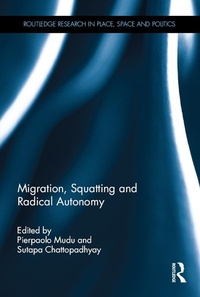
Migration, Squatting and Radical Autonomy
Resistance and destabilization of racist regulatory policies and b/ordering mechanisms
Published on 1. July 2016
316 pages
978-1-317-37575-3 (ISBN)
Description

This book offers a unique contribution, exploring how the intersections among migrants and radical squatter's movements have evolved over past decades. The complexity and importance of squatting practices are analyzed from a bottom-up perspective, to demonstrate how the spaces of squatting can be transformed by migrants. With contributions from scholars, scholar-activists, and activists, this book provides unique insights into how squatting has offered an alternative to dominant anti-immigrant policies, and the implications of squatting on the social acceptance of migrants. It illustrates the different mechanisms of protest followed in solidarity by migrant squatters and Social Center activists, when discrimination comes from above or below, and explores how can different spatialities be conceived and realized by radical practices.
Contributions adopt a variety of perspectives, from critical human geography, social movement studies, political sociology, urban anthropology, autonomous Marxism, feminism, open localism, anarchism and post-structuralism, to analyze and contextualize migrants and squatters' exclusion and social justice issues. This book is a timely and original contribution through its exploration of migrations, squatting and radical autonomy.
Contributions adopt a variety of perspectives, from critical human geography, social movement studies, political sociology, urban anthropology, autonomous Marxism, feminism, open localism, anarchism and post-structuralism, to analyze and contextualize migrants and squatters' exclusion and social justice issues. This book is a timely and original contribution through its exploration of migrations, squatting and radical autonomy.
More details
Series
Language
English
Place of publication
London
United Kingdom
Publishing group
Taylor & Francis Ltd
Target group
College/higher education
Product notice
Reflowable
Illustrations
6 s/w Abbildungen, 3 s/w Tabellen, 4 s/w Photographien bzw. Rasterbilder, 2 s/w Zeichnungen
3 Tables, black and white; 2 Line drawings, black and white; 4 Halftones, black and white; 6 Illustrations, black and white
File size
6,81 MB
ISBN-13
978-1-317-37575-3 (9781317375753)
Copyright in bibliographic data and cover images is held by Nielsen Book Services Limited or by the publishers or by their respective licensors: all rights reserved.
Schweitzer Classification
Other editions
Additional editions
Pierpaolo Mudu | Sutapa Chattopadhyay
Migration, Squatting and Radical Autonomy
Resistance and destabilization of racist regulatory policies and b/ordering mechanisms
Book
02/2018
1st Edition
Routledge
€77.00
Shipment within 10-20 days
Pierpaolo Mudu | Sutapa Chattopadhyay
Migration, Squatting and Radical Autonomy
Resistance and destabilization of racist regulatory policies and b/ordering mechanisms
Book
07/2016
Routledge
€232.20
Shipment within 10-20 days
Persons
Pierpaolo Mudu is Professor in the Faculty of Urban Studies and Interdisciplinary Arts & Sciences at the University of Washington - Tacoma, USA.
Sutapa Chattopadhyay is sessional Lecturer at the University of Toronto-Munk School (Canada) and affiliated Researcher at United Nations and Maastricht Universities (Netherlands).
Sutapa Chattopadhyay is sessional Lecturer at the University of Toronto-Munk School (Canada) and affiliated Researcher at United Nations and Maastricht Universities (Netherlands).
Content
FOREWORD
INTRODUCTION Migrations, Squatting and Radical Autonomy
PART I: BORDERS AND FRONTIERS
1. From the Desert to the Courtroom: Challenging the Invisibility of the Operation Streamline Dragnet and En-masse Hearings
2. Frontex and its Role in the European Border Regime
3. Undocumented Territories: Strategies of Specialization by Undocumented Migrants
4. Trapped on the Border: a Brief History of Solidarity Squatting Practices in Calais
PART II: SQUATTING FOR HOUSING
5. Why Migrants Squats are a Political Issue: a Few Thoughts about the Situation in France
6. Migration and Mobilization for the Right to Housing in Rome. New Urban Frontiers?
7. Student Migrants and Squatting in Rome at Times of Austerity
8. Palazzo Bernini: an Experience of a Multicultural Squatted House in Catania
9. The Untold Struggles of Migrant Women Squatters and the Occupations of Kottbusser Strasse 8 and Forster Strasse 16/17, Berlin-Kreuzberg
PART III: EXCLUSION, CRIMINALIZATION AND PRECARITY
10. Space Invaders: The 'Migrant-Squatter' as the Ultimate Intruder
11. Racialization of Informal Settlements, De-politicization of Squatting and Everyday Resistances in French Slums
12. Emancipation, Integration, or Marginality: The Romanian Roma in Bologna and the Scalo Internazionale Migranti
13. 'We are here to stay': Reflections on the Struggle of the Refugee Group "Lampedusa in Hamburg" and the Solidarity Campaign, 2013-2015
PART IV: DIFFICULTIES OF DIVERSITY AND ACTION
14. Sacred Squatting: Seeking Sanctuary in Religious Spaces
15. Beyond Solidarity: Migrants and Squatters in Madrid
16. Narrating the Challenges of Women-Refugee Activists of Ohlauer Strasse 12, International Women's Space, Berlin
PART V: SOCIAL CENTERS, RADICAL AUTONOMY AND SQUATTING - BEYOND CITIZENSHIP AND BORDERS
17. Trampolinehuset: An Autonomous Culture Center for Refugees in Copenhagen
18. When migrants meet squatters: the case of the movement of migrants and refugees in Caserta
19. Migrant Squatters in the Greek Territory: Practices of Resistance and the Production of the Athenian Urban Space
20. Natural Resource Scarcity, Degrowth Scenarios and National Borders: The Role of Migrant Squats
21. Euro Trash in Loisada, New York
22. Squatting and the Illegalized Migrants' Struggles in the Netherlands
23. Migrations, Squatting and Radical Autonomy: conclusions
INTRODUCTION Migrations, Squatting and Radical Autonomy
PART I: BORDERS AND FRONTIERS
1. From the Desert to the Courtroom: Challenging the Invisibility of the Operation Streamline Dragnet and En-masse Hearings
2. Frontex and its Role in the European Border Regime
3. Undocumented Territories: Strategies of Specialization by Undocumented Migrants
4. Trapped on the Border: a Brief History of Solidarity Squatting Practices in Calais
PART II: SQUATTING FOR HOUSING
5. Why Migrants Squats are a Political Issue: a Few Thoughts about the Situation in France
6. Migration and Mobilization for the Right to Housing in Rome. New Urban Frontiers?
7. Student Migrants and Squatting in Rome at Times of Austerity
8. Palazzo Bernini: an Experience of a Multicultural Squatted House in Catania
9. The Untold Struggles of Migrant Women Squatters and the Occupations of Kottbusser Strasse 8 and Forster Strasse 16/17, Berlin-Kreuzberg
PART III: EXCLUSION, CRIMINALIZATION AND PRECARITY
10. Space Invaders: The 'Migrant-Squatter' as the Ultimate Intruder
11. Racialization of Informal Settlements, De-politicization of Squatting and Everyday Resistances in French Slums
12. Emancipation, Integration, or Marginality: The Romanian Roma in Bologna and the Scalo Internazionale Migranti
13. 'We are here to stay': Reflections on the Struggle of the Refugee Group "Lampedusa in Hamburg" and the Solidarity Campaign, 2013-2015
PART IV: DIFFICULTIES OF DIVERSITY AND ACTION
14. Sacred Squatting: Seeking Sanctuary in Religious Spaces
15. Beyond Solidarity: Migrants and Squatters in Madrid
16. Narrating the Challenges of Women-Refugee Activists of Ohlauer Strasse 12, International Women's Space, Berlin
PART V: SOCIAL CENTERS, RADICAL AUTONOMY AND SQUATTING - BEYOND CITIZENSHIP AND BORDERS
17. Trampolinehuset: An Autonomous Culture Center for Refugees in Copenhagen
18. When migrants meet squatters: the case of the movement of migrants and refugees in Caserta
19. Migrant Squatters in the Greek Territory: Practices of Resistance and the Production of the Athenian Urban Space
20. Natural Resource Scarcity, Degrowth Scenarios and National Borders: The Role of Migrant Squats
21. Euro Trash in Loisada, New York
22. Squatting and the Illegalized Migrants' Struggles in the Netherlands
23. Migrations, Squatting and Radical Autonomy: conclusions
