

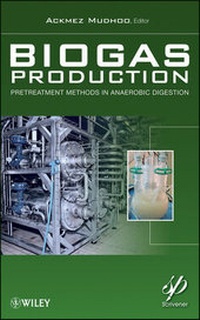
Biogas Production
Description

More details
Other editions
Additional editions
Person
Content
Preface xv
Acknowledgements xvii
Special Contributor xviii
Editor xix
List of Contributors xxi
1. Anaerobic Digestion: Pretreatments of Substrates 1
Tanta Forster-Carnetro, Ricardo Isaac, Montserrat Pérez, and Ciarita Schvartz
1.1 Pretreatments in Anaerobic Digestion Process 2
1.2 Physical Pretreatment 6
1.3 Chemical Pretreatment 15
1.4 Biological Pretreatment 17
1.5 Combined Pretreatment 18
1.6 Concluding Note 19
2. Recalcitrance of Lignocellulosic Biomass to Anaerobic Digestion 27
Mohammad J. Taherzadeh and Azam Jeihanipour
2.1 Introduction 27
2.2 Plant Cell Wall Anatomy 28
2.3 Chemistry of Cell Wall Polymers 30
2.4 Molecular Interactions Between Cell Wall Polymers 39
2.5 Plant Cell Wall Molecular Architecture 40
2.6 Recalcitrance of Plant Cell Wall Cellulose 42
2.7 Reduction of Biomass Recalcitrance 46
2.8 Concluding Note 50
3. The Effect of Physical, Chemical, and Biological Pretreatments of Biomass on its Anaerobic Digestibility and Biogas Production 55
Katerina Stamatelatou, Georgia Antonopoulou, loanna Ntaikou, and Gerasimos Lyberatos
3.1 Introduction 56
3.2 Pretreatment Methods for Lignocellulosic Biomass 57
3.3 Pretreatment Methods for Sewage Sludge 77
3.4 Concluding Note 84
4. Application of Ultrasound Pretreatment for Sludge Digestion 91
Show Kuan Yeow and Wong Lai Peng
4.1 Introduction 91
4.2 Anaerobic Digestion 93
4.3 Overview of Pretreatment Methods for Anaerobic Digestion 95
4.4 Fundamental of Ultrasound 100
4.5 Bubbles Dynamic 103
4.6 Effects of Ultrasound 106
4.7 Ultrasound Applications 109
4.8 Ultrasonication for Anaerobic Digesion 116
4.9 Evaluation on Sludge Disintegration 126
4.10 Conclusions 131
5. Microwave Sludge Irradiation 137
Cigdetn Esktctoglu and Giampiero Galvagno
5.1 Introduction 137
5.2 Microwave Theory 139
5.3 Microwave Irradiation for Waste Sludge Treatment 144
5.4 Industrial Microwave Applications 147
5.5 Microwave Absorbing Materials and Ionic Liquids 148
5.6 Sludge Pretreatment Similar to Microwave Irradiation 151
5.7 Concluding Notes 151
6. Hydrolytic Enzymes Enhancing Anaerobic Digestion 157
Teresa Suárez Quiñones, Matthias Plöchl, Katrin Päzolt, Jörn Budde, Robert Kausmann, Edith Nettmann, and Monika Heiermann
6.1 Introduction 158
6.2 Where and How can Enzymes be Applied? 170
6.3 Impact of Enzyme Application 178
6.4 Economic Assessment 191
6.5 Concluding Note 192
7. Oxidizing Agents and Organic Solvents as Pretreatment for Anaerobic Digestion 199
Lise Appels, Jan Van Impe, and Raf Dewil
7.1 Oxidative Pretreatment Methods 199
7.2 Organic Solvents 210
7.3 Concluding Note 212
8. Anaerobic Digestion and Biogas Utilization in Greece: Current Status and Perspectives 215
Avraam Karagiannidis, George Perkoultdts, and Apostólos Malamakts
8.1 Assessment of Existing Biogas Installations 215
8.2 Use of Waste Material for Biogas Production 217
8.3 Feedstock Availability and Agricultural Structures 219
8.4 Purification of Biogas for Insertion in the Natural Gas Grid 224
8.5 Biogas Utilization 226
8.6 Concluding Note 227
9. Original Research: Investigating the Potential of Using Biogas in Cooking Stove in Rodrigues 229
Dinesh Surroop and Osman Dina Bégué
9.1 Energy Crisis and Future Challenges 230
9.2 Case Study of Rodrigues 231
9.3 Rationale of Research Study 233
9.4 Research Methodology 234
9.5 Reactor Design Considerations 241
9.6 Results, Findings and Discussions 247
9.7 Conclusions 257
10. Optimizing and Modeling the Anaerobic Digestion of Lignocellulosic Wastes by Rumen Cultures 259
Zhen-Hu Hu and Han-Qing Yu
10.1 Introduction 260
10.2 Materials and Methods 262
10.3 Optimizing the Anaerobic Digestion of Microwave-Pretreated Cattail by Rumen Cultures 266
10.4 Modeling the Anaerobic Digestion of Cattail by Rumen Cultures 275
10.5 Concluding Note 287
11. Pretreatment of Biocatalyst as Viable Option for Sustained Production of Biohydrogen from Wastewater Treatment 291
S. Venkata Mohan and R. Kannatah Goud
11.1 Introduction 292
11.2 Pretreatment of Biocatalyst 294
11.3 Combined Pretreatment 300
11.4 Influence of Pretreatment on Wastewater Treatment 302
11.5 Microbial Diversity 303
11.6 Summary and Future Scope 304
Acknowledgements 305
References 305
Index 313
List of Contributors
Mohammad J. Taherzadeh is the research leader of a strategic profile at University of Borås named Resource Recovery, in which the knowledge and technology for converting wastes and residuals to different value-added materials and energy are developed. Mohammad is chemical engineer in background who got PhD in bioscience. Since 1995, he has worked on lignocelluloses and process development for their conversion to ethanol, biogas, fish feed and superabsorbents. He has more than 100 publications in scientific journals, and several book chapters, patents and contribution in scientific conferences. He is also the initiator of Waste Recovery organization for knowledge and technology transfer on solid waste management from Sweden to other countries.
Dr. Azam Jeihanipour received her BSc and MSc in Chemical Engineering from Isfahan University of Technology, and PhD in biotechnology from Chalmers University of Technology and University of Borås in Sweden (2007–2011). In her PhD thesis “Bioprocessing of waste textiles to biogas and bioethanol”, she was mainly challenging with recalcitrant structure of cellulose and succeeded to publish more than 10 articles. She has recently moved back home to Iran and work as assistant professor on bioenergy from biomass at University of Isfahan.
Dr. Katerina Stamatelatou is an assistant professor in the Democritus University of Thrace (Department of Environmental Engineering). She is a chemical engineer and obtained her diploma and PhD in the Department of Chemical Engineering of University of Patras. Her field of research includes the study and development of anaerobic digestion processes, design and operation of bioreactors and bioprocess modeling. She is the coauthor of 32 research papers in peer reviewed journals, 2 chapter books and over 40 publications in proceedings of international and national conferences.
Georgia Antonopoulou is a Chemical engineer and has completed her PhD and M.Sc in the department of Chemical Engineering, in Patras University, in October 2006. From October 2006 and until now, she is a post doctoral researcher in Laboratory of Biochemical Engineering and Environmental Technology of Institute of Chemical Engineering and High Temperature Chemical Processes. Her research interest include the development of environmental biotechnological method for the treatment of municipal, agricultural and industrial wastes, biofuels (hydrogen and methane) and electricity production through biological processes, montelling of microbial processes and management of natural ecosystems. She has 13 publications in International refereed Journals, 3 chapter books and 28 publications in Conference Proceedings (International and national).
Dr. Ioanna G. Ntaikou received her B.Sc. in Biology and her PhD in Chemical Engineering from the University of Patras, Greece. She has joined FORTH/ICE-HT in 2006 as a postdoctoral researcher. Her research interests are in the field of on biochemical engineering and microbial biotechnology, with main focus on microbial fermentations for biofuels and bioplastics production, as well as modeling of microbial metabolism. She has 11 publications in International referred Journals, and 23 publications in International Conference Proceedings.
Prof. Gerasimos Lyberatos is currently professor in the School of Chemical Engineering, National Technical university of Athens (since July 2011) and a collaborating faculty member of the Institute of Chemical Engineering and High Temperature Chemical Processes (Foundation of Research and Technology Hellas). He obtained his B.S. at M.I.T. and his M.S. and PhD at CALTECH (USA) and served as Assistant, and Associate Professor at the University of Florida. In 1990 he joined the University of Patras as an Associate Professor and in 1993 became a Full Professor. His research interests are in Biochemical Engineering and Environmental Technologies. He has over 140 publications in International refereed Journals, and over 200 participations in International Conferences, 9 Chapters in books and two books. He has supervised 25 PhD theses and 15 M.S. theses. He has organized two International Conferences. Prof. Lyberatos is Editor of the Journal of Hazardous Materials (Elsevier), Associate Editor of Waste and Biomass Valorization (Springer) and is also heading a graduate programme on “Waste Management” in the Hellenic Open University.
Dr. Kuan-Yeow Show is currently serving as Professor and Head, Department of Environmental Engineering, Faculty of Engineering and Green Technology, Universiti Tunku Abdul Rahman, Malaysia. He is also serving as Chair, SP Setia Professor of Environmental Engineering & Green Technology and as a consultant in Singapore, Taiwan, China, Vietnam and Malaysia. He has received several professional awards including the prestigious National Technology Award in Singapore, US Patent 6793822 and International Patent WO 2003/070649. He has published over 140 technical papers in refereed journals and conferences, 70 technical reports and short-courses, 2 journal/book editorships, 1 book and 18 book chapters.
Lai-Peng Wong is currently serving as a lecturer while pursuing her PhD study in Department of Environmental Engineering, Faculty of Engineering and Green Technology, Universiti Tunku Abdul Rahman (UTAR), Malaysia. She graduated from Universiti Teknology Malaysia, Malaysia in Chemistry and obtained her Master degree from National University Singapore, Singapore in Environmental Engineering. Before joining UTAR, she was a head of department in analytical laboratory and waste water treatment plant in a textile factory. Her main research interest is on ultrasonication technology for wastewater treatment.
Dr. Cigdem Eskicioglu is a registered Professional Engineer and a faculty member of the School of Engineering at the University of British Columbia Okanagan. She was previously a PhD student and Postdoctoral Fellow at the University of Ottawa. Dr. Eskicioglu’s research focuses on advanced biological treatment processes for bio-energy production and organic waste utilization. She is the recipient of numerous awards, including University of Ottawa’s National Excellence Scholarships, Air & Waste Management Association Doctoral and City of Kelowna 2011 Mayor’s Environmental Awards. She is a member of the Water Environment Federation, Canadian Association of Water Quality, and International Water Association.
Teresa Suárez Quiñones obtained her Master of Science in Chemistry and Biochemistry at the Agrarian University of Havanna, Cuba. She received her PhD from the Humboldt University of Berlin, Germany in Agricultural Engineering with special emphasis on prebiotic properties of mushrooms. Since 2007 she is research scientist at Leibniz Institute for Agricultural Engineering Potsdam-Bornim focusing on pretreatment methods for biomass conversion processes. Teresa Suárez Quiñones has a strong background in the field of hydrolytic enzymes and improved techniques of analyzing phytocellular components.
Matthias Plöchl is the managing director of the Bioenergie Beratung Bornim GmbH (Bioenergy Consulting Service). He received his PhD from Frankfurt University in Natural Sciences with a focus in ecosystem theory. After several years at the Potsdam Institute for Climate Impact Research he went to the Leibniz Institute for Agricultural Engineering Potsdam-Bornim where he developed models and algorithms for the technology assessment of animal husbandry, irrigation and biogas production. He contributed to many national and international projects and published his results in many acknowledged journals.
Katrin Päzolt obtained a diploma in Geoecology from the University of Potsdam. During her work at the Helmholtz Centre for Environmental Research, she focussed on microbial interactions and microbial processes in water-unsaturated systems. Since the beginning of the year 2011 she is working within the national joint research project “BiogasEnzyme” at the Leibniz-Institute for Agricultural Engineering Potsdam-Bornim with special emphasis on enzyme application to ligno-cellulose-rich feedstock for bio-methanation process.
Jörn Budde is research scientist at Leibniz Institute for Agricultural Engineering Potsdam-Bornim. He holds a Diploma in mechanical engineering with special emphasis on renewable energies from Berlin University of Applied Sciences. His interests include farm-based biogas technology and automation to optimize the biogas production chain. Jörn Budde has a strong background in process design and process evaluation on anaerobic digestion in lab-, pilot- and full-scale. Currently, he finalizes his PhD thesis regarding thermobarical hydrolysis as pretreatment for less digestible biomass.
In 2010 Robert Kausmann finished his study Environmental and Energy-Process Engineering at the Otto-von-Guericke-University in Magdeburg. The topic of his diploma thesis was to develop a balance model for different methods for decentralized conditioning of biomass for energy recovery. Currently, he is working at the Leibniz Institute for Agricultural Engineering Potsdam-Bornim as a PhD student within the national joint research project “BiogasEnzyme”. His primary research interests are the assessment of enzyme application at large-scale biogas plants.
Edith Nettmann received her PhD from the Technical University Berlin in 2009. The subject of the PhD thesis was the molecular genetic...
