

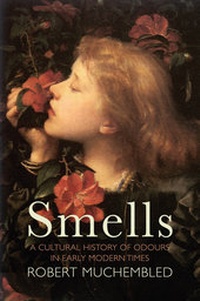
Smells
Description

In this major new book Robert Muchembled restores smell to its rightful place as one of our most important senses and examines the transformation of smells in the West from the Renaissance to the beginning of the 19th century. He shows that in earlier centuries, the air in towns and cities was often saturated with nauseating emissions and dangerous pollution. Having little choice but to see and smell faeces and urine on a daily basis, people showed little revulsion; until the 1620s, literature and poetry delighted in excreta which now disgust us. The smell of excrement and body odours were formative aspects of eroticism and sexuality, for the social elite and the popular classes alike. At the same time, medicine explained outbreaks of plague by Satan's poisonous breath corrupting the air. Amber, musk and civet came to be seen as vital bulwarks against the devil's breath: scents were worn like armour against the plague. The disappearance of the plague after 1720 and the sharp decline in fear of the devil meant there was no longer any point in using perfumes to fight the forces of evil, paving the way for the olfactory revolution of the 18th century when softer, sweeter perfumes, often with floral and fruity scents, came into fashion, reflecting new norms of femininity and a gentler vision of nature.
This rich cultural history of an under-appreciated sense will be appeal to a wide readership.
More details
Other editions
Additional editions
Persons
Content
Table of illustrations
Introduction
Chapter one: Our unique sense of smell
Is science always objective?
A sense of danger, emotions, and delight
Chapter 2: A Pervasive stench
The foul air of medieval towns
Urban cess pits
The smell of profit
Pollutant trades
Countryside smells
Chapter three: Joyous matter
A scholarly culture of scatology
Aromatic blasons
Humour in the conte
The Way to Succeed
Odorous wind
Chapter four: Scent of a woman
Demonising the smell of women
When ladies did not smell of roses
At arm's length
Guilty women
A breath of eroticism
The gutter press
A literary stink
Death and the old woman
Demonic pleasure
Chapter five: The Devil's breath
Venomous vapours
Plague-ridden towns
Perfume as armour
Perfumed rituals
Rue, vinegar and tobacco
Pomanders
Chapter six: Musky scents
Fountains of youth
Ambergris, musk and civet
The perfumed glove trade
The eroticism of leather
Nothing new under the Sun King?
Drawing death's sting
The great animal slaughter
Chapter seven: Civilising floral essences
The perfume revolution
Luxuriating in baths of scent
Sensual faces
Bodily hair care
The scent of powder
The emperor's perfumer
Conclusion
Bibliography
A note on quotations
Principle manuscript sources
Primary sources
Selected bibliography
Introduction
In The Civilizing Process, Norbert Elias put forward an overarching vision of the progress of Western civilization based on the slow domestication of affectivity, increasingly leading the subject to develop self-control.1 He explained how coarse emotionality gradually came to be driven out of its central position in the public sphere, giving way to highly codified attitudes of politeness that defined decency. His deeply optimistic, Eurocentric theory has given rise to much debate, at times heated, and has remained highly influential. It drew on a long-standing and diverse school of humanist thought, whose proponents believed in the capacity of their fellow humans to improve over time, following Erasmus - much quoted by Elias - who dreamed of a golden age in the near future, and Condorcet, who held that 'the human race [is] advancing with a firm and sure step along the path of truth, virtue and happiness'.2
When it was first published in 1939, Elias's work offered a valuable intellectual antidote to the looming threat of Nazism; however, its approach to sensory phenomena does not reflect the latest in scientific research. It takes as its main example the court of Louis XIV, seeing the restriction of bodily functions in public and the increasing disapproval of excessive or indecent reactions in the presence of others as part of a broad civilizing process. Elias argued that these new models of behaviour became ingrained in childhood among the upper classes, leading to increasing suppression of aggressive tendencies at an individual level that were then slowly adopted by other social groups.
This valuable basic framework can be used to underpin new directions in research. Smells, the focus of this book, were a key point in innovative conduct manuals such as Erasmus's De civilitate morum puerilium [On civility in boys], published in 1530 for a select readership. Recent scientific research has shown that smells are vital gateways for emotions and their recall. As the first chapter will demonstrate, smell is arguably the only one of our senses to be acquired from experience, rather than being innate. As it is binary in nature, it can easily be inflected by affective messages towards pleasure or, alternatively, fear and disgust. This opens the door to a sort of experimental history, drawing on the vast body of information left by people long since dead. This means trying to understand how their world worked, how they saw it and thought about it, rather than projecting our own presuppositions onto them. This is the path historical method must take to achieve a degree of objectivity, whatever claims may be made for other methodologies. Disgust at smells is a fundamental sensation in humans, but not one that is biologically programmed. It takes four or five years at least for European children, for instance, to construct disgust at their own excrement. Few people nowadays are willing to acknowledge this, preferring to believe that such disgust is as natural as it is universal; in fact, it is the result of several centuries of cultural pressure. Stubbornly maintained from generation to generation, this pressure has given rise to individual reactions of shame and disgust at anal excreta. The slightest suggestion of a whiff of excrement makes us literally nauseous. We can also feel the same uncontrollable repugnance at the mere sight or mention of it, even in a scatological joke; once the smell has become categorized as negative, all our senses seek to keep it at arm's length and communicate this to our consciousness. This was by no means the case in the sixteenth and seventeenth centuries, with the exception of a tiny minority who stood apart not only from the masses, materially mired in stench, but also from the majority of intellectuals, including storytellers, who took pleasure in spreading a lively scatological culture.3
While Smells: A Cultural History of Odours in Early Modern Times draws admiringly on Norbert Elias's pioneering work, it adopts a far less linear perspective. The significant shifts in our sense of smell from the Renaissance to the Napoleonic Empire cannot be framed in terms of inevitable human progress. Rather, they are approached here as first and foremost a reflection of the daily concerns of our ancestors. The aim is by no means to conjure up an image of the 'good old days'. The stench in centuries past was dreadful and omnipresent, the air saturated with nauseating emissions and dangerous pollution, particularly in urban areas hemmed in by city walls. The air in towns and cities became even harder to breathe in the eighteenth century as the population swelled, reaching noxious new heights with the advent of industrialization, until mains drainage systems were installed from the late nineteenth century on (see chapter 2). The constancy of the situation makes it impossible to believe that developments in the sense of smell under the Ancien Régime were essentially driven by material progress, symptomatic of the broader struggle against the stench of widespread putrefaction. People simply lived with it as best they could. Having no choice but to see and smell what Rabelais called 'joyous matter' on a daily basis, they showed little disgust at faeces and urine, whether human or animal; indeed, both were widely used in medicine and beauty treatments. Until the 1620s, literature and poetry both delighted in excreta which now disgust us. The smells of excrement and body odours were both formative aspects of eroticism and sexuality, for the social elite and the popular classes alike (see chapter 3). The minority opposed to such practices grew following the devastating wars of religion. After 1620, the bands of Catholics and Calvinists preaching intolerance grew and fought hard against man's animality. Making unwitting use of the simplifying binarity of smell, they taught increasing numbers of students and followers that the Devil lay nestled in the lower body, couched in excrement and urine, laying the distant foundations for the anal repression that underpins much modern psychoanalysis. Their most virulent discourse was aimed at women. Doctors relayed their opinions, believing women to be disgusting by their very nature, particularly when on their period. Older women were even a target for extraordinary hatred from men, as shown by numerous works of literature. They were accused of being close to the putrid Devil, and some were even burned as witches in the most misogynistic periods of our past (see chapter 4).
At the same period, medicine explained terrifying recurrent outbreaks of plague by Satan's poisonous breath corrupting the air. Ambergris, musk and civet came to be seen as vital bulwarks against the Devil's breath, a metaphor for sin, which was held to cause dreadful epidemics. Scents were worn like armour against the plague, and doctors explained that harmful forms of pestilence were dispelled by even worse fetid stenches. Plague was thereby correlated with terrible stenches of all sorts in countless scholarly treatises, while pleasant scents such as those emanating from the bodies of saints were thought to open the gates of paradise (see chapter 5). The finest scents were therefore initially used as repellents and prophylactics as well as to increase the wearer's desirability. This ambiguous role embodied negative and positive aspects: the scents were in many cases obtained from the sex glands of ruthlessly hunted exotic animals, transmitting a message on what death meant to people in the past, yet they were also closely bound up with the vital human impulses of eroticism and love. Their detractors may have promised eternal hellfire for those who used perfumes for pleasure, but all classes of society came to use them as a matter of course as their sole protection against the plague, and the only way of masking body odours that proved particularly rank in two centuries that took against water and bathing. Their popularity earned a fortune for the closely allied professions of glove-making and perfumery, as clothing and leather, whatever its intended use, had to be steeped in perfume to protect the wearer against contagion. Fashion did the rest to trigger the first revolution in smells and smelling of the modern age, from the Renaissance to the age of Louis XIV (see chapter 6). The second such revolution, over the course of the eighteenth century, saw a thoroughgoing rejection of musk-based fragrances in favour of fruity, floral and spice-based scents. In the absence of any decisive advances in the control of fetid stenches, this shift was essentially driven by social and cultural factors: it may be seen as a way of escaping the worsening stench of faeces which spared neither the rich nor the powerful. It was also rooted in increasing disgust at the somewhat ghoulish nature of perfumes and leather, both derived from animal carcases. Collective sensitivities were undergoing a deep-rooted shift. The disappearance of the plague after 1720 and sharp decline in fear of the Devil meant there was no longer any point in using perfumes to fight the forces of evil. A less misogynistic society also meant that it was no longer fashionable for men to wear virile, powerful perfumes to conquer women. Softer, sweeter perfumes came into fashion, heralding the triumphant return of femininity, rooted in a gentler vision of nature. This was particularly true of aristocratic culture and Enlightenment salons. Between 1789 and 1815, years of war and conquest, musk-based perfumes became relatively fashionable once more, though floral and fruity perfumes still reigned...
