

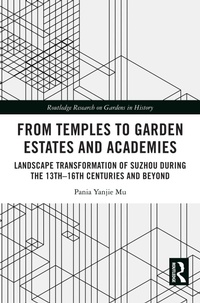
From Temples to Garden Estates and Academies
Landscape Transformation of Suzhou During the 13th-16th Centuries and Beyond
1st Edition
Published on 30. January 2025
352 pages
978-1-040-30560-7 (ISBN)
Description

How did the temple-scape of Suzhou transform into garden-scape during the 13th to 16th centuries? This book investigates the landscape evolution of China during the Yuan-Ming socio-political transformation and provides a previously unrepresented Buddhist and hydraulic history of Chinese gardens.
Utilising historical GIS mapping and 3D architectural modelling, the research uncovers spatial strategies employed by monks, the gentry, and the government. It argues that by seizing hydraulic estates from Buddhists, the gentry and government rose as a landed class and cultural elites, establishing the literati garden. Yuan temples featured a mound-field-river topography which reclaimed urban wetlands. In temples such as Shizi Lin, scenes were crafted as Chan gong'ans to support Buddhist practice towards enlightenment, underpinning a monastic architectural transformation in the 14th century. In the Ming dynasty, the gentry and government exploited the hydro-topography while erasing Buddhist traces by converting temples into gardens. The book forms a theoretical model of triangulating the garden practice with socio-hydro spaces and advocates a new garden history enabled by historical mapping and modelling.
This book is aimed at students and scholars of East Asian history, temples and gardens, and landscape architecture and design.
Utilising historical GIS mapping and 3D architectural modelling, the research uncovers spatial strategies employed by monks, the gentry, and the government. It argues that by seizing hydraulic estates from Buddhists, the gentry and government rose as a landed class and cultural elites, establishing the literati garden. Yuan temples featured a mound-field-river topography which reclaimed urban wetlands. In temples such as Shizi Lin, scenes were crafted as Chan gong'ans to support Buddhist practice towards enlightenment, underpinning a monastic architectural transformation in the 14th century. In the Ming dynasty, the gentry and government exploited the hydro-topography while erasing Buddhist traces by converting temples into gardens. The book forms a theoretical model of triangulating the garden practice with socio-hydro spaces and advocates a new garden history enabled by historical mapping and modelling.
This book is aimed at students and scholars of East Asian history, temples and gardens, and landscape architecture and design.
Reviews / Votes
"This very welcome book contributes substantially to our understanding of the developing role of gardens in Yuan and Ming Suzhou. Its particular strengths lie in the provision of a very strong sense of change over time, of an actual history of garden spaces in the city, while integrating them into wider developments. The innovative modelling and drawing of these spaces is particularly valuable, and makes a major contribution to the clarity of the argument throughout."Craig Clunas, Professor Emeritus of the History of Art, University of Oxford
More details
Series
Edition
1. Auflage
Language
English
Place of publication
London
United Kingdom
Publishing group
Taylor & Francis Ltd
Target group
Professional and scholarly
Illustrations
11 Tables, black and white; 1 Line drawings, black and white; 72 Halftones, black and white; 73 Illustrations, black and white
ISBN-13
978-1-040-30560-7 (9781040305607)
Copyright in bibliographic data and cover images is held by Nielsen Book Services Limited or by the publishers or by their respective licensors: all rights reserved.
Schweitzer Classification
Other editions
Additional editions
Pania Yanjie Mu
From Temples to Garden Estates and Academies
Landscape Transformation of Suzhou During the 13th-16th Centuries and Beyond
Book
approx. 07/2026
1st Edition
Routledge
€57.50
Not yet published

Pania Yanjie Mu
From Temples to Garden Estates and Academies
Landscape Transformation of Suzhou During the 13th-16th Centuries and Beyond
Book
02/2025
Taylor & Francis
Unfortunately, price unknown
Available (delivery time upon request)
Pania Yanjie Mu
From Temples to Garden Estates and Academies
Landscape Transformation of Suzhou During the 13th-16th Centuries and Beyond
Book
01/2025
1st Edition
Routledge
€207.20
Shipment within 10-20 days
Person
Pania Yanjie Mu is a postdoctoral research associate at the Institute of East Asian Art History, Heidelberg University, Germany, and co-founder of P. M. Architects. She received her PhD from the Faculty of Architecture, the University of Hong Kong.
Content
Introduction 1. Garden Estates: Transforming Urban Hydrology 2. Constructing the Temple-scape 3. Converting Temples into Literati Gardens 4. Converting Temples into Confucian Institutions 5. From Buddhist to Gentry Society. Conclusion: A New Garden History: Hydro-Social Transformation Illuminated by 3D Modelling and GIS Mapping
