

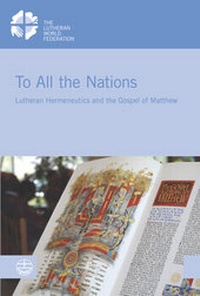
To All the Nations
Lutheran Hermeneutics and the Gospel of Matthew
1st Edition
Published on 1. February 2016
200 pages
978-3-374-04375-0 (ISBN)
Description

In his pastoral and theological reflections, Martin Luther always sought faithfully to discern the Word of God from the Scriptures. Luther drew on the Gospel of Matthew when developing edifying sermons as well as teasing out valuable ethical insights for the Christian engagement in society. While his immediate audience was in Wittenberg, the Gospel of Matthew has continued to be a resource for the church's mission. In this collection of essays, internationally renowned theologians reflect on the ongoing reception of the Gospel of Matthew from the Reformation until today, and how, in light of the Lutheran interpretive traditions, it remains a valuable resource for the church as it seeks to respond to contemporary concerns in its mission to the whole world.
More details
Other editions
Additional editions
Book
12/2015
1st Edition
Evangelische Verlagsanstalt
€19.80
Article exhausted; check different version
Content
- Cover
- Impressum
- Contents
- Preface
- Introduction to Matthew and Lutheran Hermeneutics
- Introduction
- Contemporary Approaches to Matthew: A "Lutheran" Critique
- The rise of the status quo
- Profiling Matthew in literary, socio-religious and theological terms
- Matthew and the transmission of Jesus traditions
- The Sermon on the Mount as a case study
- A Lutheran critique of current Matthean exegesis
- Reading Matthew in Light of a (Recovered) Hermeneutic of Law and Gospel
- The "Lutheran error" and the Sermon on the Mount
- Recovering the hermeneutical principle of law and gospel
- Law and gospel do not designate genres of biblical literature
- Law and gospel are not expressions of authorial intent
- Third use of the law and didactic preaching
- Interpreting Matthew (for proclamation) in light of law and gospel
- Matthew's Gospel for the Reformation: "The Messiah . Sent and Manifested"
- The hermeneutical and Christological heart of Matthew
- The hermeneutics of law and gospel
- The Christological witness of Matthew
- Concluding remarks
- Text, Context and Tradition: Implications for Reading Matthew
- Introduction
- Text, context and tradition
- The text: A great work of intertextuality
- The context: contextualization of the gospel
- The tradition: a contradiction of traditions?
- The implications of reading Matthew
- Reading Matthew as a book of the presence of God in Jesus Christ
- Sermon on the Mount
- How Do We Deal with a Challenging Text?
- What does taking the Bible "literally" mean?
- The Sermon on the Mount: a challenge for Lutheran hermeneutics
- Luther on the Sermon on the Mount
- A Lutheran interpretation of the Sermon on the Mount? Preliminary remarks
- Luther's exegesis of the Sermon on the Mount
- Matthew-not John and Paul
- The Beatitudes
- Conclusion
- Matthew and the Hermeneutics of Love
- Foundations or Israel's legacy
- Matthew's hermeneutics, or Torah and love of the neighbor
- Innovation, or Jesus Tradition (Q)
- Matthew's hermeneutics again, or Torah and "loving your enemy"
- Luther's interpretation, or perfect love as a distinguishing mark
- Love instead of hate, or implications and consequences of Matthew's hermeneutics of love for the Abrahamic religions
- Perfection of Christian Life in the Face of Anger and Retaliation. Martin Luther's Interpretation of the Sermon on the Mount
- Luther's interpretation of the antithesis on retaliation
- Solidarity in persecution and suffering and resisting anger and retaliation as a mark of the church
- Summary
- On Loving your Enemy
- The Secret Link between Faith and Love: Luther on the Beatitudes (Mt 5:43-48)
- Introduction
- Addressing the hermeneutical conundrum
- Faith and love
- Communio
- Rhetorical device
- Love's labor's limits
- Spheres and regimes
- Blessed and holy
- Love's labor's won
- Theology of the Cross, Liberation and Discipleship
- A Theology of the Cross and the Passion in Matthew: An Indian Dalit Perspective
- Dalit Christians and their world of texts
- Dalits and a theology of the cross
- The embarrassment of the cross
- The centrality of the cross in Dalit Christian tradition
- The cross in the Dalit lyrical tradition
- Focus on the passion of Christ: Embracing the crucified and abandoning the cross
- The cross as the site of God's poured out love: Devotion to the cross
- The cross in Dalit revolutionary literature
- The Dalit understanding of the cross and reading the passion in Matthew for a theology of the cross
- The Flight to Egypt: A Migrant Reading-Implications for a Lutheran Understanding of Salvation
- Migration and asylum as context
- Migration as the "locus" of theology
- Migrant readings
- Matthew 2:13-23: The flight to Egypt-A migrant reading
- Migration, Luther and salvation
- Matthew, Judaism and Lutheran Tradition
- Matthew's Pharisees: Seven Woes and Seven Warnings
- "Woe unto You"
- Who were the Pharisees?
- Two warnings
- Repairing the relationship
- Hermeneutical reflections and two more warnings
- Meant, means and ideological reading: One more warning
- Preaching Reconciliation: From "Law and Gospel" to "Justice and Mercy" in Matthew
- Beyond deicide
- Christian, feminist, post-Holocaust
- Matthew as a "Jewish Gospel"
- Christian stereotyping of Judaism as "law"
- Matthew as an opening for reconciliation
- Preaching "justice and mercy"
- Questions for further reflection
- List of Contributors
- Weitere Veröffentlichungen
