

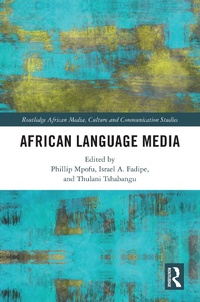
African Language Media
1st Edition
Published on 13. March 2023
288 pages
978-1-000-84709-3 (ISBN)
Description

This book outlines how African language media is affected by politics, technology, culture, and the economy and how this media is creatively produced and appropriated by audiences across cultures and contexts.
African language media can be considered as a tool for communication, socialization, and community that defines the various identities of indigenous people in Africa. This book shows how vernacular media outlets including radio and television, as well as native formats such as festivals, rituals and dance, can be used to influence all facets of local peoples' experience and understanding of community. The book also explores the relationship between African language media sources and contemporary issues including the digitalization conundrum, peace and conflict resolution, identity formation, hate speech and fake news. Furthermore, it shows how local media can be used for development communication purposes during health and environmental crises. The book includes cases studies demonstrating the uses, experiences and activities related to various forms of media available in African languages.
This book will be of interest to scholars in the field of communication and media studies, health and environmental communication, journalism, African studies and anthropology.
African language media can be considered as a tool for communication, socialization, and community that defines the various identities of indigenous people in Africa. This book shows how vernacular media outlets including radio and television, as well as native formats such as festivals, rituals and dance, can be used to influence all facets of local peoples' experience and understanding of community. The book also explores the relationship between African language media sources and contemporary issues including the digitalization conundrum, peace and conflict resolution, identity formation, hate speech and fake news. Furthermore, it shows how local media can be used for development communication purposes during health and environmental crises. The book includes cases studies demonstrating the uses, experiences and activities related to various forms of media available in African languages.
This book will be of interest to scholars in the field of communication and media studies, health and environmental communication, journalism, African studies and anthropology.
More details
Series
Edition
1. Auflage
Language
English
Place of publication
London
United Kingdom
Publishing group
Taylor & Francis Ltd
Target group
College/higher education
Professional and scholarly
Illustrations
7 Tables, black and white; 5 Line drawings, black and white; 22 Halftones, black and white; 27 Illustrations, black and white
ISBN-13
978-1-000-84709-3 (9781000847093)
Copyright in bibliographic data and cover images is held by Nielsen Book Services Limited or by the publishers or by their respective licensors: all rights reserved.
Schweitzer Classification
Other editions
Additional editions
Phillip Mpofu | Israel A. Fadipe | Thulani Tshabangu
African Language Media
Book
08/2024
1st Edition
Routledge
€64.00
Shipment within 10-20 days
Phillip Mpofu | Israel A. Fadipe | Thulani Tshabangu
African Language Media
Book
03/2023
1st Edition
Routledge
€186.80
Shipment within 10-20 days
Persons
Phillip Mpofu is Senior Lecturer in the Department of Media, Communication, Film and Theatre Arts at Midlands State University, Zimbabwe, and an Extraordinary Researcher in the Indigenous Language Media Research Entity at North West University, Mafikeng Campus in South Africa.
Israel A. Fadipe is a Postdoctoral Research Fellow at the Indigenous Language Media in Africa entity at North West University, South Africa.
Thulani Tshabangu is a Postdoctoral Research Fellow at the Indigenous Language Media in Africa entity at North West University, South Africa.
Israel A. Fadipe is a Postdoctoral Research Fellow at the Indigenous Language Media in Africa entity at North West University, South Africa.
Thulani Tshabangu is a Postdoctoral Research Fellow at the Indigenous Language Media in Africa entity at North West University, South Africa.
Content
SECTION 1: MEDIA REPRESENTATIONS, TEXT, CONTEXT AND AFRICAN LANGUAGE MEDIA 1. Introduction: African Language Media: Past, Present and Future 2. A Peek into Afrinet-24 Domestication of Foreign Films in Nigerian Indigenous Languages 3. Relevance of Cultural Studies' approaches to news media production and consumption analyses in an African context 4. Television cinema in indigenous/African languages, Are we there yet? The portrayal of Women in Naiza Boom films 5. Hausa Folk Music and the challenges of Sustainability in the Nigerian Entertainment Industry SECTION 2: DIGITAL TECHNOLOGY AND AFRICAN LANGUAGE MEDIA 6. (Dis) continuities of indigenous language radio on social media: The case of South Africa's Motsweding FM and Radio Zimbabwe 7. Reinterpreting Technological Language: The Use of Social Media Emojis to Construct New Meanings in IsiXhosa Language 8. The purpose of minority language media and the digital shift: the case of "Der Nordschleswiger" 9. Podcasting Covid19 in indigenous languages: Interrogating audio psychology and political anthropomorphism SECTION 3: HEALTH AND ENVIRONMENTAL CRISIS AND AFRICAN LANGUAGE MEDIA 10. The Role of Traditional Town Criers: Using Indigenous Yoruba Language in COVID-19 Awareness on Radio for Rural Dwellers in Lagos 11. A Critical Analysis of the Kwayedza newspaper's Ethical Coverage of COVID-19 Crisis in Zimbabwe (March 2020- December 2021) 12. How does the indigenous language media in Malawi report on health crises such as recent COVD 19 global pandemic and HIV/AIDS? 13. Trends in Indigenous Language Media Use for Rural Crime Preventions in South African Region SECTION 4: AUDIENCE PERCEPTION, PARTICIPATION, ETHNIC, IDENTITY FORMATION AND AFRICAN LANGUAGE MEDIA 14. The importance of audience participation in the success of community radio 15. Culture de la Paix in Central Africa: Building 'communities of affect' and safe spaces through Sango broadcasts 16. Marginalised voices: A reception analysis of Omurari FM's Okaruveze Kovaremane radio programme for people living with disabilities 17. Women's Participation through Indigenous Language Media and it's Outcomes, An analysis on Community Radio and Women in Northern Ghana SECTION 5: CORPORATE COMMUNICATION, PRACTICE-BASED STUDIES AND AFRICAN LANGUAGE MEDIA 18. Reimagining Indigenous African music through the Lens of urban concert halls SECTION 6: BEAT ANALYSIS, PEACE JOURNALISM AND AFRICAN LANGUAGE MEDIA 19. Socio-Cultural Issues in Ayinla Omowura's Music: Lessons for Social Decadence-Free Society 20. Explicatures and Implicatures in Selected abcderian Yoruba Poetry 21. The Use of Traditional Communication in Public Protests: Evidence from Nigeria 22. In Conclusion: African Language Media
