

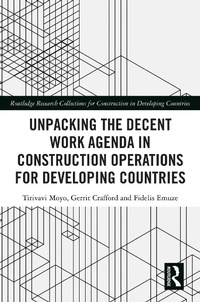
Unpacking the Decent Work Agenda in Construction Operations for Developing Countries
1st Edition
Published on 7. June 2023
132 pages
978-1-000-89097-6 (ISBN)
Description

Low construction labour productivity and the inadequate welfare of construction workers are consistent challenges in developing countries. These challenges are partially due to shortcomings situated in the Decent Work Agenda. This book proposes ways of sustaining construction labour productivity through fulfilling the Decent Work Agenda. This is a unique area of focus that is essential to fulfilling the broader and global aspects of decent work, sustainability and construction labour productivity. Also, the focus of this book is on contributing to the plight of construction workers whose treatment is significantly unsound.
The construction industry needs to develop a humanistic face and contribute to the UN's sustainable development goal of achieving full and productive employment and decent work for all women and men. To achieve this, construction companies are encouraged to implement corporate social responsibility strategies by equipping workers of different educational levels with knowledge and skills that can be transferred to benefit themselves and their communities. Thus, establishing structured on-the-job training that incorporates sustainability-learning objectives to achieve workers' safety on sites is essential.
The book advocates for decency in the workplace through people-centred management, sustainability learning of skilled and semi-skilled construction workers and decent working conditions. It will be of interest to construction industry policymakers, construction professionals, academics and students of sustainable development and developing economies.
The construction industry needs to develop a humanistic face and contribute to the UN's sustainable development goal of achieving full and productive employment and decent work for all women and men. To achieve this, construction companies are encouraged to implement corporate social responsibility strategies by equipping workers of different educational levels with knowledge and skills that can be transferred to benefit themselves and their communities. Thus, establishing structured on-the-job training that incorporates sustainability-learning objectives to achieve workers' safety on sites is essential.
The book advocates for decency in the workplace through people-centred management, sustainability learning of skilled and semi-skilled construction workers and decent working conditions. It will be of interest to construction industry policymakers, construction professionals, academics and students of sustainable development and developing economies.
More details
Series
Edition
1. Auflage
Language
English
Place of publication
London
United Kingdom
Publishing group
Taylor & Francis Ltd
Target group
College/higher education
Illustrations
22 Tables, black and white
ISBN-13
978-1-000-89097-6 (9781000890976)
Copyright in bibliographic data and cover images is held by Nielsen Book Services Limited or by the publishers or by their respective licensors: all rights reserved.
Schweitzer Classification
Other editions
Additional editions
Tirivavi Moyo | Gerrit Crafford | Fidelis Emuze
Unpacking the Decent Work Agenda in Construction Operations for Developing Countries
Book
09/2025
1st Edition
Routledge
€72.70
Shipment within 10-20 days
Tirivavi Moyo | Gerrit Crafford | Fidelis Emuze
Unpacking the Decent Work Agenda in Construction Operations for Developing Countries
Book
06/2023
1st Edition
Routledge
€214.20
Shipment within 10-20 days
Persons
Tirivavi Moyo, PhD, is a Senior Lecturer in the Department of Quantity Surveying at the Nelson Mandela University, Gqeberha, South Africa. He is an upcoming researcher with several publications on construction economics issues and holds a PhD in Construction Economics. He has a passion for decent work, sustainable construction and productivity.
Gerrit Crafford, PhD, is a Professor in the Department of Quantity Surveying at the Nelson Mandela University, South Africa. He is a results-driven, independent, determined and resourceful construction economics academic. Dr Crafford has an established domestic research track record and enjoys international recognition for his research outputs' quality and impact. He has research interests in higher education teaching and learning and business strategy. Dr Crafford envisions driving strategic innovation in an international institution or organisation in his ideal future.
Fidelis Emuze, PhD, is a Professor and Head of the Department of Built Environment at the Central University of Technology, Free State (CUT), South Africa. Lean construction, health, safety, wellbeing, and sustainability constitute the primary research interest of Dr Emuze, a National Research Foundation-rated researcher who has published over 270 research outputs and received over 25 awards and recognitions. Dr Emuze is the editor of Value and Waste in Lean Construction and Valuing People in Construction, and co-editor of Construction Health and Safety in Developing Countries. Dr Emuze authored Construction Safety Pocketbook for South Africa in 2020. Dr Emuze is the International Coordinator of CIB W123 - People in Construction Working Commission.
Gerrit Crafford, PhD, is a Professor in the Department of Quantity Surveying at the Nelson Mandela University, South Africa. He is a results-driven, independent, determined and resourceful construction economics academic. Dr Crafford has an established domestic research track record and enjoys international recognition for his research outputs' quality and impact. He has research interests in higher education teaching and learning and business strategy. Dr Crafford envisions driving strategic innovation in an international institution or organisation in his ideal future.
Fidelis Emuze, PhD, is a Professor and Head of the Department of Built Environment at the Central University of Technology, Free State (CUT), South Africa. Lean construction, health, safety, wellbeing, and sustainability constitute the primary research interest of Dr Emuze, a National Research Foundation-rated researcher who has published over 270 research outputs and received over 25 awards and recognitions. Dr Emuze is the editor of Value and Waste in Lean Construction and Valuing People in Construction, and co-editor of Construction Health and Safety in Developing Countries. Dr Emuze authored Construction Safety Pocketbook for South Africa in 2020. Dr Emuze is the International Coordinator of CIB W123 - People in Construction Working Commission.
Content
LIST OF TABLES
PREFACE
ACKNOWLEDGEMENTS
ABOUT THE AUTHORS
CHAPTER 1 - BACKGROUNDCHAPTER
CHAPTER 2- DECENT WORK OBJECTIVES FOR MONITORING CONSTRUCTION LABOUR PERFORMANCE
CHAPTER 3 - DECENT WORK CONDITIONS FOR IMPROVING CONSTRUCTION LABOUR PRODUCTIVITY IN ZIMBABWE
CHAPTER 4 - CORPORATE SOCIAL RESPONSIBILITY FOR ENHANCED SKILLED CONSTRUCTION WORKERS' SOCIAL SECURITY
CHAPTER 5 - PEOPLE-CENTRED MANAGEMENT FOR IMPROVED CONSTRUCTION WORKERS' PRODUCTIVITY
CHAPTER 6 - SUSTAINABILITY LEARNING FOR SKILLED CONSTRUCTION WORKERS' PRODUCTIVE WORK ENVIRONMENTS
CHAPTER 7 - DECENT WORK IN DEVELOPING COUNTRIES' CONSTRUCTION INDUSTRIES: CASE STUDIES
CHAPTER 8 - CONCLUSIONS AND RECOMMENDATIONS
PREFACE
ACKNOWLEDGEMENTS
ABOUT THE AUTHORS
CHAPTER 1 - BACKGROUNDCHAPTER
CHAPTER 2- DECENT WORK OBJECTIVES FOR MONITORING CONSTRUCTION LABOUR PERFORMANCE
CHAPTER 3 - DECENT WORK CONDITIONS FOR IMPROVING CONSTRUCTION LABOUR PRODUCTIVITY IN ZIMBABWE
CHAPTER 4 - CORPORATE SOCIAL RESPONSIBILITY FOR ENHANCED SKILLED CONSTRUCTION WORKERS' SOCIAL SECURITY
CHAPTER 5 - PEOPLE-CENTRED MANAGEMENT FOR IMPROVED CONSTRUCTION WORKERS' PRODUCTIVITY
CHAPTER 6 - SUSTAINABILITY LEARNING FOR SKILLED CONSTRUCTION WORKERS' PRODUCTIVE WORK ENVIRONMENTS
CHAPTER 7 - DECENT WORK IN DEVELOPING COUNTRIES' CONSTRUCTION INDUSTRIES: CASE STUDIES
CHAPTER 8 - CONCLUSIONS AND RECOMMENDATIONS
