

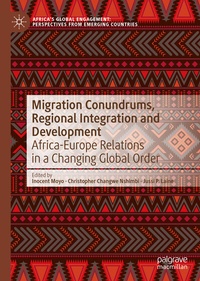
Migration Conundrums, Regional Integration and Development
Description

This book examines Africa-Europe relationships and intra-Africa relationships vis-à-vis migration. It analyses the African integration project that is being used to effectively manage migration within Africa and across its RECs, and harnessing it for development.
The book presents debates related to the EU's hardening and securitisation of its external border against migrants from Africa. It shows that migration actually challenges Africa-European relations, which is discussed as an important theme in this book.
Authors in this book volume investigate several issues ranging from conundrums relating to migration between Africa and Europe to migration within Africa, but also in relation to borders and boundaries, its bearing on regional and continental integration and the significance of this in terms of relations between Africa and Europe. This book volume brings into conversation issues relating to the governance of migration for development, social cohesion andregional integration.More details
Other editions
Additional editions
Persons
Dr Inocent Moyo is a Lecturer in the Department of Geography and Environmental Science at the University of Zululand, South Africa. Dr Moyo is a Human Geographer with a deep interest in the interface between people and the environment, particularly the broader fields of Political Geography, Political Economy, Political Ecology, Migration, Regional Development, Globalization and Transnationalism, Borders and Borderlands and Urban Geography, among others. Dr Moyo is committed to emancipatory research and the deployment of critical social theory in an attempt to understand the problems that affect humanity today and in the future and contribute towards solutions to the same. He has published and done international presentations on these topics. He is the founding Chair of the IGU Commission on African Studies (IGU CAS).
Dr Christopher Changwe Nshimbi is Director and Department of Science and Technology/National Research Foundation(DST/NRF) Research Fellow in the Centre for the Study of Governance Innovation (GovInn), University of Pretoria, South Africa. He researches migration, borders, regional integration, the informal economy, social cohesion and water resource management. Besides teaching and supervising postgraduate research at the University of Pretoria, Chris also participates and sits on regional and international technical working groups on trade, labour and migration as well as water. His opinion pieces are occasionally published in Africa - The Conversation, OpenDemocracy and other media outlets.
Dr Jussi P. Laine
is an assistant professor of multidisciplinary border studies at the Karelian Institute of the University of Eastern Finland and holds the title of Docent of Human Geography from the University of Oulu, Finland. He is the Vice President of the Association for Borderlands Studies and currently also serves in the Steering Committee of the International Geographical Union'sCommission on Political Geography. By his background, Dr Laine is a human geographer, yet in his approach to borders he combines influences also from international relations and geopolitics, political sociology, history, anthropology as well as psychology. Within border studies, he seeks to explore the multiscalar production of borders and bring a critical perspective on the relationship between state, territory, citizenship and identity construction. Most recently, Dr Laine has published works focused on border mobility and tourism, the ethics of borders and bordering, bottom-up construction of borders and border making, as well as on ontological security.
