

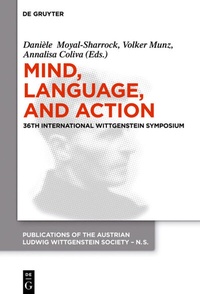
Mind, Language and Action
Proceedings of the 36th International Wittgenstein Symposium
1st Edition
Published on 10. March 2015
XII, 622 pages
978-3-11-037879-5 (ISBN)
Description

The volume takes on the much-needed task of describing and explaining the nature of the relations and interactions between mind, language and action in defining mentality. Papers by renowned philosophers unravel what is increasingly acknowledged to be the enacted nature of the mind, memory and language-acquisition, whilst also calling attention to Wittgenstein's contribution. The volume offers unprecedented insight, clarity, scope, and currency.
More details
Other editions
Additional editions
Danièle Moyal-Sharrock | Volker Munz | Annalisa Coliva
Mind, Language and Action
Proceedings of the 36th International Wittgenstein Symposium
Book
04/2015
1st Edition
De Gruyter
€209.00
Article exhausted; check different version
Danièle Moyal-Sharrock | Volker Munz | Annalisa Coliva
Mind, Language and Action
Proceedings of the 36th International Wittgenstein Symposium
E-Book
03/2015
1st Edition
De Gruyter
€199.95
Available for download
Danièle Moyal-Sharrock | Volker Munz | Annalisa Coliva
Mind, Language and Action
Proceedings of the 36th International Wittgenstein Symposium
Book
02/2015
1st Edition
De Gruyter
€199.95
Shipment within 7-9 days
Persons
D. Moyal-Sharrock, Univ. of Hertfordshire; V. Munz, Alpen-Adria-Univ., Klagenfurt; A. Coliva, Univ. of Modena & Reggio Emilia.
Content
- Intro
- Table of contents
- Preface
- I. Wittgenstein
- Wittgenstein's Most Important Contribution to the Philosophy of Logic
- Rule-following, Intellectualism, and Logical Reasoning. On the importance of a type-distinction between performances and 'propositional knowledge' of the norms that govern them
- Logical Space and Phase-Space
- Implication in Interpretation. Wittgenstein, Artistic Content, and 'The Field of a Word'
- Was Wittgenstein a Cultural Relativist?
- Keep it real
- Wittgenstein, Anscombe, and What Can Only Be True
- Solipsism from a logical point of view: the limits of sense reconsidered
- Davidson and the Wittgensteinians on Reasons and Causes
- Ménage à trois: Saying, Showing, Acting
- Wittgenstein und Fodor: Die hinweisende Definition und ihre Voraussetzung
- The "Middle Wittgenstein" Revisited
- Zur Genese der "Philosophischen Untersuchungen" im engeren Sinne und im weiteren Sinne
- How Ordinary Is the Language of Love?
- Sceptics, heretics and human grounds: A Cavellian reading of On Certainty
- Could There Be a Logical Alien?. The austere reading of Wittgenstein and the nature of logical truths
- II. Enactivism and extended mind
- Back to the rough ground and into the hurly-burly Why cognitive ethology needs 'Wittgenstein's razor'
- "The Play Of Expression": Understanding Ontogenetic Ritualisation
- The Far Side of Things: Seeing, Visualizing and Knowing
- The framework of perception
- Magnitudes: Metaphysics, Explanation, and Perception
- III. Memory
- The extent of memory. From extended to extensive mind
- Remembering as Public Practice: Wittgenstein, memory, and distributed cognitive ecologies
- Visual Memory and the Bounds of Authenticity
- IV. Language acquisition
- Training and Transformation
- Crying and learning to speak
- V. Intentional mental contents and qualia
- Concepts: Too Heavy a Burden
- Propositional Attitudes, Intentional Contents and Other Representationalist Myths
- Seeing Without an I. Another Look at Immunity to Error Through Misidentification
- Bewusstsein, Reflexion und Gedanken höherer Ordnung. Zur Kritik der Idee der inneren Wahrnehmung
- Becoming aware of one's thoughts. Kant on self-knowledge and reflective experience
- Index
