

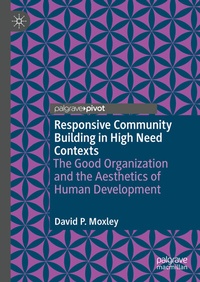
Responsive Community Building in High Need Contexts
Description

This book provides a description of what a good human service organization is, and what it does. The author relies on a broad framework to define "good" and offers a fictional account as a methodology, using his considerable consulting and research experience in human service organizations as a content enriching approach to the case examples he presents in this volume. The book details the fictional story of Fifth Street, a non-governmental organization nested in a high-need community, which itself is hypothetical but reflects what is occurring within communities whose residents are struggling with poverty. The content of this fictional account leans on a synthesis of multiple case examples. This approach will appeal to faculty and students as well as practitioners who are seeking a grand example of how human service organizations can work effectively in high need contexts. Students will also gain from the ethical perspective the author presents in this monograph. This is a project of hope: one that can inspire us all practicing in human services to strive for the best in novel and innovative ways.
More details
Other editions
Additional editions
Person
David P. Moxley is Professor and Assistant Dean responsible for the School of Justice and Human Services in the University of Alaska Anchorage College of Health, USA, where he also directs two projects in behavioral health workforce development in Alaska.
Content
Chapter 1.-Introduction.-Chapter 2.-The origins and conceptual framework of the monograph.-Chapter 3.-Fiction as method.-Chapter 4.-Community aesthetics as the Foundation of the Good.-Chapter 5.-Hello, Mrs. James.-Chapter 6.-We are one from many.-Chapter 7.-Honoring and building our local capabilities.-Chapter 8.-Releasing Know how.- Chapter 9.-Angela's story.-Chapter 10.-Unobtrusive leadership.-Chapter 11.-Governing the commons.- Chapter 12.- We are not alone.-Chapter13.- A final commentary on intrinsic social innovation.
