

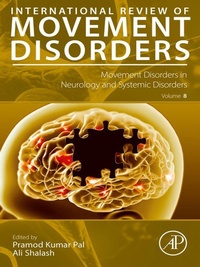
Movement Disorders in Neurology and Systemic Disorders
Elsevier (Publisher)
Published on 12. November 2024
422 pages
978-0-323-99110-0 (ISBN)
Description

International Review of Movement Disorders series, highlights new advances in the field, with this new volume presenting interesting chapters. Each chapter is written by an international board of authors.
- Provides the authority and expertise of leading contributors from an international board of authors
- Presents the latest release in the International Review of Movement Disorders series
- Updated release includes the latest information on Myoclonus
More details
Other editions
Additional editions
Pramod Kumar Pal | Ali Shalash
Movement Disorders in Neurology and Systemic Disorders: Volume 8
Book
11/2024
Academic Press
€220.36
Shipment within 15-20 days
Persons
Content
- Intro
- Movement Disorders in Neurology and Systemic Disorders
- Copyright
- Contents
- Contributors
- Chapter One: Approach to movement disorders
- 1. Introduction
- 2. Hypokinetic/Akinetic-rigid movement disorders
- 3. Hyperkinetic movement disorders
- 3.1. Dystonia
- 3.2. Tremor
- 3.3. Myoclonus
- 3.4. Chorea
- 3.5. Ballismus
- 3.6. Dyskinesia
- 3.7. Athetosis
- 3.8. Tics
- 3.9. Stereotypy
- 3.10. Ataxia
- 4. Approaching a case of movement disorder
- 5. Investigations
- 6. Conclusions
- References
- Chapter Two: Movement disorders in stroke and vascular disorders
- 1. Introduction
- 2. Methods
- 3. Epidemiology
- 4. Phenomenology
- 4.1. Hyperkinetic movement disorders
- 4.1.1. Hemichorea-hemiballism and athetosis
- 4.1.2. Dystonia
- 4.1.3. Tremor
- 4.1.4. Myoclonus and asterixis
- 4.1.5. Stereotypies, akathisia, and tics
- 4.1.6. Post-stroke restless leg syndrome (psRLS) and periodic limb movement disorder (psPLMD)
- 4.1.7. Limb shaking TIA (transient ischemic attacks)
- 4.1.8. Post-stroke lateropulsion
- 4.2. Hypokinetic movement disorders
- 4.2.1. Vascular parkinsonism
- 4.2.2. Vascular progressive supranuclear palsy (PSP) and corticobasal syndrome (CBS)
- 4.3. Ataxia
- 5. Neuroimaging
- 5.1. Lesion locations
- 5.2. Circuits and brain networks
- 5.3. Molecular brain imaging
- 6. Pathophysiology
- 7. Treatment
- 8. Outcome and prognosis
- 9. Future directions
- Funding sources and conflict of interest
- Financial disclosures
- References
- Chapter Three: Movement disorders associated with neuromuscular and mitochondrial disorders
- 1. Movement disorders associated with muscular disorders and neuromuscular junction disorders
- 1.1. Parkinsonism
- 1.2. Tremor
- 1.3. Dystonia and pseudodystonia
- 2. Peripheral nerve hyperexcitability syndrome
- 2.1. Myokymia and neuromyotonia
- 2.2. Hemimasticatory spasm and hemifacial spasm
- 2.3. Muscle cramps
- 2.4. Tetany
- 3. Movement disorders associated with peripheral neuropathies
- 3.1. Possible pathomechanisms
- 3.2. Movement disorders associated with peripheral neuropathies based on phenomenology
- 3.2.1. Neuropathic tremor
- 3.2.2. Myoclonus
- 3.2.3. Dystonia
- 3.2.4. Focal dyskinesias
- 3.2.5. Painful legs and moving toes and its variants
- 3.2.6. Restless legs syndrome
- 3.3. Movement disorders associated with peripheral neuropathies according to etiology
- 3.3.1. Chronic acquired demyelinating neuropathies
- 3.3.2. Nutritional and metabolic disorders
- 3.3.3. Medication-induced peripheral neuropathy and movement disorders
- 3.3.4. Hereditary neuropathies with movement disorders
- 3.3.5. Movement disorders associated with peripheral injury
- 4. Movement disorders associated with mitochondrial disorders
- 4.1. Movement disorders associated with mitochondrial disorders based on phenomenology
- 4.1.1. Ataxia
- 4.1.2. Dystonia
- 4.1.3. Parkinsonism
- 4.1.4. Myoclonus
- 4.1.5. Chorea
- 4.1.6. Other movement disorders
- 5. Conclusion
- References
- Chapter Four: Movement disorders associated with demyelinating disorders
- 1. Introduction
- 2. Movement disorders in multiple sclerosis
- 2.1. Tremor
- 2.2. Ataxia
- 2.3. Restless legs syndrome
- 2.4. Paroxysmal movement disorders
- 2.5. Parkinsonism
- 2.6. Myoclonus
- 2.7. Chorea/Ballism
- 2.8. Hemifacial spasm
- 2.9. Facial myokymia
- 2.10. Tics
- 3. Movement disorders in other demyelinating diseases
- 3.1. Neuromyelitis optica spectrum disorder (NMOSD)
- 3.2. Acute disseminated encephalomyelitis (ADEM)
- 3.3. Osmotic myelinolysis
- 4. Conclusion
- References
- Chapter FIve: Movement disorders and seizures: Overlapping phenomenology, shared etiologies and diagnostic challenges
- 1. The overlapping phenomenology (shared semiology)
- 1.1. Tonic phenomena
- 1.2. Clonic phenomena
- 1.3. Atonic phenomena
- 1.4. Spasm phenomena
- 1.5. Versive phenomena
- 1.6. Dystonic phenomena
- 1.7. Automotor phenomena
- 1.8. Hyperkinetic/hypermotor phenomena
- 1.9. Myoclonic phenomena
- 2. Shared etiologies of movement disorders and epilepsy
- 2.1. Epileptic syndromes with movement disorders
- 2.2. Movement disorders with seizures
- 2.3. Autoimmune disorders with movement disorders and seizures
- 2.4. Movement disorders and Seizures: Impact of their therapies
- 2.5. Functional movement disorders and functional seizures
- 3. Shared pathophysiology between epilepsy and movement disorders
- 3.1. Genetic channelopathies
- 3.2. Genetic non-channelopathies
- 3.3. Proteinopathies
- 4. Diagnostic approach and management
- 5. Conclusions
- References
- Chapter Six: Movement disorders in autoimmune and paraneoplastic disorders
- 1. Introduction
- 2. Movement disorders and autoimmune diseases
- 2.1. Movement disorders associated with neuronal antibodies
- 2.1.1. Anti-N-methyl-d-aspartate-receptor (NMDAR) antibody associated movement disorders
- 2.1.2. Anti-GAD65 antibody associated movement disorders
- 2.1.3. Caspr2 antibody associated movement disorders
- 2.1.4. Dipeptidyl-peptidase-like protein-6 (DPPX) antibody associated movement disorders
- 2.1.5. Leucine-rich-glioma-inactivated-1 (LGI1) antibody associated movement disorders
- 2.1.6. Metabotropic glutamate receptor 1 (mGluR1) antibody associated movement disorders
- 2.1.7. Immunoglobulin-like cell adhesion molecule 5 (IgLON5) antibody associated movement disorders
- 2.1.8. Gamma aminobutyric acid type A and type B receptors (GABAAR, GABABR) antibody associated movement disorders
- 2.1.9. Anti-dopamine 2 receptor (D2R) antibody associated movement disorders
- 2.2. General treatment strategies in autoimmune movement disorders
- 2.3. Movement disorders in paraneoplastic diseases
- 2.3.1. Paraneoplastic cerebellar degeneration (PCD)
- 2.3.2. Opsoclonus myoclonus ataxia
- 2.3.3. Stiff-person spectrum disorders
- 2.3.4. Neuromyotonia and myokymia
- 2.3.5. Paraneoplastic jaw dystonia and laryngospasm
- 2.3.6. Paraneoplastic chorea
- 2.4. Diagnostic investigations in autoimmune and paraneoplastic diseases
- 2.5. Movement disorders in systemic autoimmune diseases
- 2.5.1. Systemic lupus erythematosus (SLE)
- 2.5.2. Antiphospholipid antibody syndrome
- 2.5.3. Sjögren syndrome
- 2.5.4. Hashimoto´s thyroiditis
- 2.5.5. Coeliac disease
- 2.5.6. Behçet disease
- 3. Conclusion
- References
- Chapter Seven: Movement disorders in the intensive care unit
- 1. Introduction
- 2. Pathophysiology of movement disorders in critical illness
- 3. Hyperkinetic movements and syndromes
- 3.1. Myoclonus
- 3.2. Tremor
- 3.3. Acute dystonic reaction and status dystonicus
- 3.4. Chorea, ballismus, and athetosis
- 3.5. Tardive syndromes and akathisia
- 3.6. Parkinson´s dyskinesia and dyskinesia-hyperpyrexia syndrome
- 3.7. Tetanus
- 3.8. Hyperkinetic movement disorder mimics
- 4. Hypokinetic movements and syndromes
- 4.1. Neuroleptic malignant syndrome
- 4.2. Parkinsonism-hyperpyrexia syndrome
- 4.3. Malignant catatonia
- 4.4. Serotonin syndrome
- 4.5. Malignant hyperthermia
- 5. Ataxia
- 6. The complexities of autoimmune and paraneoplastic encephalitis
- 7. Post-traumatic movement disorders
- 8. Additional emergencies in Parkinson´s disease and atypical Parkinsonisms
- 9. Conclusion and practical considerations in the ICU
- References
- Chapter Eight: Movement disorders associated with infections
- 1. Introduction
- 2. Definition of infection related movement disorders
- 3. Infectious pathogens commonly associated with movement disorders
- 3.1. Viral infections
- 3.2. Bacterial infections
- 3.3. Other infections
- 4. Pathophysiological mechanisms in infection related movement disorders
- 5. Approach to suspected infection related movement disorders
- 6. Investigative modalities in the diagnosis of infection related movement disorders
- 6.1. Blood and cerebrospinal fluid analysis
- 6.2. Neuroimaging
- 7. Diagnostic criteria for infection related movement disorders
- 8. Management approach for infection related movement disorders
- 8.1. Early initiation of disease specific therapy for underlying infections
- 8.2. Symptomatic therapy of the existing movement disorder phenotype
- 8.3. Immunosuppressive or immunomodulator therapy in suspected inflammatory/autoimmune pathophysiology
- 9. Management of specific causes of infection-related movement disorders
- 9.1. Management based on syndromic diagnosis
- 9.1.1. Acute cerebellar ataxia in children or post-infectious cerebellar ataxia
- 9.1.1.1. Clinical features
- 9.1.1.2. Investigations
- 9.1.1.3. Management
- 9.1.2. Opsoclonus myoclonus ataxia syndrome (OMAS)
- 9.1.2.1. Clinical features
- 9.1.2.2. Investigations
- 9.1.2.3. Management
- 9.1.3. Parkinsonism secondary to infections
- 9.1.3.1. Mechanism
- 9.1.3.2. Management
- 9.2. Management of infection related movement disorders due to specific bacterial infections
- 9.2.1. Sydenham´s chorea
- 9.2.1.1. Clinical features
- 9.2.1.2. Diagnosis and investigations
- 9.2.1.3. Management and outcome
- 9.2.2. CNS tuberculosis (CNS-TB)
- 9.2.2.1. Clinical features
- 9.2.2.2. Mechanism
- 9.2.2.3. Management
- 9.2.2.4. Outcome
- 9.2.3. Neurosyphilis
- 9.2.3.1. Clinical features
- 9.2.3.2. Mechanisms
- 9.2.3.3. Investigations
- 9.2.3.4. Management and outcome
- 9.2.4. Whipple disease
- 9.2.5. Enteric fever
- 9.2.6. Scrub typhus
- 9.3. Management of infection related movement disorders due to viral infections
- 9.3.1. HIV and opportunistic infection-related movement disorders
- 9.3.1.1. Clinical features
- 9.3.1.2. Tremor in HIV-AIDS
- 9.3.1.3. AIDS related parkinsonism
- 9.3.2. Progressive multifocal leukoencephalopathy
- 9.3.3. Subacute sclerosing panencephalitis
- 9.3.3.1. Clinical features
- 9.3.3.2. Investigations
- 9.3.3.3. Treatment
- 9.3.4. Movement disorders associated with COVID-19 infection
- 9.4. Management of infection related movement disorders due to other infections
- 9.4.1. Cerebral malaria
- 9.4.1.1. Clinical features
- 9.4.1.2. Mechanism
- 9.4.1.3. Treatment
- 9.4.2. Neurocysticercosis
- 9.4.2.1. Clinical features
- 9.4.2.2. Mechanism
- 9.4.2.3. Treatment
- 9.4.3. CNS toxoplasmosis
- 9.4.4. Cryptococcus and other fungal infections
- 9.4.5. Creutzfeldt Jacob disease (CJD)
- 10. Conclusion
- References
- Chapter Nine: Movement disorders related to metabolic, endocrinal and nutritional disorders
- 1. Introduction
- 2. Endocrinal disorders
- 2.1. Thyroid disease
- 2.2. Hypoparathyroidism/pseudohypoparathyroidism and Fahr´s disease
- 2.3. Hyperparathyroidism
- 3. Metabolic disorders
- 3.1. Hyperglycemia and hypoglycemia
- 3.2. Nephropathy and uremia
- 3.3. Hepatic diseases
- 4. Electrolyte disorders
- 4.1. Hyponatremia
- 4.2. Hypermanganesemia
- 5. Nutritional disorders
- 5.1. Thiamine deficiency
- 5.2. Vitamin E deficiency
- 6. Inherited/inborn errors of metabolism
- 7. Conclusion
- References
- Chapter Ten: Movement disorders related to drugs and toxins
- 1. Mode of action
- 2. Drug-induced movement disorders
- 2.1. Acute and subacute reactions
- 2.1.1. Dystonia
- 2.1.2. Akathisia
- 2.2. Drug-induced hyperthermic syndromes
- 2.2.1. Neuroleptic malignant syndrome
- 2.2.2. Serotonin syndrome
- 2.3. Parkinsonism
- 2.4. Tardive syndromes
- 2.4.1. Definitions
- 2.4.1.1. Tardive dyskinesia
- 2.4.1.2. Tardive dystonia, tardive akathisia
- 2.4.2. Causes and risk factors
- 2.4.3. Clinical features
- 2.4.4. Management
- 2.5. Others
- 2.5.1. Summary
- 3. Toxin-induced movement disorders
- 3.1. Heavy metals
- 3.1.1. Manganese
- 3.1.1.1. Management
- 3.1.2. Lead
- 3.1.2.1. Management
- 3.1.3. Mercury
- 3.2. Pesticides
- 3.2.1. Paraquat
- 3.2.1.1. Management
- 3.2.2. Rotenone
- 3.2.2.1. Management
- 3.2.3. Organophosphorus compounds
- 3.2.3.1. Management
- 3.3. Carbon monoxide (CO)
- 3.3.1. Treatment
- 4. Conclusion
- References
- Further reading
- Chapter Eleven: Movement disorders in pediatric neurology
- 1. Introduction
- 2. Anatomic basis of movement disorders in children
- 3. Phenomenology of movement disorders in children
- 4. Individual MD and their causes (Table 2)
- 4.1. Dystonia
- 4.2. Chorea, ballismus, and athetosis
- 4.3. Ataxia
- 4.4. Tremors
- 4.5. Myoclonus
- 4.6. Tics and Tourette syndrome
- 4.7. Stereotypies
- 4.8. Parkinsonism
- 5. General approach
- 5.1. Whether the movements are part of normal development or pathological?
- 5.2. Characterization according to the phenomenology
- 5.3. Is the movement disorder isolated or combined?
- 5.4. Temporal profile
- 5.5. What are the additional neurological signs/symptoms?
- 6. Diagnosis and management
- 7. Conclusion
- References
- Chapter Twelve: Clinical approaches and managements of sleep-related movement disorders
- 1. Introduction
- 2. Basic neurology of sleep and circadian rhythm
- 3. Anatomical structures and mechanisms involved in sleep-wake control
- 4. Motor control during sleep
- 5. International classification of sleep disorders: Spotlights on sleep-related movement disorders and parasomnias
- 6. Clinical approaches and investigations for sleep-related movement disorders
- 7. Sleep-related movement disorders
- 7.1. Restless legs syndrome/Willis-Ekbom disease (RLS/WED)
- 7.1.1. Pathophysiology of RLS/WED
- 7.1.2. Primary and secondary RLS/WED
- 7.1.3. Epidemiology of RLS/WED
- 7.1.4. Clinical features of RLS/WED
- 7.1.5. Investigations of RLS/WED
- 7.1.6. Management of RLS/WED
- 7.1.7. Pharmacological interventions
- 7.1.7.1. Iron therapy
- 7.1.8. Treatment of intermittent RLS/WED
- 7.1.9. Treatment of chronic persistent RLS/WED
- 7.1.10. Treatment of refractory RLS/WED
- 7.1.11. Non-pharmacological interventions
- 7.1.12. Augmentation
- 7.1.13. Management of Augmentation
- 7.2. Periodic limb movement disorder (PLMD)
- 7.2.1. Clinical diagnosis criteria and essential characteristics
- 7.2.2. Epidemiology of PLMD
- 7.2.3. Associated features and differential diagnosis of PLMD
- 7.2.4. Investigation of PLMD
- 7.2.5. Management of PLMD
- 7.3. Nocturnal muscle cramps
- 7.3.1. Clinical diagnosis criteria and essential characteristics
- 7.3.2. Epidemiology of nocturnal muscle cramps
- 7.3.3. Pathophysiology and Aetiologic of nocturnal muscle cramps
- 7.3.4. Managements of nocturnal muscle cramps
- 7.4. Sleep-related bruxism
- 7.4.1. Clinical diagnosis criteria and essential characteristics
- 7.4.2. Epidemiology of sleep-related bruxism
- 7.4.3. Pathophysiology and etiology of sleep-related bruxism
- 7.4.4. Investigations of sleep-Related bruxism
- 7.4.5. Associated features and differential diagnosis of sleep-related bruxism
- 7.4.6. Managements of sleep-related bruxism
- 7.5. Sleep-related rhythmic movement disorder
- 7.5.1. Clinical diagnosis criteria and essential characteristics
- 7.5.2. Pathophysiology and etiology of sleep-related rhythmic movement disorder
- 7.5.3. Associated features and differential diagnosis of sleep-related rhythmic movement disorder
- 7.5.4. Managements of sleep-related rhythmic movement disorder
- 7.6. Other sleep-related movement disorders
- 7.7. Other parasomnias and sleep disorders with abnormal nocturnal motor behaviors/ movements
- 8. Conclusions
- Acknowledgment
- Author roles
- Financial disclosure
- References
