

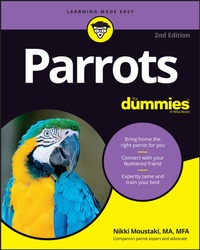
Parrots For Dummies
Description

While parrots have a historical reputation for being a pirate's best friend, in the modern-day U.S.--where birds are the nation's third most popular household pet-thousands of landlubbers are in on the act! And that's not surprising--parrots are as affectionate, friendly, and fun to be with as a dog or cat. They are also relatively low-maintenance, with no rude 5 a.m. awakenings with demands for food or punishing walks.
Renowned avian care and behavior consultant Nikki Moustaki is your friendly guide to the colorful world of this intelligent and chatty pet. In this book, you'll be introduced to the vibrant diversity of the parrot world, which covers a wide variety of Psittacidae family members, including macaws, cockatiels, and parakeets. You'll also learn the best ways to choose, care for, and love your resplendently feathered companion.
* Pick your perfect parrot
* Devour the latest on nutrition
* Tame and train
* Make the perfect home
Whether you're just setting out in the parrot world or are a seasoned voyager on the parrot-y seas, this 2nd edition of Parrots For Dummies has something for you and your pet--and will repay the hard-won pirate gold you spent on it a thousand times over!
More details
Other editions
Additional editions
Person
Content
Chapter 1
Meeting the Parrots, Just the Basics
IN THIS CHAPTER
Announcing the parrots
Creating a good parrot home
Reflecting a bit on parrot behavior
Becoming friends with your parrot
Welcome to the wonderful world of parrots. It may be wonderful, but it's not utopia. There's a lot to know and a lot to do in order to make a parrot happy and keep him healthy in the average home. This chapter gives you an overview of this entire book and shows you where to look for the important information you'll need to get started with parrots.
Introducing the Parrots
If parrots were human, they'd be supermodels. They'd want their spring water and their carrot sticks, and they'd want them now. Parrots are beautiful, temperamental creatures that need a lot of handling from a good manager - that's you, the parrot's guardian - to make sure they're cared for properly (see Figure 1-1). It's in the fine print of the parrot's contract: You'll do the bird's bidding, and you won't ask any questions.
Photo by Priscilla Schmidt
FIGURE 1-1: These tame budgies are wonderful companions and are as close to officially domesticated as parrots get.
Well, doing the bird's bidding sounds a little un-fun, doesn't it? I don't mean that you're the bird's servant, though it can sometimes feel that way. What I mean is that parrots have a lot of requirements that need to be met or else. The or else means high veterinary bills, a very unhappy parrot, and perhaps even a dead bird. The or else isn't a place you want to go.
You have to feed the parrot right, house him right, and give him your full and total attention. You have to provide him with toys, friends, things to do, health care, and everything else he needs. A parrot is a complicated companion, far more so than a dog or cat. If you read this book cover to cover, you'll have a great handle on how to properly care for your bird.
From pet to companion
The first and most important thing to know about parrots is that they're not like other pets. They're companions. Rather than being the owner, you're the guardian. This is the vocabulary I use throughout this book. The language you use to describe other people is how you perceive and relate to them, and the same goes for the language you use to describe the animals in your life. You can find out more about all of this in Chapter 2.
MASTERING SOME BIRD LINGO
Here's some lingo you might see or hear in bird circles. Most of these definitions apply to the bird world:
- Birb: A playful internet nickname for birds, mostly used online for videos or photos of birds behaving silly or cute. According to
www.knowyourmeme.com, the first example of the word used online was on Twitter in 2012. - Borb: Chunky bird.
- Fids: Feathered kids.
- Floof: Fluffy bird.
- Hooman: What a birb might call you.
- Parront: The hooman guardian of a birb.
- Seeb: Bird seed.
- Scritches: A combo of scratches and itches, used when you gently pet a bird's head or face, usually against the feather growth.
- Smol birb: An adorably tiny bird.
I use some of these terms throughout the book.
A little bit of wilderness
Having a parrot in your home is like bringing a little bit of the rainforest, grasslands, or plains inside. A parrot is a wild animal and always will be, no matter where the parrot lives. When you live with a parrot, you have the unique responsibility of caring for a truly natural (not human manipulated) creature, one that hasn't been domesticated in any way. Captive parrots and wild parrots share the exact same instincts, developed over millions of years of evolution to keep them safe and help them find food, shelter, a mate, and rear babies. See Chapter 11 for more details on how instincts inform your parrot's behavior.
Some parrots are indeed easier to care for than others. Which parrot you choose should depend on how much space and time you have. There's never really enough time in the day to give a larger parrot the attention he wants because a parrot that's bonded to you will want to hang out with you all day, the way he would with a mate in the wild. Smaller parrots, such as parakeets and lovebirds, are often kept happily in pairs, which is a great option when you can't interact with your bird enough. Large parrots love each other's company as well. Because parrots are social, flock-oriented animals, they tend to like to be together. Chapter 3 gives you the lowdown on which parrot species might be right for you (as in Figure 1-2). Chapter 4 shows you how to choose a healthy parrot from the right kind of place.
Photo by Shari Markowitz
FIGURE 1-2: Parrots have some funny behaviors, like this caique eating a big cookie with one foot.
Home Tweet Home: Welcoming a Parrot into Your Home
The average home must be modified to accommodate a parrot, whether it's a little budgie or a large macaw. You have to parrot-proof your home the way you'd kid-proof it for toddlers. Parrots can get into even more trouble than toddlers, because not only can a parrot open the cupboard under the sink, but he can also get up to the cupboard above the refrigerator. He can eat through drywall, pick at the chipping paint near the window, and dunk itself in the toilet. He can get outside and never come back again. Parrot-proofing is crucial. See Chapter 7 for parrot-proofing ideas.
Making birdy comfortable
After you've parrot-proofed, you have to find acceptable housing for your bird. In parrot circles, the idiom bigger is better is applied to bird cages, aviaries, and habitats. Birds are meant to fly, so it's great if you can offer a safe flying space. Flying is essential for healthy respiratory, muscular, and skeletal systems.
Where you place the bird's housing is also crucial. Parrots like a secure spot close to a wall, out of drafts, and in a room where there's a lot of traffic. A parrot relegated to the garage or back room is a lonely and miserable bird. Chapter 5 gives you lots of housing do's and don'ts.
Parrot paraphernalia
After you decide on housing, you need a lot of parrot paraphernalia. Fortunately, manufacturers of birdy stuff have gotten incredibly creative over the years, and a cornucopia of parrot accessories are out there that will make your bird more comfortable, give him things to do, and perhaps even save his life. Check out Chapter 6 for your parrot shopping guide.
Parrot Care 101: Taking Care of Your Bird
There's a lot more to know about parrot care than tossing some seed and water into a cage and hoping for the best. Much research has been done on parrot health and nutrition in the last three decades, bringing parrot people to a new level of awareness and allowing parrots to live longer, healthier lives. Though some species of parrots are long-lived, some with a lifespan of more than 80 years, most don't even live past a decade. The information throughout this book shows you how to ensure that your parrot lives out his full lifespan. Most people think that budgies (parakeets) only live a few years. With the proper care, budgies can actually live to be well over 15.
The following sections highlight health care and nutrition - two areas important for taking care of your bird.
Health care
Parrots are complex organisms that have very different systems than humans do. Common household items that don't bother humans at all can kill a bird instantly. For example, the fumes from nonstick cookware, avocadoes, and aerosol sprays are deadly for birds. By far the most deadly thing for birds, however, is lack of proper health care. Getting your parrot to an avian veterinarian is crucial to keeping your bird healthy and alive. Check out Chapter 10 for more information on illness. While you're at it, delve into more health tips in Chapter 9.
Nutrition
One of the most deadliest things for most parrots is poor nutrition. A parrot that's suffering from vitamin and mineral deficiency has a weakened immune system and is susceptible to many diseases and ailments, not to mention behavioral problems. Read Chapter 8 for a lot of good tips on proper parrot nutrition.
Parrot Behavior: Checking How Your Bird Acts
It's too bad parrots don't come with owner's manuals - well, until now. You've got a great one in your hand. But as with just about everything, you're going to discover more about parrot behavior by trial and error. If your parrot bites you, hopefully you'll figure out what caused the bite and won't repeat the events leading up to the incident. Chapter 11 gives you some insight into wild parrot behavior and why your bird behaves the way he does.
These sections examine what you need to know when your parrot is acting like a...
